
Plant Care
Guzmania Care Guide: Light, Water Cup & The Long-Lasting Bromeliad Bloom
Guzmania is the bromeliad you probably bought at the grocery store. Bright red, orange, or yellow flower bracts (technically modified leaves) that look like a flame rising from a green rosette, and stay vibrant for 2–4 months. Like all bromeliads, Guzmania blooms once and slowly dies, but produces pups for the next generation. Easier than most bromeliads with consistent indoor care.
Quick Care Card
☀️ Light
Bright indirect (medium tolerated)
💧 Water
Fill central cup; soil barely watered
💨 Humidity
50%+ (60% ideal)
🌡️ Temp
65–80°F
🪴 Soil
Loose, well-draining bromeliad/orchid mix
🐾 Cat/Dog Safe
✅ Safe for cats & dogs
🎯 Difficulty
🟢 Beginner
📏 Size
12–18 inches tall
🌎 Zone
10–11 outdoors
🏞️ Origin
Central & South American rainforests
In this guide
About Guzmania
Guzmania is a genus of about 200 species native to the rainforests of Central and South America (especially Colombia, Ecuador, Peru, Brazil). Most species grow as epiphytes on tree branches in the forest canopy.
The popular indoor species is G. lingulata (Scarlet Star) and its many hybrids. Bract colors range from fire-engine red (most common) through orange, yellow, pink, and bicolors. The colorful spike emerges from the center of the leaf rosette and may have small white or yellow flowers in addition to the showy bracts.
Guzmania is monocarpic, meaning it blooms once and then slowly dies over 6–12 months. Before dying, it produces 1–4 pups at its base. Separate pups when 1/3–1/2 the size of the mother and pot up to continue the cycle. The bracts themselves last an unusually long time, with 2–4 months of color from a single bloom.
Care Guide
Light
Bright indirect light. Direct sun bleaches the bracts.
- Best: bright indirect light.
- Direct afternoon sun fades the colorful bracts.
- Tolerates medium light better than many bromeliads.
- Low light leads to fading bracts during bloom.
Water
Use the bromeliad method by filling the central cup, with soil barely watered.
- Fill the central cup (the funnel-shaped center) with fresh water; refill weekly.
- Empty cup completely once a week to prevent stagnation.
- Water soil only sparingly, every 2–3 weeks, just enough to prevent drying.
- Use rainwater, distilled, or filtered water, since Guzmania is sensitive to chlorine/fluoride.
- Critical: never use copper-containing water vessels (toxic to bromeliads).
Humidity
Higher is better. 50%+ ideal.
- Ideal: 50–70%.
- Tolerable: 40–50%.
- Below 30% causes crispy edges.
Temperature
Warm tropical temperatures.
- Ideal: 65–80°F.
- Below 55°F damages leaves.
- Below 45°F is potentially fatal.
Soil
Loose, fast-draining mix. Orchid mix works well.
- Easy mix: orchid bark + perlite + small amount of potting soil.
- Avoid dense soil.
- Small pot is fine because bromeliad roots are minimal.
- Repot rarely.
Pro tip: the spectacular bract lasts months
Unlike fast-fading flowers, Guzmania bracts (the colorful flame-shaped center) maintain their vibrant color for 2–4 months in indoor conditions. This makes Guzmania one of the longest-lasting bloomers you can buy, much longer than poinsettia, hydrangea, or florist hydrangea. Once the bract eventually fades (turns brown), the mother plant has finished its life cycle but pups will appear at the base over the following 6–12 months.
Fertilizer
Light feeders.
- Diluted bromeliad fertilizer at quarter strength every 6–8 weeks April–September.
- Apply to cup water and soil.
- Never copper-containing.
- Skip fertilizing October–March.
Seasonal Care
🌱 Spring & Summer
- New leaves emerge from rosette
- Mature plants bloom, with bract lasting 2–4 months
- Refresh cup water weekly
- Light fertilizer every 6–8 weeks
❄️ Fall & Winter
- Cup water still needs refreshing
- No fertilizer
- Mother plant declining after bloom is normal
Common Problems & Fixes
| Symptom | Likely Cause | Fix |
|---|---|---|
| Bract slowly fading after 2–3 months | Normal end-of-bloom cycle | Continue caring; pups emerge over the following months |
| Mother plant dying after bloom | Normal (Guzmania is monocarpic) | Wait for pups; remove mother when pups are large enough |
| Crispy leaf edges | Low humidity or tap water sensitivity | Raise humidity; switch to filtered water |
| Mushy crown | Stagnant water in cup; bacterial issue | Empty cup; refresh weekly |
| Yellow leaves | Overwatering of soil | Reduce soil watering; focus on cup water |
| Bleached bracts | Direct sun scorch | Move from direct sun |
| No pups forming | Insufficient light or premature mother removal | Bright indirect light; let mother stay even as she browns |
| Mealybugs in leaf folds | Common pest | Wipe with alcohol; insecticidal soap |
| Mosquito larvae in cup | Stagnant water | Empty and refill cup weekly |
Guzmania is the bromeliad with the longest-lasting flower in horticulture. Two to four months of vivid color from a single bloom, and then the mother dies and the pups take over.
Propagation
Pup separation (only practical method)
Wait until pups are 1/3–1/2 the size of the mother.
Cut pup away with sterilized knife.
Pot in fresh bromeliad/orchid mix.
Fill pup’s cup with fresh water immediately.
Resume normal care.
Pup blooms in 1–2 years.
Featured Guzmania Species
| Species | Common Name | Notable Trait | Difficulty |
|---|---|---|---|
| Guzmania lingulata (red) | Scarlet Star | Classic bright red bract; most common | 🟢 Beginner |
| G. lingulata (yellow) | Yellow Scarlet Star | Bright yellow bract | 🟢 Beginner |
| G. lingulata (orange) | Orange Scarlet Star | Vibrant orange bract | 🟢 Beginner |
| G. monostachia | Striped Torch | Striped white-and-green leaves with red bract tip | 🟢 Beginner |
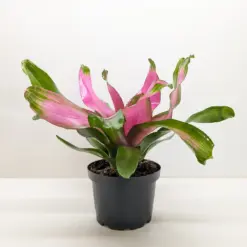
| G. ‘Hilda’ | Hilda Guzmania | Hot pink bract | 🟢 Beginner |
Shop Our Guzmania Collection
Every Guzmania we ship is greenhouse-grown, climate-acclimated, and packed with care for transit. Sold-out species? Use the Notify Me button on any product page and we’ll email you the moment it’s restocked.
Frequently Asked Questions
Are Guzmania bromeliads safe for cats and dogs?
Yes. Guzmania (and most bromeliads) are non-toxic to cats and dogs per ASPCA listings. Pet-safe choice.
Why is my Guzmania bract turning brown?
Normal end-of-bloom. Guzmania bracts last 2–4 months at full color, then gradually fade and brown as the mother plant begins its natural decline. The plant lives another 6–12 months after the bract fades, producing pups before fully dying. This is monocarpic biology, not a care failure.
Should I water the cup or the soil?
Primarily the cup. Fill the central cup with fresh water, refresh weekly. Water the soil only sparingly, every 2–3 weeks, just enough to keep roots from drying completely. Bromeliad roots are mainly for stability; the cup is the main water source.
Why is the bract on my Guzmania faded?
Either natural end-of-bloom or insufficient light. If the bract was vibrant when you got it and slowly faded over 2–4 months, that’s normal life cycle. If the bract was never vibrant or faded quickly, the plant likely isn’t getting enough light, so move to a brighter spot.
How do I get my Guzmania pup to bloom?
Wait 1–2 years for maturity. Provide bright indirect light, regular cup refreshing, light fertilizing. Some pups bloom on their own; stubborn ones can be triggered by enclosing the plant in a clear plastic bag with a ripe apple for 7–10 days (the ethylene gas from the apple triggers bromeliad blooming).
Can Guzmania survive outdoors?
In USDA zones 10–11 (frost-free) yes. They’re tropical epiphytes and tolerate outdoor conditions in mild climates. Elsewhere, keep indoors year-round or summer outdoors and bring inside before fall.
Related Care Guides
- Bromeliad Care Guide
- Tillandsia (Air Plant) Care Guide
- Cryptanthus (Earth Star) Care Guide
- Anthurium Care Guide
