
Plant Care
Bromeliad Care Guide: Light, Water Cup, And The Plant That Blooms Once
Bromeliads are the houseplant family that breaks every standard rule. Don’t water the soil — water the cup in the center of the rosette. Don’t fertilize too much — they barely need it. Don’t expect the plant to live long after blooming — most bromeliads are monocarpic, meaning they bloom once spectacularly and then die. The good news: before they die, they produce pups (baby plants) at the base, so the show goes on for generations. Here’s how to keep them gorgeous through their bloom cycle.
Quick Care Card
☀️ Light
Bright indirect (some types tolerate medium)
💧 Water
Fill the central cup; soil barely watered
💨 Humidity
50%+ (higher = better)
🌡️ Temp
65–85°F
🪴 Soil
Loose, well-draining, orchid-bark-like mix
🐾 Cat/Dog Safe
✅ Most species safe (verify your specific bromeliad)
🎯 Difficulty
🟢 Beginner
📏 Size
12–24 inches across (varies)
🌎 Zone
10–11 outdoors
🏞️ Origin
Tropical Americas
In this guide
About Bromeliad
Bromeliad is the common name for the family Bromeliaceae — about 3,500 species native almost exclusively to the Americas (with one species in West Africa as the family outlier). The pineapple is a bromeliad. Spanish moss is a bromeliad. Most popular indoor bromeliads are tropical epiphytes from Central and South American rainforests — they grow on tree branches, capturing rainwater in the central rosette cup.
The houseplant trade focuses on a few showy genera: Aechmea (Urn Plant — silver-banded leaves, pink bracts), Guzmania (showy red/orange/yellow flower bracts that last 2–3 months), Vriesea (Flaming Sword — flat sword-shaped flower bracts), Neoregelia (colorful red/pink central cup color when blooming), and Tillandsia (air plants — covered separately in their own guide because they don’t grow in soil at all).
The defining biological trait: most bromeliads are monocarpic. They grow vegetatively for 1–3 years, produce one spectacular bloom, then slowly die over 6–12 months. Before dying, the mother plant produces pups (baby plants) at her base — these grow up and bloom themselves in 1–2 years. The cycle continues indefinitely; one bromeliad becomes many over years.
Care Guide
Light
Bright indirect light. Direct sun bleaches leaves; low light prevents pup development.
- Best: bright indirect light — within 3–6 feet of an east window, or behind sheer curtains on a south/west window.
- Aechmea, Vriesea, Guzmania: tolerate medium light better than most bromeliads.
- Neoregelia: wants the brightest light to develop its iconic red central cup color.
- Direct afternoon sun bleaches and crisps the leaves of most bromeliad species.
- Low light prevents the plant from forming pups after blooming — pups need bright light to develop properly.
Water (the bromeliad way)
Bromeliads are watered through the central cup, not the soil. This is the biggest difference from other houseplants.
- Fill the central cup (the funnel-shaped center of the rosette): water collects there and the plant absorbs through specialized leaf scales.
- Empty and refill the cup weekly with fresh water to prevent stagnation, mosquito breeding, and bacterial buildup.
- Water the soil only sparingly — once every 2–3 weeks, just enough to keep it from drying out completely. Bromeliad roots are mainly for stability, not water uptake.
- Use rainwater, distilled, or filtered water if possible — bromeliads are sensitive to fluoride and chlorine.
- Critical: never use copper pipes or copper containers for bromeliad water — copper is toxic to bromeliads.
- Brown leaf tips = tap water sensitivity. Soft mushy base of the rosette = water sitting in the cup too long without refresh, causing rot.
Humidity
Higher is better. Bromeliads are tropical rainforest plants.
- Ideal: 50–70% humidity. Most homes need a humidifier or pebble tray to reach this.
- Tolerable: 40–50%. Plants survive but are more prone to spider mites.
- Below 30% (winter heating) leaves go crispy at the edges.
- Bathrooms with a window are excellent bromeliad spots — bright and humid.
- Misting helps temporarily but doesn’t replace ambient humidity. Wipe water off the leaves; sitting water on the rosette can spot the foliage.
Temperature
Warm tropical temperatures. Bromeliads hate cold.
- Ideal: 65–85°F (18–29°C).
- Below 55°F damages leaves and slows growth.
- Below 45°F is potentially fatal.
- Avoid AC vents in summer and cold windows in winter — sudden temperature drops cause leaf damage.
- Some bromeliad species need a brief cool period (60–65°F nights for 4–6 weeks) to trigger blooming, but most bloom on their own when mature.
Soil
Loose, fast-draining, orchid-bark-like mix. Bromeliads have minimal roots.
- Best: commercial orchid mix or a mix of equal parts fine bark, perlite, and peat or coco coir.
- DIY: 40% orchid bark + 30% perlite + 30% peat or coco coir.
- Avoid: standard potting soil, dense peat-only mixes, anything that stays wet for more than 5–7 days.
- Use a small pot — bromeliad roots are minimal and the plant doesn’t need much soil. The pot’s main job is to hold the plant upright.
- Repot rarely — bromeliads dislike disturbance and the mother plant’s pot will be reused for pups after she fades.
- Some growers grow bromeliads completely soilless — mounted on driftwood or wired into a tree branch (their natural epiphytic habit).
Pro tip — when the mother dies, the pups carry on
Most bromeliads bloom once spectacularly and then begin a slow decline that can take 6–12 months. During that decline, the mother plant produces 1–4 pups at her base — small replicas of herself. Wait until each pup is 1/3 to 1/2 the size of the mother before separating. Cut the pup off with a sterilized knife, ensuring it has its own roots, and pot it in fresh bromeliad mix. The pup will grow for 1–2 years and bloom on its own schedule. The mother eventually browns and dies — that’s the natural cycle. One bromeliad purchase = decades of bromeliads with patience.
Fertilizer
Light feeders. Easy to over-fertilize bromeliads.
- Diluted balanced liquid fertilizer (or specific bromeliad fertilizer) at quarter strength every 6–8 weeks April–September.
- Apply fertilizer to the soil and in the central cup at a very dilute ratio.
- Skip fertilizing October–March entirely.
- Bromeliads naturally absorb nutrients from rainwater and decomposing leaves in their cup — they don’t need much supplementation.
- Brown leaf tips after fertilizing = salt buildup. Flush soil and rinse cup with plain water; reduce fertilizer.
Seasonal Care
🌱 Spring & Summer
- New leaves emerge from the rosette every 2–4 weeks on healthy plants
- Mature plants (1–3 years old) push up flower stalks once and bloom for 2–4 months
- After blooming, the mother begins producing pups at her base over the following 6–12 months
- Refill central cup weekly; water soil sparingly
- Best time to repot pups when separating from mother
❄️ Fall & Winter
- Reduce watering slightly; cup still needs refreshing
- Stop fertilizing entirely
- Move from cold drafts; below 55°F damages leaves
- Mother plants in their decline phase continue browning naturally
- Pups continue developing slowly through winter
Common Problems & Fixes
| Symptom | Likely Cause | Fix |
|---|---|---|
| Mother plant slowly browning after bloom | Normal — bromeliads bloom once and then die over 6–12 months | Continue caring for the mother to support pup development; eventually the mother is removed and pups take over |
| Brown crispy leaf tips | Tap water sensitivity, low humidity, or salt buildup | Switch to filtered or rainwater; raise humidity; flush soil and cup with plain water |
| Mushy soft base of rosette | Stagnant water in cup or overwatered soil — crown rot | Empty cup; reduce soil watering; if rot has reached the heart of the plant, focus on saving any pups |
| No flowering despite plant being mature | Insufficient light or plant not yet old enough | Move to brighter indirect light; some species need 1–3 years of growth before blooming |
| No pups developing after bloom | Insufficient light or premature mother removal | Provide bright indirect light; let mother stay in place even as she browns — she’s feeding the pups |
| Bleached spots on leaves | Direct sun scorch | Move from direct afternoon sun; affected leaves don’t recover |
| White cottony spots between leaves | Mealybugs | Wipe with isopropyl alcohol; insecticidal soap; never use systemic on bromeliads (they hold water in cup) |
| Tiny webs on leaves | Spider mites (low humidity) | Rinse under shower; raise humidity; insecticidal soap weekly until clear |
| Mosquito larvae in cup | Stagnant water in cup | Empty and refill weekly with fresh water; consider mosquito dunks (Bti) in summer outdoors |
Bromeliads bloom once and die — but they leave you babies first. Don’t mourn the mother; raise the pups.
Propagation
Pup separation (the only practical method)
Wait until pups have grown to 1/3 to 1/2 the size of the mother plant — usually 6–12 months after the mother bloomed.
Each pup should have at least 4–5 leaves and ideally some visible roots of its own.
Use sterilized sharp scissors or a knife to cut the pup away from the mother where they connect.
Let the cut surface callus over for 1–2 days in a dry shaded spot if the cut was large.
Pot the pup in fresh bromeliad mix in a small pot — just barely large enough to hold the plant upright.
Fill the pup’s central cup with fresh water immediately; water the soil very lightly.
Place in bright indirect light. Resume normal bromeliad care.
The pup grows for 1–2 years before producing its own bloom and the cycle repeats.
Seed (slow — multi-year project)
- Mature bromeliads occasionally produce seeds after blooming — collected from dried seed pods.
- Sow seeds on top of damp seedling mix; do not bury.
- Cover with clear plastic for humidity. Place in bright indirect light at 70–80°F.
- Germination takes 4–12 weeks depending on species.
- Tiny bromeliads grow extremely slowly — expect 3–6 years to reach a mature blooming-size plant.
- Most growers propagate from pups rather than seed.
Featured Bromeliad Species
| Species | Common Name | Notable Trait | Difficulty |
|---|---|---|---|
| Aechmea fasciata | Urn Plant / Silver Vase | Silver-banded leaves with bright pink bracts and small blue flowers | 🟢 Beginner |
| Guzmania lingulata | Scarlet Star | Showy red/orange/yellow flower bracts last 2–3 months | 🟢 Beginner |
| Vriesea splendens | Flaming Sword | Flat sword-shaped red flower bract; striking architectural form | 🟢 Beginner |
| Neoregelia carolinae | Blushing Bromeliad | Bright red central cup color when blooming; flat rosette form | 🟢 Beginner |
| Cryptanthus bivittatus | Earth Star | Star-shaped flat rosette; grows in soil more like a typical houseplant | 🟢 Beginner |
| Billbergia nutans | Queen’s Tears / Friendship Plant | Dangling pink/blue/green flowers; very forgiving and easy | 🟢 Beginner |
| Ananas comosus | Pineapple Plant | Yes — the fruit you eat is a bromeliad; can be grown indoors from a top | 🟡 Intermediate |
| Tillandsia spp. | Air Plants | Soilless bromeliads — see separate Tillandsia care guide | 🟢 Beginner |
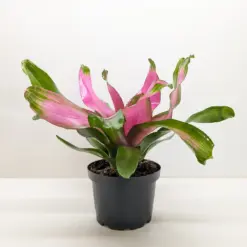
Shop Our Bromeliad Collection
Every Bromeliad we ship is greenhouse-grown, climate-acclimated, and packed with care for transit. Sold-out species? Use the Notify Me button on any product page — we’ll email you the moment it’s restocked.
Frequently Asked Questions
Are bromeliads safe for cats and dogs?
Most bromeliad species (Aechmea, Guzmania, Vriesea, Neoregelia) are non-toxic to cats and dogs per ASPCA listings. They’re a great pet-safe houseplant option. Pineapple plants (Ananas) are also non-toxic. (For more confirmed pet-safe houseplants, see Spider plant, Calathea, and Peperomia.)
Why is my bromeliad dying after it bloomed?
That’s normal — most bromeliads are monocarpic, meaning they bloom once spectacularly and then slowly die over 6–12 months. There’s nothing wrong with your care. Before dying, the mother plant produces pups at her base — small baby plants that you separate and pot up to continue the cycle. One bromeliad becomes 2–4 over years. Don’t mourn the mother; raise the pups.
Should I water my bromeliad’s soil or the cup?
Both, but the cup is primary. Bromeliads are tropical epiphytes that absorb water through specialized leaf scales in their central rosette cup. Fill the cup with fresh water and refill weekly. Water the soil sparingly — every 2–3 weeks, just enough to keep roots from drying completely. Bromeliad roots are mainly for stability, not water uptake. This is the biggest care difference from other houseplants.
Why hasn’t my bromeliad pup bloomed yet?
Bromeliad pups need 1–2 years of growth before they bloom on their own. Don’t expect immediate flowering — the pup must reach roughly the size of the original mother plant first. Provide bright indirect light, refresh the cup weekly, and be patient. Some species are also seasonal bloomers and only flower under specific day-length and temperature conditions. If yours hasn’t bloomed in 3+ years, try the "apple in a bag" trick — see next FAQ.
How do I make my bromeliad bloom?
Two methods: (1) natural maturity — provide bright indirect light and patience; mature plants bloom on their own in 1–3 years. (2) ethylene trick — place the bromeliad in a clear plastic bag with a ripe apple for 7–10 days. The apple emits ethylene gas, which triggers blooming in bromeliads. Remove the apple and bag after a week; flowers should appear within 2–3 months. Works best on mature plants.
Can I leave water in my bromeliad’s cup all the time?
Yes, but refresh it weekly. Stagnant water leads to mosquito breeding (in summer outdoors), bacterial buildup, and eventually crown rot. Empty the cup completely every 7 days and refill with fresh water — rainwater, distilled, or filtered preferred. Tap water with high mineral content can leave deposits in the cup over time.
Why are my bromeliad’s leaves turning brown at the tips?
Almost always tap water sensitivity. Bromeliads are sensitive to fluoride and chlorine — switch to filtered, distilled, or rainwater. Salt buildup from over-fertilizing is the second cause; flush the soil and rinse the cup with plain water. Existing brown tips don’t recover; trim with scissors at an angle to mimic the natural taper. New leaves emerge clean once you fix the water source.
Related Care Guides
- Tillandsia (Air Plant) Care Guide — soilless bromeliads — same family, different growing approach
- Orchid Care Guide
- Anthurium Care Guide
- Cryptanthus (Earth Star) Care Guide
