
Plant Care
Begonia Care Guide: Light, Water & The 2,000-Species Family
Begonia is one of the largest plant genera on the planet — over 2,000 species, all native to subtropical and tropical regions. The houseplant world breaks them into four practical groups: rex (showy patterned leaves), rhizomatous (creeping rhizomes, including beefsteak and eyelash types), cane (angel wing and polka-dot types with bamboo-like stems), and tuberous (showy flowering types, often seasonal). Each group has slightly different care — most guides lump them together and miss what actually matters.
Quick Care Card
☀️ Light
Bright indirect (no direct sun)
💧 Water
Top inch dry; never soggy
💨 Humidity
50%+ (rex types want 60%+)
🌡️ Temp
65–75°F
🪴 Soil
Light, well-draining, peat-based mix
🐾 Cat/Dog Safe
☠️ Toxic to cats & dogs
🎯 Difficulty
🟡 Intermediate
📏 Size
6–36 inches (varies by group)
🌎 Zone
10–11 outdoors
🏞️ Origin
Tropical & subtropical Americas, Africa, Asia
In this guide
About Begonia
The Begonia genus was named after Michel Bégon, a 17th-century French governor and patron of botany, by his friend Charles Plumier — a French monk and one of the founding figures of botanical taxonomy. The family expanded explosively as Victorian explorers brought back species from across the tropics; modern hybridization has multiplied that into thousands of named cultivars.
What makes Begonia tricky is the shorthand: people say "begonia" and mean wildly different plants. Rex begonias (B. rex-cultorum hybrids) are grown for their dramatically patterned leaves — silver, purple, pink, swirled, spiraled. They want bright indirect light and 60%+ humidity. Rhizomatous begonias (including beefsteak B. erythrophylla and eyelash B. bowerae) creep horizontally from a thick rhizome and tolerate household humidity better. Cane begonias (angel wing, polka dot — B. coccinea, B. maculata) grow upright on bamboo-like stems and produce dangling flowers. Tuberous begonias are showy summer bloomers that go dormant in winter.
What unites all of them: they’re forgiving with water but unforgiving with overwatering, they hate cold drafts, and almost all are toxic to pets if ingested.
Care Guide
Light
Bright indirect light. Direct sun bleaches and crisps the leaves of all Begonia types.
- Best: bright indirect light — within 3–6 feet of an east or north window, or behind a sheer curtain on a south/west window.
- Direct sun for more than an hour fades the dramatic patterns on rex begonias and crisps the leaves of all types.
- Medium light is tolerated by rhizomatous and cane types. Rex begonias get leggy and lose vibrancy in medium light.
- Cane begonias (angel wing types) need the brightest light of the group — without it, stems get leggy and they stop flowering.
- Under grow lights works great for rex begonias — they thrive 12 inches below a standard plant grow light at 12 hours/day.
Water
Top inch dry between waterings. Never let Begonia sit in soggy soil — they rot fast.
- Water when the top inch of soil is dry. Stick your finger in — if dry to the first knuckle, water.
- Water at the soil line, not on the leaves — Begonia leaves spot easily and are prone to powdery mildew when wet.
- Water thoroughly until it runs from the drainage holes; empty the saucer after 10 minutes.
- Most plants need water every 5–7 days in summer, every 7–14 days in winter.
- Yellow leaves with mushy stems = overwatering. Wilted leaves with dry soil = underwatered (recoverable).
- Use room-temperature water. Tap water is generally fine; if you see leaf spotting, switch to filtered.
Humidity
Higher is better — especially for rex begonias.
- Rex begonias: 60%+ humidity ideal. They look dramatically better in a humidifier room or terrarium.
- Rhizomatous and cane types: 50% is fine, 40% is tolerable.
- Below 30% (winter heating) all types develop crispy edges.
- Pebble trays help slightly. A small humidifier near the plant is the most effective fix.
- Skip aggressive misting — water sitting on Begonia leaves causes powdery mildew and bacterial leaf spot.
Temperature
Standard household temperatures. All Begonias hate cold drafts.
- Ideal: 65–75°F (18–24°C). Tolerates 60–80°F.
- Below 55°F damages leaves and stops growth.
- Below 50°F is potentially fatal to rex and tuberous types.
- Avoid AC vents in summer and cold windows in winter — sudden drops cause leaf drop and stem collapse.
Soil
Light, well-draining, peat-based mix. Begonia rots in dense soil.
- Easy mix: 50% standard houseplant potting soil + 30% perlite + 20% peat moss or coco coir.
- Better: African violet mix (sold pre-formulated for shallow-rooted humidity-loving plants) — works for most Begonia types.
- Avoid: dense potting soil straight from the bag, anything with too much sand, pots without drainage.
- Use a wide shallow pot. Begonias have shallow root systems and rot in deep pots that hold too much water.
- Repot every 1–2 years in spring — only when roots have filled the pot. Rex and rhizomatous types prefer being slightly pot-bound.
Pro tip — water from below to prevent leaf damage
Begonia leaves are the whole point of growing rex and rhizomatous types — and water on those leaves causes spotting, mildew, and bacterial issues. The fix: water from below. Set the pot in a saucer of water for 15–20 minutes and let the soil draw water up through the drainage holes. The leaves stay dry and the soil gets evenly moistened. This single technique makes rex begonia care dramatically easier.
Fertilizer
Light feeders. Easy to over-fertilize.
- Balanced liquid fertilizer at half strength every 4 weeks April–September.
- Cane begonias (heavy feeders, especially when flowering) tolerate full-strength feeding every 4 weeks.
- Skip fertilizing October–March entirely.
- Brown leaf tips after fertilizing = salt buildup. Flush soil with plain water until it runs clear; skip feeding for 2 months.
Seasonal Care
🌱 Spring & Summer
- New leaves emerge every 1–3 weeks on healthy rex and rhizomatous types
- Cane begonias produce dangling pink/white flowers — leave them or cut for indoor cut-flower use
- Water every 5–7 days when top inch is dry
- Fertilize every 4 weeks at half strength
- Best time to repot, divide, or take cuttings
❄️ Fall & Winter
- Reduce watering to every 7–14 days
- Stop fertilizing entirely
- Move from cold windows; below 55°F damages leaves
- Tuberous begonias may go fully dormant — leaves die back, plant rests until spring
- Don’t repot until spring
Common Problems & Fixes
| Symptom | Likely Cause | Fix |
|---|---|---|
| Yellowing leaves | Overwatering or natural shedding of oldest leaves | Reduce watering frequency; check soil moisture; old leaves dropping is normal |
| White powdery dust on leaves | Powdery mildew (most common Begonia disease) | Improve air circulation; reduce humidity slightly; treat with neem oil or potassium bicarbonate spray |
| Brown spots on leaves with yellow halos | Bacterial leaf spot from water on leaves | Stop overhead watering; remove affected leaves; improve air circulation |
| Leggy stems with sparse leaves | Insufficient light (especially cane types) | Move to brighter indirect light; pinch stems to encourage bushiness |
| Crispy edges and curled leaves | Low humidity | Raise humidity to 50%+ for rhizomatous, 60%+ for rex; humidifier or pebble tray |
| Stems collapsing at the base | Stem rot from overwatering or cold damage | Cut healthy stem above rot, propagate as cutting; mother plant usually lost |
| Loss of dramatic patterns on rex types | Insufficient light | Move to brighter indirect light; new leaves recolor over weeks |
| Tuberous begonia died back in winter | Natural dormancy — not death | Reduce watering to nearly nothing; resume when new shoots emerge in spring |
| White cottony spots on stems and leaf joints | Mealybugs | Wipe with isopropyl alcohol; insecticidal soap weekly until clear |
If your begonia leaves keep getting brown spots, you’re watering them wrong. Water the soil, not the leaves, and the spotting stops within two weeks of new growth.
Propagation
Leaf cuttings (rex begonias — easiest, classic method)
Cut a healthy mature leaf with a 1–2 inch petiole (stem) attached.
Option A — full leaf in soil: insert the petiole into damp perlite or seedling mix at a 45-degree angle, leaf flat above the surface.
Option B — leaf wedges: cut the leaf into pie-slice wedges, each containing a major vein. Press the wedge cut-edge-down into damp medium.
Cover loosely with a clear bag or dome for humidity. Place in bright indirect light.
Tiny new plantlets emerge from the cut veins or petiole base in 4–8 weeks.
Once new plants have 3–4 leaves, pot up individually in small pots of well-draining mix.
Original leaf eventually withers — that’s normal.
Stem cuttings (cane begonias)
- Cut a 4–6 inch stem section with at least 2–3 leaves and a node (where leaves meet the stem).
- Strip the bottom 1–2 leaves so the lower node is bare.
- Place stem in a glass of water with the bare node submerged. Leaves stay above water.
- Change water every 5 days. Place in bright indirect light.
- Roots emerge from the node in 2–4 weeks.
- Once roots are 1–2 inches long, pot up in well-draining soil. Keep moist for the first 2 weeks.
Rhizome division (rhizomatous begonias)
- In spring, unpot a mature rhizomatous begonia and brush soil from the rhizomes.
- Identify natural breaks where the rhizome can be separated.
- Cut between sections with a sterilized knife — each division should have at least 2–3 leaves and a section of rhizome with roots.
- Let cut surfaces callus over for 24 hours in a dry shaded spot.
- Pot each division in shallow pots of well-draining mix. Water lightly.
- Resume normal care — established within 2–4 weeks.
Featured Begonia Species
| Species | Common Name | Notable Trait | Difficulty |
|---|---|---|---|
| B. rex-cultorum hybrids | Rex Begonia | Dramatic patterned leaves — silver, purple, pink, swirled | 🟡 Intermediate |
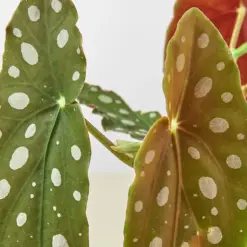
| B. maculata | Polka Dot / Angel Wing Begonia | Cane type with silver polka dots on dark green leaves; pink flowers | 🟢 Beginner |
| B. erythrophylla | Beefsteak Begonia | Rhizomatous; round red-undersided leaves; very forgiving | 🟢 Beginner |
| B. bowerae | Eyelash Begonia | Rhizomatous; small leaves with eyelash-like hairs along the edges | 🟢 Beginner |
| B. coccinea | Coral Cane Begonia | Cane type with hanging coral-pink flower clusters | 🟡 Intermediate |
| B. masoniana | Iron Cross Begonia | Rhizomatous; chocolate-brown cross pattern on bright green leaves | 🟡 Intermediate |
| B. tamaya ‘Dragon Wing’ | Dragon Wing Begonia | Cane type with glossy red-tinted leaves; profuse pink/red flowers | 🟢 Beginner |
| B. luxurians | Palm-Leaf Begonia | Cane type with deeply divided palm-like leaves; statement plant | 🟡 Intermediate |
Shop Our Begonia Collection
Every Begonia we ship is greenhouse-grown, climate-acclimated, and packed with care for transit. Sold-out species? Use the Notify Me button on any product page — we’ll email you the moment it’s restocked.

Begonia Plant ‘Maculata’
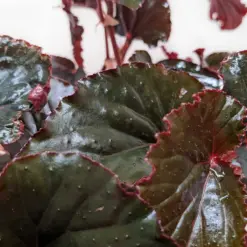
Price range: $36.99 through $68.99Begonia Plant ‘Black Magic’
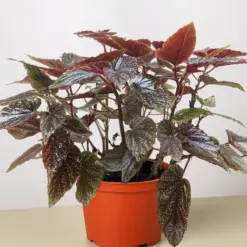
$39.99Begonia Plant ‘Corallina’
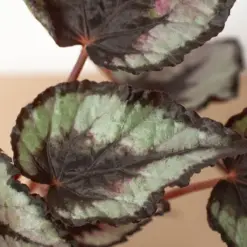
$39.99Begonia Plant ‘Rex’
Price range: $30.99 through $161.99
Frequently Asked Questions
Are begonias toxic to cats and dogs?
Yes — most Begonia species contain insoluble calcium oxalates and other compounds that are toxic to cats, dogs, and humans if ingested. Causes oral irritation, drooling, vomiting, and difficulty swallowing in pets that chew. Tuberous begonias are the most toxic (especially the tubers). Keep out of reach of pets and kids. (For pet-safe alternatives with similar dramatic foliage, see Calathea or Peperomia.)
What’s the difference between a rex begonia and a regular begonia?
Rex begonias are the dramatic foliage type — bred specifically for showy patterned leaves with silver, purple, pink, or metallic markings. They want bright indirect light and 60%+ humidity. "Regular" begonias usually means cane begonias (angel wing, polka dot) or rhizomatous begonias (beefsteak, eyelash) — these are tougher, tolerate household humidity better, and are easier for beginners. All come from the same genus but have very different care needs in practice.
Why is my begonia getting white powdery stuff on its leaves?
Powdery mildew — the single most common Begonia disease. Caused by stagnant air, high humidity, and water sitting on leaves. Fix: improve air circulation (small fan nearby), reduce humidity slightly if you’ve been running a humidifier, water at the soil only (not on leaves), and treat affected leaves with neem oil or potassium bicarbonate spray. Remove badly affected leaves to prevent spread.
Why are my begonia leaves curling and crispy at the edges?
Low humidity. Begonias — especially rex types — develop crispy curled edges below 50% humidity. Add a humidifier or pebble tray to raise humidity. New leaves emerge with proper edges; existing crispy edges can be trimmed with scissors. Inadequate watering is the second cause — check the soil before assuming it’s humidity.
Why won’t my angel wing begonia bloom?
Insufficient light is the most common cause. Cane begonias (angel wing, polka dot, dragon wing) need bright indirect light — within 3–4 feet of an unshaded east window, or behind sheer curtains on south/west — to bloom. Move closer to a window and feed monthly with a balanced fertilizer. Some cane types also need slight cooler nights (60–65°F) to trigger flowering.
Can I grow begonias from a single leaf?
Yes — rex begonias are famous for leaf propagation. Cut a healthy leaf with a piece of stem attached, insert at 45 degrees into damp perlite, cover loosely for humidity, and tiny plantlets emerge from the cut surface within 4–8 weeks. You can also cut a single leaf into pie-slice wedges and root each wedge separately. Cane begonias propagate from stem cuttings instead, not leaf cuttings.
Why is my begonia dropping leaves?
Three usual causes: (1) cold draft — Begonias drop leaves below 55°F or near AC/heating vents; (2) overwatering — soggy soil rots roots and leaves yellow then drop; (3) natural seasonal shedding — tuberous begonias die back fully in winter (this is dormancy, not death). Stabilize temperature, check soil moisture, and identify which type of begonia you have.
Related Care Guides
- Calathea Care Guide — another patterned-leaf statement plant
- Peperomia Care Guide
- Maranta Care Guide
- Humidity Guide for Houseplants
