
Plant Care
Maranta (Prayer Plant) Care Guide: Light, Water & The Folding Leaves
Maranta is the prayer plant — the genus that gave the name to the whole family. Watch one for a day and you’ll see why: leaves spread flat in daylight and fold vertically at night, like hands in prayer. The most famous member is Maranta leuconeura ‘Erythroneura’ (Red-Veined Prayer Plant), with bright pink veins on velvety green leaves. They’re easier than calatheas (a closely related cousin) but still need consistent humidity and filtered water to look their best.
Quick Care Card
☀️ Light
Medium to bright indirect (no direct sun)
💧 Water
Top half-inch dry; keep evenly moist
💨 Humidity
60%+ (higher = better)
🌡️ Temp
65–80°F
🪴 Soil
Rich, well-draining, peat-based mix
🐾 Cat/Dog Safe
✅ Safe for cats & dogs
🎯 Difficulty
🟡 Intermediate
📏 Size
6–12 inches tall, spreading 12+ inches
🌎 Zone
11–12 outdoors
🏞️ Origin
Brazilian rainforest understory
In this guide
About Maranta (Prayer Plant)
Maranta is named after Bartolomeo Maranta, a 16th-century Italian botanist. The plant family it anchors — Marantaceae — also includes calathea, ctenanthe, and stromanthe, all of which share the same prayer-plant leaf-folding behavior (called nyctinasty, driven by daily light cycles and small motor cells at the base of each leaf).
What sets Maranta apart from calathea: Maranta is more forgiving. The leaves are softer, slightly thicker, and trail or sprawl rather than standing upright. Maranta tolerates household humidity better than calathea (calathea wants 60%+; Maranta is OK with 50%). It’s also more vigorous — a healthy Maranta sprawls 12+ inches across and can be divided into multiple plants within a year.
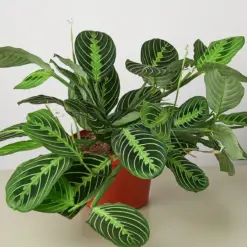
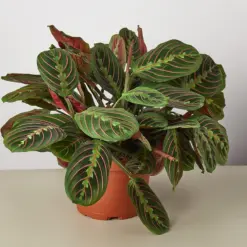
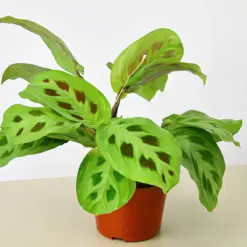
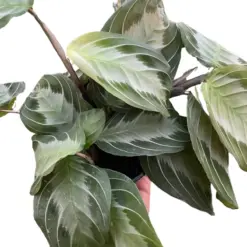
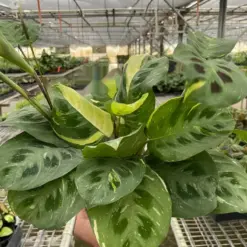
The flagship cultivars: M. leuconeura ‘Erythroneura’ (Red-Veined / Herringbone — the famous pink-veined one), ‘Kerchoveana’ (Rabbit’s Tracks — pale green with dark blotches), ‘Lemon Lime’ (chartreuse veins on dark green), and ‘Marisela’ (silver center stripe). All have the same care needs.
Care Guide
Light
Medium to bright indirect light. Direct sun bleaches the patterns within days.
- Best: medium to bright indirect light — within 3–6 feet of an east or north window, or behind a sheer curtain on a south/west window.
- Avoid direct sun completely. Even an hour of afternoon sun bleaches and crisps the leaves.
- Low light is tolerated but patterns fade and the plant gets leggy. The bright pink veins on Erythroneura especially need decent light to stay vibrant.
- Under grow lights works great — they thrive 12 inches below a standard plant grow light at 12 hours/day.
- If the leaves stay folded during the day (not just at night), it’s getting too much light or too little — check intensity.
Water
Keep evenly moist — never soggy, never bone dry. Use filtered or rainwater.
- Water when the top half-inch of soil is dry. Don’t let the rootball dry out completely — Maranta wilts dramatically and recovery takes days.
- Water thoroughly until it runs from the drainage holes; empty the saucer after 10 minutes.
- Most plants need water every 5–7 days in summer, every 7–10 days in winter.
- Critical: Maranta is sensitive to chlorine, fluoride, and chloramine in tap water. Use filtered, distilled, or rainwater. Or: leave tap water in an open container 24 hours so chlorine evaporates (doesn’t help with fluoride/chloramine — only filtered/distilled does).
- Crispy brown leaf edges almost always means tap water sensitivity, low humidity, or both.
- Water at the soil, not the leaves — water spots can damage the velvety leaf surface.
Humidity
60%+ humidity is the sweet spot. Maranta tolerates household humidity (40–50%) better than calathea but looks much better in higher humidity.
- Ideal: 60–80%. A small humidifier near the plant is the easiest fix.
- Tolerable: 40–50% (typical home humidity year-round). Plant survives but expect crispy edges in winter.
- Pebble trays help slightly but don’t replace a humidifier in dry rooms.
- Bathrooms with a window are great Maranta spots — bright humid environment.
- Skip aggressive misting — water sitting on leaves causes spotting and bacterial issues.
Temperature
Standard household temperatures. Hates cold drafts.
- Ideal: 65–80°F (18–27°C).
- Below 55°F slows growth dramatically and damages leaves.
- Below 50°F causes leaf drop and can be fatal.
- Avoid AC vents in summer and cold windows in winter — sudden temperature swings cause leaf curl and drop.
Soil
Rich, well-draining, peat-based mix. Maranta likes consistent moisture but rots fast in dense soil.
- Easy mix: 60% standard houseplant potting soil + 30% perlite + 10% orchid bark.
- Better: 50% peat-based potting mix + 30% perlite + 10% orchid bark + 10% coco coir or sphagnum moss for moisture retention.
- Avoid: dense potting soil that compacts, anything cactus-mix-based (too dry), pots without drainage.
- Use a wider, shallow pot. Maranta has a shallow root system and sprawls horizontally.
- Repot every 1–2 years in spring — Maranta grows fast. Go up only 1–2 inches in diameter.
Pro tip — switch to filtered water before adding humidity
If your Maranta’s leaves get crispy brown edges, the most common fix is not raising humidity — it’s switching to filtered or distilled water. Maranta is sensitive to chloramines and fluoride, which most municipal tap water contains. A $25 Brita pitcher fixes most leaf-edge problems within 2–3 new leaves. Add a humidifier as a secondary upgrade only if filtered water alone doesn’t solve it.
Fertilizer
Light feeders during growing season.
- Balanced liquid fertilizer at half strength every 4 weeks April–September.
- Skip fertilizing October–March entirely.
- Fresh soil at repotting is enough nutrients for 6+ months — many growers don’t fertilize in the year of repotting.
- Brown crispy edges getting worse after fertilizing = salt buildup. Flush soil with filtered water until it runs clear.
Seasonal Care
🌱 Spring & Summer
- New leaves unfurl every 1–2 weeks on healthy plants
- Small white-purple flowers may appear (rare indoors) — purely cosmetic
- Water every 5–7 days when top half-inch is dry
- Fertilize every 4 weeks at half strength
- Best time to repot, divide, or take cuttings
❄️ Fall & Winter
- Reduce watering to every 7–10 days
- Stop fertilizing entirely
- Move from cold windows; Maranta drops leaves below 55°F
- Don’t repot or divide until spring
- Slower growth — 1 new leaf every 3–4 weeks is normal
Common Problems & Fixes
| Symptom | Likely Cause | Fix |
|---|---|---|
| Crispy brown leaf edges | Tap water sensitivity, low humidity, or both | Switch to filtered/distilled/rainwater; raise humidity to 50%+; trim crispy edges with scissors |
| Leaves curling inward / not unfurling at dawn | Underwatered, low humidity, or cold draft | Check soil — water if dry; raise humidity; move from drafts |
| Yellowing leaves | Overwatering or natural aging of oldest leaves | Reduce watering frequency; if many leaves are yellowing fast, check for root rot |
| Leaves pale or losing pattern | Insufficient light | Move to brighter indirect light (no direct sun); patterns return on new growth |
| Leaves bleached / brown patches | Direct sun scorch | Move from direct sun; affected leaves don’t recover |
| Plant flopping / sprawling out of pot | Normal Maranta growth habit — it’s a sprawler not an upright plant | Use a wider pot; trim back leggy stems to encourage bushiness; or let it cascade |
| Stems rotting at soil line | Severe overwatering | Cut off healthy stems and propagate as cuttings; mother plant is usually lost |
| Tiny webs and stippled leaves | Spider mites (low humidity) | Rinse under shower; raise humidity above 50%; insecticidal soap weekly until clear |
| Leaves staying folded all day | Too much direct light (folds to protect itself) or severely dehydrated | Move to indirect light and check soil moisture; leaves should reopen within a day |
If your Maranta has crispy edges, the answer is almost never "more humidity." It’s almost always "different water." Switch to filtered first.
Propagation
Stem cuttings (easiest)
In spring or summer, identify a healthy stem with at least 2–3 leaves and a visible node (where leaves meet the stem).
Cut just below a node with sterilized scissors. Cutting should be 4–5 inches long.
Strip the bottom leaf so the lower node is bare.
Place cutting in a glass of filtered or distilled water with the bare node submerged.
Change water every 5 days. Place in bright indirect light.
Roots emerge from the node in 3–5 weeks.
Once roots are 1–2 inches long, pot up in a small pot of well-draining soil. Keep moist for the first 2 weeks.
Division (for established plants)
- In spring, unpot the plant and gently brush soil from the roots.
- Identify natural clumps where the rhizome can be separated — Maranta grows from a central rhizome that sends out multiple stems.
- Tease apart the clumps by hand or cut with a sterilized knife between root sections.
- Each division should have at least 3–4 leaves and a healthy section of root.
- Pot each division in a small pot with fresh well-draining mix. Water lightly.
- Resume normal care — new growth appears within 2–4 weeks.
Featured Maranta (Prayer Plant) Species
| Species | Common Name | Notable Trait | Difficulty |
|---|---|---|---|
| M. leuconeura ‘Erythroneura’ | Red-Veined / Herringbone Prayer Plant | The famous one — bright pink veins on velvety dark green leaves | 🟡 Intermediate |
| M. leuconeura ‘Kerchoveana’ | Rabbit’s Tracks Prayer Plant | Pale green leaves with dark green blotches like animal tracks | 🟡 Intermediate |
| M. leuconeura ‘Lemon Lime’ | Lemon Lime Prayer Plant | Chartreuse-yellow veins on dark green; brighter than Erythroneura | 🟡 Intermediate |
| M. leuconeura ‘Marisela’ | Marisela Prayer Plant | Silver-grey center stripe down each dark green leaf | 🟡 Intermediate |
| M. leuconeura ‘Massangeana’ | Black Prayer Plant | Dark blackish-green leaves with silvery midrib stripe | 🟡 Intermediate |
| M. leuconeura ‘Beauty Kim’ | Beauty Kim Prayer Plant | Variegated cream/white splashes on the standard pattern | 🟡 Intermediate |
Shop Our Maranta (Prayer Plant) Collection
Every Maranta (Prayer Plant) we ship is greenhouse-grown, climate-acclimated, and packed with care for transit. Sold-out species? Use the Notify Me button on any product page — we’ll email you the moment it’s restocked.

Maranta Plant ‘Lemon Lime’
Price range: $24.99 through $39.99Maranta Plant ‘Red Prayer’
Price range: $22.99 through $60.99Maranta Leuconeura Plant
Price range: $22.99 through $64.99Maranta Plant ‘Silver Band’
Price range: $24.99 through $59.99Maranta Variegated ‘Beauty Kim’
Price range: $38.99 through $51.99
Frequently Asked Questions
Are Maranta (prayer plants) safe for cats and dogs?
Yes — Maranta leuconeura and other Maranta species are non-toxic to cats and dogs per ASPCA listings. They’re a great pick for pet households. (For more pet-safe houseplants, see Calathea, Pilea, and Spider plant.)
What’s the difference between Maranta and Calathea?
They’re cousins in the same family (Marantaceae) but different genera. Maranta is shorter, sprawling, slightly thicker leaves, and more forgiving — tolerates 40–50% humidity. Calathea is taller, more upright, with thinner more dramatic leaves and stricter requirements (60%+ humidity, must use filtered water). If you’ve struggled with calathea, try Maranta — same prayer-plant fold, easier care.
Why are my Maranta’s leaves crispy at the edges?
Almost always tap water sensitivity. Maranta is sensitive to chlorine, fluoride, and chloramine in municipal water. Switch to filtered (Brita-style), distilled, or rainwater. New leaves emerge clean within 2–3 weeks. Low humidity is the second most common cause — raise to 50%+ if filtered water alone doesn’t fix it.
Why won’t my Maranta’s leaves unfold during the day?
Three possibilities: (1) too much direct light — leaves fold to protect themselves; move to indirect light; (2) severely dehydrated — check soil and water if dry; (3) cold draft — leaves stay closed at temperatures below 55°F. The folding is driven by light cycles and stress responses; healthy Marantas open leaves at dawn and close them at dusk like clockwork.
Can I grow Maranta in low light?
Yes, but it survives rather than thrives. Patterns fade (especially the bright pink veins on Erythroneura), the plant gets leggy, and growth slows dramatically. For best appearance, keep Maranta in medium to bright indirect light. If your only option is low light, accept that the plant will be a more muted version of itself.
How often should I water my Maranta?
Every 5–7 days in summer and every 7–10 days in winter, but always check the soil first. Water when the top half-inch is dry — don’t let the rootball dry out completely. Maranta wilts dramatically when underwatered and recovers slowly. Use filtered or distilled water, not tap.
Is my Maranta supposed to look this messy and sprawling?
Yes. Unlike calathea (which grows upright in a tidy clump), Maranta naturally sprawls outward and trails over the pot edge. This is a feature, not a problem. If you want a tidier look, pinch back leggy stems to encourage bushy growth, or use a wider shallow pot to give it room to spread.
Related Care Guides
- Calathea Care Guide — the closest cousin — same prayer-plant fold, slightly fussier
- Stromanthe Care Guide
- Ctenanthe Care Guide
- Humidity Guide for Houseplants
