
Plant Care
Ivy Care Guide: Light, Water & Why English Ivy Hates Your House
Ivy is the trailing plant Pinterest sells you on but indoor reality fights against. Hedera helix (English ivy) — the most common houseplant ivy — is a temperate vine that evolved in the cool moist forests of Western Europe. Indoors, most homes are too warm, too dry, and not bright enough to keep ivy thriving. The good news: with the right spot (a cool, bright, humid room) and consistent care, ivy is one of the most beautiful trailing plants you can grow. The bad news: this guide is honest about why most people kill it.
Quick Care Card
☀️ Light
Bright indirect (variegated needs more)
💧 Water
Top inch dry; never soggy
💨 Humidity
50%+ (higher = better)
🌡️ Temp
55–70°F (cooler is better)
🪴 Soil
Well-draining standard mix
🐾 Cat/Dog Safe
❌ Toxic to cats & dogs
🎯 Difficulty
🟡 Intermediate (sensitive to indoor conditions)
📏 Size
3–6+ ft trailing length
🌎 Zone
4–9 outdoors (invasive in many regions)
🏞️ Origin
Western & Central Europe
In this guide
About Ivy
Hedera helix, English ivy, is native to Western, Central, and Southern Europe — cool temperate forests with moderate rainfall and dappled understory light. It’s a climbing/trailing evergreen vine that uses small adventitious roots to cling to bark, walls, and fences. Outdoors in moderate climates it’s vigorous to the point of being invasive (banned or restricted in parts of the US Pacific Northwest and Australia).
Indoors, ivy struggles for the opposite reason: most homes are warmer, drier, and darker than ivy prefers. The plant’s natural habitat is 50–65°F with 60–80% humidity — closer to a cool basement or unheated mudroom than a typical living room. Pampered indoor ivy in a heated apartment usually limps along, drops leaves, and gets spider mites within months.
The houseplant trade includes hundreds of Hedera helix cultivars — solid green, white-variegated (‘Glacier’, ‘Ingrid’), gold-variegated (‘Goldchild’), curly-leaved (‘Curly Locks’), and miniature forms. Two related species sold as houseplants: H. canariensis (Algerian ivy — larger leaves, slightly more heat-tolerant) and H. colchica (Persian ivy — large leathery leaves).
Care Guide
Light
Bright indirect light. Variegated cultivars need brighter conditions to maintain color.
- Best: bright indirect light — within 2–4 feet of an east or north window, or behind sheer curtains on a south/west window.
- Variegated cultivars (white, gold): need brighter light to maintain variegation. Without it they revert to solid green.
- Direct afternoon sun bleaches and crisps the leaves, especially variegated types.
- Low light is tolerated by solid-green types, but growth slows dramatically and the plant gets leggy.
- Outdoor summer break (porch or balcony in dappled shade) helps reset indoor ivy that has gotten leggy or pest-ridden.
Water
Keep evenly moist but never soggy. Ivy is unforgiving with overwatering.
- Water when the top inch of soil is dry. Stick your finger in — if dry to the first knuckle, water thoroughly.
- Water until water runs from the drainage holes; empty the saucer after 10 minutes.
- Most plants need water every 5–7 days in summer, every 7–10 days in winter.
- Wilting limp leaves = thirsty (recoverable in hours). Yellow leaves with mushy stems = overwatering / root rot.
- Use room-temperature water. Tap water is fine for most species.
- Crispy brown leaf edges = low humidity, dry soil, or both.
Humidity
Higher is better. Ivy hates dry indoor air.
- Ideal: 50–70% humidity. Most homes don’t reach this without a humidifier.
- Tolerable: 40–50%. Plant survives but is more prone to spider mites.
- Below 40%: spider mite infestations are nearly inevitable; leaves dry and drop.
- Bathrooms and kitchens are good ivy spots — the highest natural humidity in most homes.
- Pebble trays help slightly. A small humidifier nearby is the most effective fix.
- Spider mite warning: dry indoor air + ivy = spider mites. Higher humidity is the best long-term prevention.
Temperature
Cooler is better. Ivy struggles in warm overheated rooms.
- Ideal: 55–70°F (13–21°C). Cool homes, mudrooms, unheated stairwells are great spots.
- Above 75°F stresses the plant — leaves drop faster and pest pressure increases.
- Below 45°F slows growth dramatically; below 35°F damages leaves.
- Avoid AC vents in summer and heating vents in winter — both create the warm dry conditions ivy hates.
Soil
Standard well-draining mix. Ivy isn’t picky about soil composition.
- Easy mix: 70% standard houseplant potting soil + 30% perlite.
- Better: 60% potting soil + 30% perlite + 10% orchid bark for drainage.
- Avoid: dense potting soil that compacts, anything that stays wet for more than a week, pots without drainage.
- Use a wider/shallow pot rather than deep — ivy roots are shallow.
- Repot every 1–2 years in spring. Or simply propagate cuttings and start fresh.
Pro tip — give it a monthly shower
The single best thing you can do for indoor ivy is give it a monthly shower. Take the plant to your bathroom or shower, run lukewarm water over the leaves for 30–60 seconds (rinse top and underside), and let it drain fully before returning to its spot. The shower (1) raises humidity instantly, (2) washes off any spider mites or eggs starting to colonize, and (3) cleans dust off the leaves so they can photosynthesize properly. This single habit prevents 80% of indoor ivy problems.
Fertilizer
Light feeders. Easy to over-fertilize.
- Balanced liquid fertilizer at half strength every 4–6 weeks April–September.
- Skip fertilizing October–March entirely.
- Brown crispy edges after fertilizing = salt buildup. Flush soil with plain water; reduce fertilizer.
- Variegated cultivars sometimes benefit from slightly more nitrogen — a balanced 20-20-20 at half strength is usually enough.
Seasonal Care
🌱 Spring & Summer
- New leaves emerge from the growing tip every 2–4 weeks in good conditions
- Pinch growing tips to encourage bushiness
- Water every 5–7 days when top inch is dry
- Fertilize every 4–6 weeks at half strength
- Best time to repot, take cuttings, or do hard pruning
❄️ Fall & Winter
- Reduce watering to every 7–10 days
- Stop fertilizing entirely
- Cooler conditions are actually preferred — keep on the cooler side of the home
- Don’t repot until spring
- Slower growth — 1 leaf every 3–4 weeks is normal
Common Problems & Fixes
| Symptom | Likely Cause | Fix |
|---|---|---|
| Tiny webs and stippled / yellowing leaves | Spider mites (the #1 ivy pest, especially in dry indoor air) | Rinse under shower; raise humidity above 50%; treat with insecticidal soap or neem oil weekly until clear |
| Crispy brown leaf edges | Low humidity, dry soil, or salt buildup | Raise humidity to 50%+; check soil moisture; flush soil with plain water if recently fertilized |
| Yellow leaves dropping | Overwatering, cold draft, or sudden temperature change | Reduce watering frequency; stabilize location; check for AC/heat vent nearby |
| Loss of variegation | Insufficient light | Move to brighter indirect light; cut back solid-green reverted stems to force colored regrowth |
| Leggy stems with sparse leaves | Insufficient light or no pinching | Move to brighter spot; pinch growing tips every 2–4 weeks during growing season |
| Bleached spots on leaves | Direct sun scorch | Move from direct afternoon sun; affected leaves don’t recover |
| White cottony spots in leaf joints | Mealybugs | Wipe with isopropyl alcohol; insecticidal soap weekly until clear |
| Brown sticky scales on stems | Scale insects | Scrape off with fingernail; insecticidal soap or systemic neem; persistent treatment needed |
| Plant just slowly declining despite all care | Indoor environment too warm and dry — natural ivy hate | Move to coolest brightest spot; consider grow-light + humidifier combo; or replace with a more heat-tolerant trailing plant |
If your ivy keeps getting spider mites, it’s not a pest problem — it’s a humidity problem. Spider mites thrive in dry air; raise humidity above 50% and they vanish.
Propagation
Stem cuttings in water (easiest)
Cut a 4–6 inch piece of stem with at least 4–5 leaves and 1–2 visible nodes (where leaves meet the stem).
Strip the bottom 1–2 leaves so the lower nodes are bare.
Place stem in a glass of water with the bare nodes submerged. Leaves stay above water.
Change water every 5 days. Place in bright indirect light.
Roots emerge from the nodes in 2–4 weeks.
Once roots are 1–2 inches long, pot up in a small pot of well-draining soil. Keep moist for the first 2 weeks.
Plant 5–7 cuttings together in one pot for an instantly fuller plant.
Stem cuttings direct in soil
- Cut 4–6 inch stems with at least 1–2 nodes each.
- Strip the bottom leaves and dip the cut end in rooting hormone (optional but improves success rate).
- Insert into damp potting soil — multiple cuttings per pot.
- Cover loosely with a clear bag or dome for humidity. Place in bright indirect light.
- Roots form in 2–4 weeks. Remove the cover once new growth is visible.
- Resume normal care after 4–6 weeks once cuttings are well-rooted.
Layering (for an even fuller plant)
- While the parent plant is still in its pot, take a long trailing stem and pin it down (with a hairpin) onto the soil of the same pot at multiple points.
- The pinned nodes root into the soil within 3–5 weeks.
- After rooting, leave attached for an automatically fuller plant, or cut the stem connections to create separate plants.
- This is how ivy spreads outdoors — vigorous trailing nodes root anywhere they touch the ground.
Featured Ivy Species
| Species | Common Name | Notable Trait | Difficulty |
|---|---|---|---|
| H. helix (solid green) | English Ivy | Classic dark green ivy; the most cold-tolerant | 🟡 Intermediate |
| H. helix ‘Glacier’ | Glacier Ivy | Silver-grey leaves with white edges; classic variegated form | 🟡 Intermediate |
| H. helix ‘Goldchild’ | Goldchild Ivy | Yellow/cream variegation on green leaves; bright accent | 🟡 Intermediate |
| H. helix ‘Needlepoint’ | Needlepoint Ivy | Long narrow pointed leaves; less invasive habit | 🟡 Intermediate |
| H. helix ‘Curly Locks’ | Curly Locks Ivy | Tightly curled and ruffled leaves; novelty form | 🟡 Intermediate |
| H. canariensis ‘Variegata’ | Algerian Ivy / Variegated Algerian | Larger leaves with white/cream variegation; more heat-tolerant than English | 🟢 Beginner |
| H. colchica ‘Sulphur Heart’ | Persian Ivy | Very large leathery leaves with chartreuse-yellow centers | 🟡 Intermediate |
| H. helix ‘Ivalace’ | Ivalace Ivy | Glossy ruffled dark green leaves; compact form | 🟢 Beginner |
Shop Our Ivy Collection
Every Ivy we ship is greenhouse-grown, climate-acclimated, and packed with care for transit. Sold-out species? Use the Notify Me button on any product page — we’ll email you the moment it’s restocked.

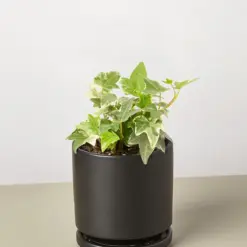
English Ivy ‘Glacier’ Plant
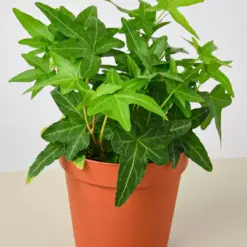
Price range: $22.99 through $47.99English Ivy ‘Green California’ Plant
Price range: $22.99 through $39.99English Ivy ‘Gold Child’ Plant
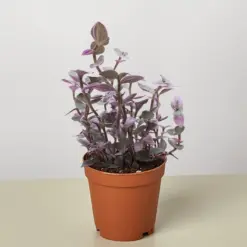
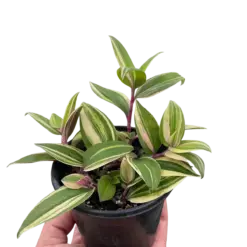
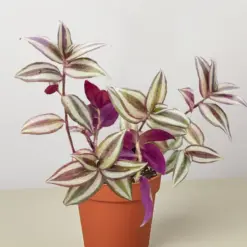
Price range: $22.99 through $39.99Tradescantia Callisia ‘Pink Panther’
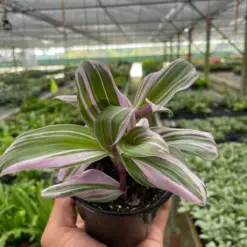
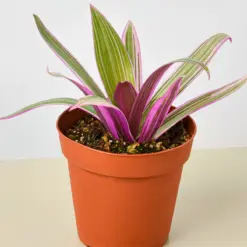
Price range: $12.99 through $40.99Tradescantia Plant ‘Nanouk’
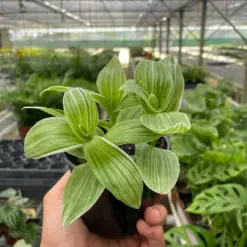
Price range: $16.99 through $50.99Tradescantia Plant ‘Sanna’
$22.99
Frequently Asked Questions
Are ivy plants safe for cats and dogs?
No — English ivy and most Hedera species are toxic to cats and dogs per ASPCA listings. Contains saponins (triterpenoid saponins) that cause vomiting, diarrhea, hypersalivation, and abdominal pain when ingested. Skin contact can cause contact dermatitis in sensitive humans and pets. Keep out of reach of pets and kids. (For confirmed pet-safe trailing alternatives, see Spider plant, Hoya, and Peperomia.)
Why does my ivy keep getting spider mites?
Dry indoor air. Spider mites thrive in low humidity (below 40%) and ivy is one of their preferred targets indoors. The single best fix is raising humidity above 50% — small humidifier or pebble tray near the plant. Monthly showers (literally rinsing the plant in your bathroom shower) wash off mites and raise immediate humidity. If mites are already present, treat with insecticidal soap or neem oil weekly for 3–4 weeks while raising humidity.
Why is my ivy losing leaves?
Three usual causes: (1) too warm/too dry — most homes are warmer than ivy prefers; move to a cooler spot and raise humidity; (2) spider mites — check leaf undersides for tiny webs and stippling; (3) overwatering — soggy soil rots roots and causes leaf drop. Ivy is one of the more demanding indoor plants — the typical heated apartment is fundamentally hostile to it.
Why is my variegated ivy turning solid green?
Insufficient light. Variegation in ivy (white, gold, silver markings) is energy-expensive and the plant only maintains it in bright light. In low light, the plant produces solid-green leaves to maximize photosynthesis. Move to a brighter spot — east or north window with no shade — and cut back any solid-green reverted stems. New growth in proper light should come in variegated.
Can I grow ivy outdoors instead?
In most climates yes — and it’ll thrive far better outside than indoors. However, English ivy is invasive in much of North America (especially the Pacific Northwest and Southeast), parts of Australia, and New Zealand — it smothers native vegetation and damages tree bark. Check your region’s invasive species list before planting outside; in restricted areas, keep ivy in pots and never let it touch the ground. Consider native alternatives where ivy is restricted.
How do I propagate ivy?
Stem cuttings root easily. Cut a 4–6 inch piece of stem with at least 1–2 nodes, strip the lower leaves, and place in a glass of water with the bare nodes submerged. Roots emerge in 2–4 weeks. You can also stick cuttings directly in damp soil — works equally well, especially if you cover with a clear bag for humidity. Plant 5–7 cuttings per pot for an instant full plant.
Why are my ivy’s leaves getting crispy brown edges?
Almost always low humidity. Ivy prefers 50%+ humidity and most heated/air-conditioned homes run drier. Add a humidifier or pebble tray, and try giving the plant a monthly shower (rinse leaves under lukewarm water for 30 seconds). Existing crispy edges don’t recover; trim with scissors and focus on preventing recurrence. Salt buildup from over-fertilizing is a less common second cause.
Related Care Guides
- Pothos Care Guide — easier trailing alternative — much more heat-tolerant
- Spider Plant Care Guide
- Tradescantia Care Guide
- Humidity Guide for Houseplants
