
Plant Care
Calathea Care Guide: Light, Water, Humidity & Fixing Crispy Leaves
Calatheas are the houseplant world’s drama queens. Striking patterned leaves, a nightly “prayer” movement that folds them upward at dusk, and a long list of grievances about wrong water, wrong humidity, wrong light, and wrong everything. But once you understand what they actually want, they become reliably stunning. Here’s the brutally honest care guide most growers wish they’d read first.
Quick Care Card
☀️ Light
Medium indirect (no direct sun)
💧 Water
Top inch dry, filtered water
💨 Humidity
60%+ (critical)
🌡️ Temp
65–80°F
🪴 Soil
Peat-based, moisture-retentive
🐾 Cat/Dog Safe
✅ Safe for cats & dogs
🎯 Difficulty
🟡 Intermediate
📏 Size
1–3 ft tall
🌎 Zone
10–11 outdoors
🏞️ Origin
Tropical South America
In this guide
About Calathea
Calathea is a genus of around 60 species in the prayer plant family (Marantaceae) native to tropical South America. Most species you’ll see in stores have been recently reclassified to Goeppertia, but the houseplant industry still calls them all calathea, and we will too. They’re famous for their nyctinasty: leaves fold upward at night and unfurl in the morning, driven by water pressure changes in specialized cells at the leaf base (the pulvinus).
What makes calatheas hard isn’t any single thing, but that they have narrow tolerances for several variables at once. They need filtered or distilled water (tap water with chlorine and fluoride causes brown edges). They need high humidity (60%+), whereas most homes are 30–40%. They want bright indirect but not direct sun. The soil should stay consistently damp but never soggy. Get any one of these wrong and the leaves protest visibly.
The good news: calatheas are pet-safe and non-toxic to cats and dogs, making them one of the best statement plants for households with curious animals. And once you’ve nailed the watering and humidity, the rest takes care of itself.
Care Guide
Light
Medium indirect light. No direct sun, ever.
- Place 4–8 feet from a north or east-facing window, or further back from a south-facing one.
- Direct sun (more than 30 minutes) bleaches the patterns and burns the leaves. Even mild morning sun fades the colors over time.
- Too little light flattens the leaf patterns and slows growth dramatically. The plant survives in low light but loses its ornamental value.
- If you can’t read a book comfortably without a lamp in the spot, it’s too dark for calathea.
Water
This is the make-or-break for calathea. Tap water is the #1 cause of brown leaf edges.
- Use filtered, distilled, or rainwater. Tap water contains chlorine and fluoride that calathea cannot tolerate, because the chemicals build up in leaf tissue and burn the edges over weeks.
- Water when the top 1 inch of soil is dry. Water thoroughly until water runs from the drainage holes.
- Empty the saucer within 15 minutes, because root rot is the second most common killer.
- Most plants need watering every 5–7 days in summer, every 10–14 days in winter.
- Use room-temperature water. Cold water shocks the roots and stalls growth.
- Yellowing leaves with brown edges = water-quality issue + overwatering. Switch to filtered water and reduce frequency.
Humidity
60% humidity is the floor, not the goal. Below that, expect crispy edges within weeks.
- Run a small humidifier within 6 feet of the plant, since it’s the only reliable way to maintain 60%+ in most homes.
- Group plants together to create a humidity microclimate, because multiple humidity-loving plants raise local humidity 10–15%.
- A pebble tray with water under the pot helps marginally (avoid water touching the pot bottom).
- Bathrooms with bright indirect light are excellent calathea spots if humidity stays high from showers.
- Skip frequent misting, because the moisture evaporates within minutes, and water sitting on patterned leaves can encourage fungal spots.
Temperature
Stable warmth. No drafts.
- 65–80°F (18–27°C) is ideal. Calathea prefer the warm end of that range.
- Below 60°F slows growth and can cause permanent leaf damage. Below 50°F kills the plant.
- Avoid AC vents, exterior doors, single-pane windows. Calatheas hate sudden temperature swings.
Soil
Moisture-retentive but well-draining, because calathea want consistently damp roots without sitting in water.
- DIY recipe: 70% peat-based potting mix or coco coir, 20% perlite, 10% orchid bark.
- Or buy: any “prayer plant mix” or African violet mix.
- Avoid: chunky aroid mixes (drain too fast), cactus mixes, or pure peat (compacts).
- Repot every 1–2 years. Don’t go up too many pot sizes, because excess soil holds water and rots roots.
Pro tip: the wet-paper-towel test
Calatheas want soil that’s consistently damp but not wet. Aim for the moisture level of a wrung-out paper towel. Press a finger into the soil 1 inch down. If your finger comes out clean and dry, water now. If it comes out with damp soil clinging, wait 1–2 days. If your finger is wet or muddy, you’ve overwatered, so let the soil dry to the touch before the next watering.
Fertilizer
Light feeders, especially sensitive to fertilizer salt buildup.
- Balanced liquid fertilizer at quarter strength every 4–6 weeks during growing season (April–September).
- Skip fertilizing October–March entirely.
- Flush soil with plain water every 2–3 months to prevent salt buildup. Calatheas are extra sensitive to this, since buildup shows as brown leaf tips even with filtered water.
Seasonal Care
🌱 Spring & Summer
- New leaves every 4–6 weeks on healthy plants
- Water every 5–7 days with filtered water
- Run humidifier consistently
- Fertilize monthly at quarter strength
- Best time to repot or divide, once new growth appears in spring
❄️ Fall & Winter
- Cut watering by 30–40% because soil dries slower
- Stop fertilizing entirely
- Move further from cold windows; even brief cold exposure damages leaves
- Run humidifier MORE in winter, since heating drops indoor humidity below 30%
- Don’t repot or divide; wait until spring growth resumes
Common Problems & Fixes
| Symptom | Likely Cause | Fix |
|---|---|---|
| Brown crispy leaf edges | Tap water (chlorine/fluoride) or low humidity | Switch to filtered/distilled water; add humidifier |
| Yellow leaves (multiple) | Overwatering or chlorinated water | Cut watering frequency; switch to filtered water; check drainage |
| Curled, rolled-up leaves | Underwatered or extremely low humidity | Water immediately; raise humidity; leaves may not uncurl fully |
| Leaves not opening fully (staying “prayed”) | Light is too low or stress from recent move | Brighter indirect light; allow 2 weeks for adjustment |
| Faded patterns | Too much direct sun | Move to lower light; patterns return on new growth, not damaged leaves |
| Brown spots on leaf interior | Cold damage or fungal infection | Move from cold; reduce humidity around foliage temporarily |
| Drooping leaves | Underwatered, root rot, or transplant shock | Check soil moisture and root health; adjust accordingly |
| Tiny webs under leaves | Spider mites | Increase humidity; spray leaves with water; treat with neem oil |
| White cottony spots on stems | Mealybugs | Wipe with alcohol; insecticidal soap weekly until clear |
| Leaves fading to pale green overall | Insufficient light or nutrient deficiency | Move closer to indirect light; resume light fertilizing |
If you take only one piece of advice from this guide: switch to filtered water immediately. It fixes 80% of calathea problems and prevents the rest.
Propagation
Division (the only reliable method)
Calatheas can’t be propagated from leaf or stem cuttings, because they grow from underground rhizomes that must be physically split.
Wait until spring when new growth is active. Don’t divide a stressed or recently-purchased plant.
Water the plant 1–2 days before division to ease the rhizome out of the pot.
Unpot the plant. Gently brush soil from the rhizome to expose the natural break points.
Identify a section with at least 3–4 healthy leaves and visible roots. Use clean hands to tease the rhizome apart at a natural break, and only use a sterilized blade if needed.
Pot each section in fresh damp prayer-plant mix. Water lightly with filtered water.
Cover with a clear plastic bag or dome for 1–2 weeks while new roots establish, because humidity is critical during recovery.
Expect a 2–4 week growth pause as the plant recovers, then new leaves emerge.
Featured Calathea Species
| Species | Common Name | Notable Trait | Difficulty |
|---|---|---|---|
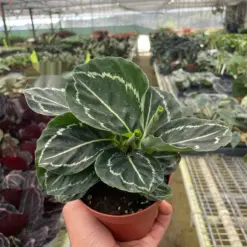
| G. orbifolia | Round-Leaf Calathea | Large round leaves with silver-and-green stripes | 🟡 Intermediate |
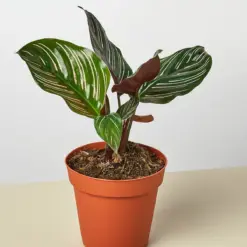
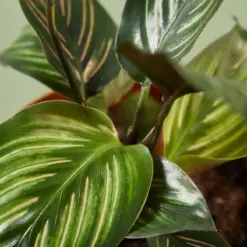
| G. ornata | Pinstripe Calathea | Dark green with thin pink-white stripes | 🟡 Intermediate |
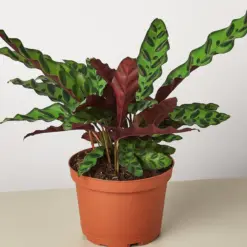
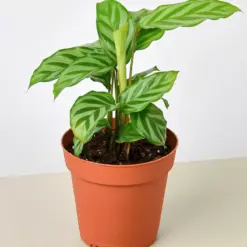
| G. lancifolia | Rattlesnake Calathea | Elongated leaves with dark green spots, purple undersides | 🟡 Intermediate |
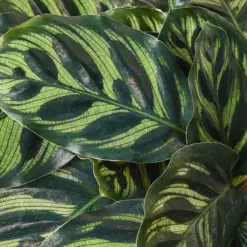
| G. makoyana | Peacock Plant | Pale green with dark green pattern; very ornate | 🟡 Intermediate |
| G. roseopicta ‘Medallion’ | Medallion Calathea | Round leaves with dramatic feathered patterning | 🟡 Intermediate |
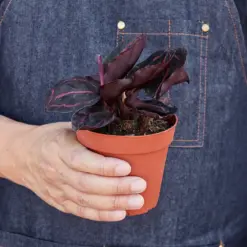
| G. roseopicta ‘Dottie’ | Dottie Calathea | Near-black leaves with hot pink patterning | 🟡 Intermediate |
| G. zebrina | Zebra Plant | Velvety leaves with dark zebra stripes | 🟡 Intermediate |
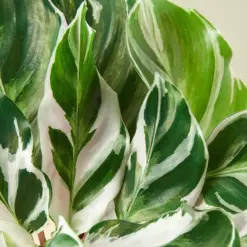
| G. white fusion | White Fusion | Variegated white-pink-green; notoriously fussy | 🔴 Expert |
| G. crocata | Eternal Flame | Smaller plant with bright orange flower spikes | 🟡 Intermediate |
Shop Our Calathea Collection
Every Calathea we ship is greenhouse-grown, climate-acclimated, and packed with care for transit. Sold-out species? Use the Notify Me button on any product page and we’ll email you the moment it’s restocked.

Calathea Lancifolia ‘Rattlesnake’ – Rattlesnake
Price range: $19.99 through $41.99Calathea Plant ‘Ornata’
Price range: $29.99 through $41.99Calathea Plant ‘White Fusion’
Price range: $27.99 through $59.99Calathea Plant ‘Dottie’
Price range: $33.99 through $39.99Calathea Concinna ‘Freddie’
Price range: $34.99 through $46.99Calathea Plant ‘Beauty Star’
Price range: $34.99 through $46.99Calathea Plant ‘Green Goddess’
Price range: $33.99 through $53.99Calathea Plant ‘Makoyana’
Price range: $22.99 through $50.99Calathea Plant ‘Musaica’
Price range: $30.99 through $53.99Calathea Plant ‘Orbifolia’
Price range: $34.99 through $46.99Calathea Plant ‘Purple Rose’
Price range: $22.99 through $39.99Calathea Plant ‘Vittata’
Price range: $34.99 through $56.99

Frequently Asked Questions
Related Care Guides
- Maranta Care Guide (the closest prayer-plant cousin, easier care)
- Stromanthe Care Guide
- Ctenanthe Care Guide
- Humidity & Misting Guide
- Pet-Safe Plants Guide
