
Plant Care
Fiddle Leaf Fig Care Guide: Light, Water & The Plant That Defines Diva
Fiddle Leaf Fig (Ficus lyrata) became the most photographed houseplant of the 2010s and the most-killed houseplant of the 2010s. It’s gorgeous: massive violin-shaped glossy leaves on a tall trunk, the perfect statement piece for any modern interior. It’s also a diva: hates being moved, drops leaves from drafts, gets root rot from overwatering, gets crispy from underwatering, and needs more light than most homes provide. With consistent conditions, FLF is one of the most beautiful houseplants you’ll own. With inconsistency, it’s a slow death.
Quick Care Card
☀️ Light
Bright direct or very bright indirect (6+ hours)
💧 Water
Top 1–2 inches dry; consistent schedule
💨 Humidity
50%+ (60% ideal)
🌡️ Temp
65–80°F (avoid drafts)
🪴 Soil
Rich, well-draining mix
🐾 Cat/Dog Safe
❌ Toxic to cats & dogs
🎯 Difficulty
🔴 Advanced
📏 Size
6–10 ft indoors
🌎 Zone
10–11 outdoors
🏞️ Origin
West African rainforest
In this guide
About Fiddle Leaf Fig
Ficus lyrata is native to the lowland rainforests of West Africa, from Sierra Leone to Cameroon. In its native habitat, it’s a massive tree (60+ ft tall) that often grows as a hemiepiphyte, starting life in the crook of another tree and eventually wrapping its roots down to the ground. The huge violin-shaped ("lyre-shaped," hence lyrata) leaves are an adaptation to capture light in the dim rainforest understory.
FLF entered the houseplant trade in the 1940s but became famous around 2010 when designers like Apartment Therapy and Architectural Digest started featuring it in every modern interior. The Instagram era amplified it further. Demand exploded, supply scrambled to keep up, and millions of FLFs ended up in homes that couldn’t support them, leading to the "diva" reputation.
The reality: FLF is a tropical tree that needs tree conditions to thrive, including lots of direct light, consistent moisture, stable temperatures, and minimal disturbance. It’s not actually more difficult than other rainforest trees; it’s just notoriously visible when it’s unhappy. Drooping leaves, brown spots, leaf drop, and yellowing are highly photogenic problems that show up dramatically on its huge leaves.
Care Guide
Light
FLF wants more light than almost any other houseplant. Direct or very bright indirect, 6+ hours daily.
- Best: 6+ hours of direct sun or very bright indirect light daily. South or west-facing window with no obstructions, or behind sheer curtains on a south window.
- Insufficient: medium light or filtered light. FLF survives but grows slowly, drops leaves, and gets leggy.
- Direct afternoon sun is usually fine, since FLF tolerates more sun than most houseplants in good health.
- Grow lights help dramatically, with full-spectrum LED at 12 inches above the plant for 12 hours daily.
- Rotate the pot a quarter-turn weekly so the plant grows evenly. FLF leans hard toward light without rotation.
Water
Consistent watering on a schedule. FLF hates both extremes.
- Water when the top 1–2 inches of soil are dry. Stick your finger in, and if dry to the second knuckle, water thoroughly.
- Water until water runs from the drainage holes; empty the saucer after 10 minutes.
- Most plants need water every 7–10 days in summer, every 10–14 days in winter.
- Critical: establish a consistent routine. FLF hates erratic watering, like being soaked one week and bone-dry the next.
- Yellow leaves with brown spots near the veins = overwatering (root rot). Brown crispy edges = underwatered or low humidity.
- Use room-temperature water. Filtered or rainwater is ideal; tap water is often acceptable but can cause leaf spotting.
Humidity
Higher is better. 50%+ is the comfort zone.
- Ideal: 50–60% humidity. Most homes need a humidifier or pebble tray to reach this.
- Tolerable: 40–50%. Plant survives but may develop crispy edges in winter.
- Below 30% (winter heating) leaves crisp and drop.
- A small humidifier nearby is the most effective fix.
- Wipe large leaves with a damp cloth monthly to remove dust, since they’re literally giant solar panels.
- Skip aggressive misting because water sitting on leaves can encourage bacterial leaf spot.
Temperature
Stable warm temperatures. FLF hates drafts and sudden changes.
- Ideal: 65–80°F (18–27°C).
- Below 55°F damages leaves and causes leaf drop.
- Below 50°F is potentially fatal.
- Critical: avoid AC vents in summer and cold windows/heating vents in winter, since sudden drops cause dramatic leaf drop.
- Keep FLF in one stable spot and don’t move it between rooms. Even small location changes shock the plant.
Soil
Rich, well-draining mix.
- Easy mix: 60% standard houseplant potting soil + 30% perlite + 10% orchid bark.
- Better: 50% potting soil + 30% perlite + 10% peat moss + 10% orchid bark.
- Avoid: dense potting soil that compacts, anything cactus-mix-based (too dry), pots without drainage.
- Use a deep pot because FLF has substantial root systems and needs the depth.
- Repot every 2–3 years in spring, because FLF hates root disturbance, so don’t repot more often than necessary. Plan for stress leaf drop after repotting.
Pro tip: establish location and don’t move it
The single biggest cause of FLF failure is moving the plant. Once you bring an FLF home, pick its spot (bright direct or very bright indirect light, away from drafts, in a stable temperature zone) and don’t move it. Don’t rotate it 180° to even out growth (a small quarter-turn weekly is fine). Don’t relocate it to your bedroom for the season. Don’t take it outside for summer and back in for winter. FLF responds to environmental change by dropping leaves. Pick its spot, leave it there for years, and water on a schedule. That’s the entire secret to a thriving FLF.
Fertilizer
Moderate to heavy feeders during growing season.
- Balanced liquid fertilizer at half strength every 4 weeks April–September.
- Or use a slow-release tropical fertilizer once in spring per package directions.
- Skip fertilizing October–March entirely.
- FLF responds visibly to feeding, with larger leaves, faster growth, and deeper green color.
- Brown leaf spots after fertilizing = salt buildup. Flush soil thoroughly with plain water; reduce fertilizer.
Seasonal Care
🌱 Spring & Summer
- New leaves emerge from the growing tip every 3–6 weeks on healthy plants
- Each new leaf starts as a tightly-rolled spear and unfurls over 1–2 weeks
- Water every 7–10 days when top 1–2 inches are dry
- Fertilize every 4 weeks at half strength
- Best time to repot (only if necessary)
❄️ Fall & Winter
- Reduce watering to every 10–14 days
- Stop fertilizing entirely
- Move from cold drafts; below 55°F damages leaves
- Don’t repot until spring
- Growth pauses or slows dramatically, with 1 new leaf every 2–3 months being normal in winter
Common Problems & Fixes
| Symptom | Likely Cause | Fix |
|---|---|---|
| Brown spots on leaves, often near veins | Overwatering / root rot (the #1 FLF problem) | Stop watering until soil dries; check roots; cut affected sections; let dry out properly between waterings |
| Crispy brown edges on leaves | Underwatered, low humidity, or both | Establish consistent watering routine; raise humidity to 50%+ |
| Massive leaf drop after recent move/repot | Stress response (FLF hates change) | Resume consistent care; leave plant alone; new leaves emerge over 8–12 weeks |
| Yellow leaves | Overwatering, natural shedding, or cold draft | Reduce watering; check for drafts; stabilize location |
| Drooping leaves | Severely underwatered (most common) or root rot from overwatering | Check soil and if dry, water thoroughly; if soggy, let dry and check roots |
| Stretched / leggy with bare lower stem | Insufficient light or mature growth habit | Move to brighter spot; rotate weekly; mature FLFs lose lower leaves naturally |
| Bleached patches on leaves | Sudden move into direct sun without acclimation | Move to shadier spot temporarily; affected leaves don’t recover; acclimate gradually next time |
| Sticky milky-white sap when cut | Normal (Ficus produces latex when damaged) | Wipe with damp cloth; sap can be irritating to sensitive skin |
| Tiny webs and stippled leaves | Spider mites (low humidity) | Rinse under shower; raise humidity above 50%; insecticidal soap weekly until clear |
Pick a spot. Water on a schedule. Don’t move it. That’s the entire fiddle leaf fig manual. Everything else is just expensive overthinking.
Propagation
Stem cuttings rooted in water (most common)
In spring or early summer, cut a 6–8 inch stem section with 2–3 leaves and a visible node.
Cut just below a node with sterilized sharp scissors.
Strip the bottom leaves so the lower nodes are bare.
FLF produces milky latex sap when cut, so let the cutting sit out for 15 minutes to seal, then rinse.
Place in a jar of water with the bare nodes submerged. Leaves stay above water.
Change water every 5–7 days. Place in bright indirect light.
Roots emerge from the nodes in 6–10 weeks (slower than most houseplants).
Once roots are 2–3 inches long, pot up in well-draining soil. Keep moist for the first 3–4 weeks while transitioning.
Air layering (most reliable method for thick canes)
- On a thick stem of an established FLF, ring-bark a 1/2 inch section (cut through the bark down to the cambium, all the way around).
- Apply rooting hormone to the upper edge of the cut.
- Wrap the cut area with damp sphagnum moss; cover tightly with plastic and secure top and bottom.
- Keep moss damp by injecting water with a syringe every 2–3 weeks.
- Roots form into the moss in 8–16 weeks.
- Once visible roots fill the moss, cut below the rooted section and pot up.
- This method has higher success than water rooting and produces an instant mature plant.
Featured Fiddle Leaf Fig Species
| Species | Common Name | Notable Trait | Difficulty |
|---|---|---|---|
| Ficus lyrata (standard) | Fiddle Leaf Fig | Standard form with massive violin-shaped glossy leaves | 🔴 Advanced |
| Ficus lyrata ‘Bambino’ | Bambino Fiddle Leaf Fig | Compact form with smaller leaves; same care as standard but more manageable size | 🔴 Advanced |
| Ficus lyrata ‘Compacta’ | Compacta Fiddle Leaf Fig | Dense compact form with tightly clustered leaves | 🔴 Advanced |
| Ficus lyrata ‘Variegata’ | Variegated Fiddle Leaf Fig | Rare cream-and-green variegated cultivar; even more challenging than standard | 🔴 Advanced |
Shop Our Fiddle Leaf Fig Collection
Every Fiddle Leaf Fig we ship is greenhouse-grown, climate-acclimated, and packed with care for transit. Sold-out species? Use the Notify Me button on any product page and we’ll email you the moment it’s restocked.

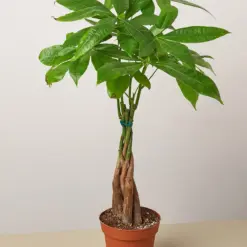
Money Tree ‘Guiana Chestnut’ Pachira Braid – Pachira Braid
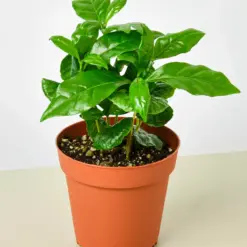
Price range: $31.99 through $158.99Arabica Coffee Plant (Coffea Arabica)
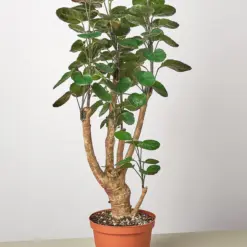
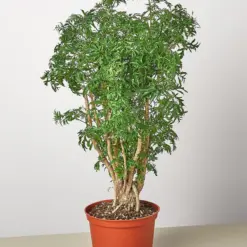
Price range: $22.99 through $39.99Aralia Fabian Stump ‘Polyscias Scutellaria’
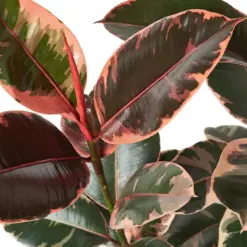
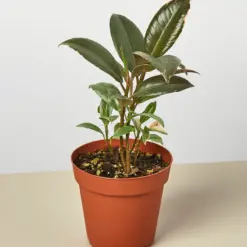
Price range: $31.99 through $56.99Ficus Elastica ‘Ruby Pink’
Price range: $29.99 through $158.99Aralia Plant ‘Ming Stump Plant’
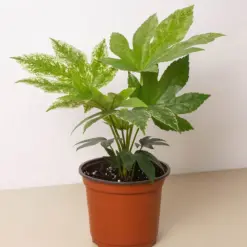
Price range: $38.99 through $68.99Fatsia ‘Spider’s Web’
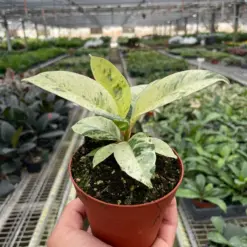
$56.99Ficus ‘Shivereana’ (Moonshine)
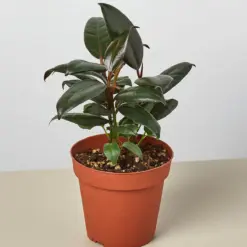
Price range: $23.99 through $70.99Ficus Elastica ‘Burgundy’
Price range: $28.99 through $164.99Ficus Elastica ‘Tineke’
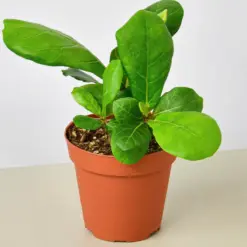
Price range: $22.99 through $164.99Ficus Lyrata ‘Fiddle Leaf Fig’
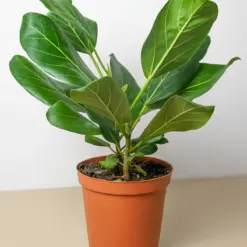
Price range: $23.99 through $121.99Ficus Plant ‘Audrey’
Price range: $26.99 through $50.99

Frequently Asked Questions
Are fiddle leaf figs safe for cats and dogs?
No. Ficus lyrata is toxic to cats and dogs per ASPCA listings. The milky latex sap contains insoluble calcium oxalates and other compounds that cause oral irritation, drooling, vomiting, and skin irritation on contact. Skin contact with the sap can cause contact dermatitis in sensitive humans. Keep firmly out of reach of pets and kids. Wear gloves when pruning. (For pet-safe large-leaf alternatives, see Calathea and Anthurium.)
Why does my fiddle leaf fig keep getting brown spots?
Almost always root rot from overwatering, which is the #1 FLF problem. The spots typically appear near the veins or as random brown patches. Stop watering immediately. Lift the pot to check if it’s heavy (soggy) or light (dry). If wet, let the soil dry completely before watering again. In severe cases, unpot to check roots and cut any brown mushy roots back to firm tissue. Use well-draining soil and water only when the top 1–2 inches are dry.
Why is my fiddle leaf fig dropping leaves?
FLF drops leaves in response to environmental change: (1) recent move with different light, humidity, or temperature; give it 2–4 weeks to acclimate; (2) cold draft from AC or heating vent; eliminate the draft; (3) overwatering with soggy soil rotting roots; reduce watering; (4) severely underwatered with soil bone dry; soak thoroughly. Resume consistent care and don’t panic-treat, since new leaves emerge over 8–12 weeks.
How much light does a fiddle leaf fig need?
More than you think, since 6+ hours of direct sun or very bright indirect light daily is ideal. A south or west-facing window with no obstructions, or behind sheer curtains on a south window. FLF is one of the highest-light houseplants and rarely thrives in medium or filtered light. If your home only gets moderate light, FLF is the wrong plant, so consider Ficus altissima or Dracaena fragrans for similar large-leaf statement with lower light needs.
How often should I water my fiddle leaf fig?
Every 7–10 days in summer and every 10–14 days in winter, but always check the soil first. Water when the top 1–2 inches are dry (push your finger 2 inches in). FLF tolerates dry soil better than soggy soil. The key is consistency, so pick a watering rhythm and stick to it; FLF hates erratic watering far more than slightly imperfect timing.
Can I move my fiddle leaf fig outside in summer?
Technically yes, but the move stress often causes massive leaf drop. If you do it, acclimate gradually over 2 weeks by starting with 2 hours of outdoor shade daily and increasing exposure. Bring back inside before nighttime temperatures drop below 55°F. Expect another round of leaf drop when you bring it back inside. Most experienced FLF growers keep their plants in a single stable indoor spot year-round to avoid the cycle of stress shedding.
How do I make my fiddle leaf fig branch out?
FLFs naturally grow as single tall trunks. To force branching: cut the top of the trunk (called "notching" or "topping") with sterilized sharp scissors. The cut triggers the plant to produce 2–3 new branches from buds along the trunk. Wait until your plant is at least 4 ft tall and healthy. Cut in spring or early summer. The plant looks awkward for several months while new branches develop. Don’t notch if the plant is already stressed or losing leaves.
Related Care Guides
- Ficus Care Guide (broader Ficus family including FLF, rubber plant, and weeping fig)
- Monstera Care Guide
- Bird of Paradise Care Guide
- Rubber Plant (Ficus elastica) Care Guide
