
Plant Care
Money Tree Care Guide: Light, Water & The Braided Trunk Plant That Survives Anything
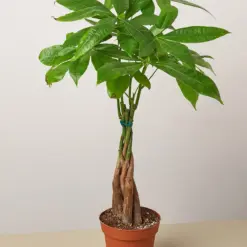
Money Tree (Pachira aquatica) is the houseplant with the iconic braided trunk and the feng shui reputation for bringing wealth and good luck. The braid isn’t natural; it’s done by growers while the trunks are young and flexible. Beyond the symbolism, it’s a genuinely easy indoor tree: tolerates moderate light, recovers from overwatering, handles missed waterings, and grows reliably for decades. The biggest mistake people make is treating it like a desert plant, because Money Tree comes from swampy wetlands and actually likes consistent moisture.
Quick Care Card
☀️ Light
Bright indirect (some direct sun OK)
💧 Water
Top inch dry; consistent watering
💨 Humidity
40–60% (average home)
🌡️ Temp
65–80°F
🪴 Soil
Well-draining standard mix
🐾 Cat/Dog Safe
✅ Safe for cats & dogs
🎯 Difficulty
🟢 Beginner
📏 Size
4–8 ft indoors
🌎 Zone
10–11 outdoors
🏞️ Origin
Central & South American wetlands
In this guide
About Money Tree
Pachira aquatica is native to the wetland regions of Central and South America, including flooded forests, swamps, and riverbanks from Mexico south to Brazil. The species name aquatica tells you everything about its native habitat: it grows in standing water and seasonally flooded soil, which is why indoor Money Tree tolerates overwatering far better than most tropical houseplants.
The braided trunk is purely decorative. Growers braid 3, 5, or 7 young flexible trunks together while still pliable, and the trunks fuse and continue growing as a single decorative unit. Numbers carry symbolic meaning in feng shui (5 is most common; 5 trunks = 5 elements; 7 = luck), but the plant itself is identical regardless.
Money Tree also has an interesting horticultural origin: it became popular as a houseplant when a Taiwanese truck driver named Houwen Lai began braiding the trunks in the 1980s. By the 1990s the plant was everywhere in East Asian businesses and homes as a feng shui symbol, then spread globally. The huge palmate leaves (5–7 leaflets) and unique trunk make it instantly recognizable.
Care Guide
Light
Bright indirect light. Tolerates some direct sun but adapts to moderate conditions.
- Best: bright indirect light within 3–6 feet of an east, north, or filtered south/west window.
- Some direct morning sun is fine and even encouraged because it improves growth and trunk thickness.
- Medium light is tolerated. Growth slows but the plant stays healthy.
- Low light is survivable but the plant gets leggy with sparse leaves over time.
- Rotate the pot a quarter-turn weekly so the plant grows evenly. Money Tree leans toward light strongly.
Water
Top inch dry between waterings. Money Tree is one of the more forgiving plants with watering.
- Water when the top inch of soil is dry. Stick your finger in, and if it’s dry to the first knuckle, water thoroughly.
- Water until water runs from the drainage holes; empty the saucer after 10 minutes.
- Most plants need water every 7–10 days in summer, every 10–14 days in winter.
- Money Tree tolerates occasional soggy soil better than most tropicals, because its native wetland habit means brief wet feet won’t kill it. Just don’t keep it constantly soggy.
- Yellow lower leaves = overwatering or natural shedding. Crispy brown leaf edges = severely underwatered or low humidity.
- Use room-temperature water. Tap water is generally fine.
Humidity
Average household humidity is fine.
- 40–60% humidity (typical home year-round) is plenty.
- Below 30% (winter heating) you may see slight crispy edges.
- Pebble trays or a humidifier help in dry winter rooms but aren’t critical.
- Skip aggressive misting, since water on leaves can encourage fungal issues.
Temperature
Standard household temperatures.
- Ideal: 65–80°F (18–27°C). Tolerates 60–85°F.
- Below 55°F damages leaves and causes leaf drop.
- Below 45°F is potentially fatal.
- Avoid AC vents in summer and cold windows in winter, because sudden drops cause leaf drop.
Soil
Well-draining standard mix. Money Tree isn’t picky.
- Easy mix: 70% standard houseplant potting soil + 30% perlite.
- Better: 60% potting soil + 30% perlite + 10% orchid bark for extra drainage.
- Avoid: heavy clay soils, peat-only mixes that compact, pots without drainage.
- Use a sturdy pot that won’t tip, since mature Money Tree gets top-heavy.
- Repot every 2–3 years in spring when roots fill the pot. Money Tree prefers being slightly pot-bound.
Pro tip: protect the braid by avoiding excessive growth
The decorative braided trunk loses its tight braid as the trunks thicken over years. To keep the braid looking neat, avoid heavy fertilizing (slow growth keeps braids tight longer), don’t over-water (faster growth = faster trunk thickening), and accept some loosening as the plant matures. If the braid loosens dramatically, you can carefully re-braid the trunks while they’re still flexible (younger growth), but mature thick trunks can’t be re-braided. Many growers prefer the look of a thickening loose braid over a tight new one anyway.
Fertilizer
Light feeders.
- Balanced liquid fertilizer at half strength every 4–6 weeks April–September.
- Skip fertilizing October–March entirely.
- Brown leaf tips after fertilizing = salt buildup. Flush soil with plain water; reduce fertilizer.
- Heavy fertilizing accelerates growth which loosens the decorative braid faster.
Seasonal Care
🌱 Spring & Summer
- New leaves emerge from the growing tips every 3–6 weeks on healthy plants
- Each new leaf has 5–7 palmate leaflets
- Mature Money Trees may produce showy cream-and-pink flowers in summer (rare indoors)
- Water every 7–10 days when top inch is dry
- Best time to repot or take cuttings
❄️ Fall & Winter
- Reduce watering to every 10–14 days
- Stop fertilizing entirely
- Move from cold drafts; below 55°F damages leaves
- Don’t repot until spring
- Slower growth (1 new leaf every 1–2 months is normal)
Common Problems & Fixes
| Symptom | Likely Cause | Fix |
|---|---|---|
| Yellow lower leaves | Overwatering or natural shedding of oldest leaves | Reduce watering frequency; some lower leaf shedding is normal as plant matures |
| Crispy brown leaf edges / tips | Low humidity, dry soil, or salt buildup | Raise humidity slightly; check soil moisture; flush soil if recently fertilized |
| Massive leaf drop | Cold draft, sudden temperature change, or stress from recent move | Stabilize location; check for AC/heat vents; resume consistent care |
| Drooping leaves | Severely underwatered or root rot from overwatering | Check soil; if dry, water thoroughly, and if soggy, let it dry and reduce frequency |
| Soft mushy trunk | Root rot from severe overwatering (usually terminal) | Cut healthy upper portion for propagation; rotted trunk unrecoverable |
| Leggy with bare lower trunk | Insufficient light or mature growth habit | Move to brighter spot; prune the top to encourage branching |
| Braid loosening over years | Natural aging as trunks thicken | Accept as natural aging; or carefully re-braid younger growth above the thickened base |
| White cottony spots in leaf joints | Mealybugs | Wipe with isopropyl alcohol; insecticidal soap weekly until clear |
| Tiny webs on leaves | Spider mites (low humidity) | Rinse under shower; raise humidity; insecticidal soap weekly until clear |
Money Tree is from a swamp. Stop treating it like a desert plant, because it actually likes consistent moisture, and that’s why it forgives your forgetfulness so well.
Propagation
Stem cuttings (most common)
In spring or summer, take 4–6 inch stem cuttings from healthy upper growth.
Cuttings should have 3–4 leaves; remove the lowest leaves.
Dip cut end in rooting hormone (improves success rate).
Insert into damp well-draining soil or perlite-peat mix. Keep evenly moist.
Cover loosely with a clear bag for humidity. Place in bright indirect light.
Roots form in 4–8 weeks.
Once well-rooted, transition to normal care. Note: cuttings produce single-trunk Money Trees, not braided, because braids require multiple young trunks grown together from seed.
Seed (slow, multi-year project)
- Money Tree seeds (called "Malabar chestnuts" in some regions) are large and dense.
- Soak seeds in warm water 24 hours.
- Plant 1 inch deep in damp seedling mix; keep at 75–80°F.
- Germination takes 2–4 weeks.
- To create a braided trunk: plant 3, 5, or 7 seedlings together in a single pot, let them grow to 12+ inches with flexible trunks, then carefully braid the still-flexible trunks together.
- Continue caring for the braided unit as a single plant; trunks fuse and continue growing over years.
Featured Money Tree Species
| Species | Common Name | Notable Trait | Difficulty |
|---|---|---|---|
| Pachira aquatica | Money Tree | The standard braided form; 5–7 palmate leaflets per leaf | 🟢 Beginner |
| Pachira glabra | Saba Nut (sometimes sold as Money Tree) | Similar appearance; sometimes substituted in the trade | 🟢 Beginner |
| Pachira aquatica (un-braided) | Single-trunk Money Tree | Same species sold without braiding; thicker single trunk | 🟢 Beginner |
Shop Our Money Tree Collection
Every Money Tree we ship is greenhouse-grown, climate-acclimated, and packed with care for transit. Sold-out species? Use the Notify Me button on any product page and we’ll email you the moment it’s restocked.
New Home, New Jungle Bundle
Original price was: $287.94.$259Current price is: $259.The Statement Trio Bundle
Original price was: $297.97.$269Current price is: $269.
Money Tree ‘Guiana Chestnut’ Pachira Braid – Pachira Braid
Price range: $31.99 through $158.99Money Tree ‘Guiana Chestnut’ Pachira Stump
Price range: $32.99 through $44.99
Frequently Asked Questions
Are money trees safe for cats and dogs?
Yes. Pachira aquatica (Money Tree) is non-toxic to cats and dogs per ASPCA listings. They’re a great pet-safe indoor tree option. (For more confirmed pet-safe houseplants, see Spider plant, Calathea, and Peperomia.)
Why are the lower leaves on my money tree yellowing?
Two normal, two not. Normal: the oldest lower leaves yellow and shed naturally as new growth emerges from the top, and 1–2 leaves at a time is fine. Not normal: if many leaves yellow rapidly, suspect (1) overwatering with soggy soil rotting roots, or (2) cold draft near AC or heating vents. Check soil moisture and stabilize location.
Is the braided trunk natural?
No. The braid is done by growers while the young trunks are flexible (similar to braiding wet hair). 3, 5, or 7 trunks are braided together as seedlings; they continue growing as a fused decorative unit over years. The plant itself is identical to a single-trunk Money Tree. As the trunks thicken with age, the braid naturally loosens, and that’s normal.
Why is my money tree’s trunk soft / mushy?
Severe root rot from overwatering. The roots have rotted and the trunk is following. Stop watering immediately. Lift the pot to check moisture, and if soggy, the rot is advanced. Cut off the healthy upper portion of the plant (above the soft trunk) and propagate it as a stem cutting. The rotted trunk and roots are usually unrecoverable. Going forward: well-draining soil, pot with drainage, water only when top inch is dry.
How often should I water my money tree?
Every 7–10 days in summer and every 10–14 days in winter, when the top inch of soil is dry. Money Tree is from wetland habitats and tolerates consistent moisture better than most tropicals, but standing water in the saucer still causes rot. Empty saucers after watering and use a well-draining soil. When in doubt, wait another day; underwatering is recoverable but rot often isn’t.
Why is my money tree dropping all its leaves?
Three usual causes: (1) recent move from greenhouse to home with different light, humidity, and temperature, which calls for 2–4 weeks to acclimate; (2) cold draft from an AC or heating vent, which you can fix by eliminating the draft; (3) overwatering with soggy soil rotting the roots. Resume consistent care and don’t panic-treat. New leaves emerge over 6–8 weeks once the plant stabilizes.
Can I prune my money tree?
Yes. Money Tree responds well to pruning. To encourage branching, cut the top of the trunk with sterilized sharp scissors in spring. The plant produces 2–3 new branches from buds along the trunk within 6–8 weeks. To control overall size, trim individual branches at junctions. Avoid heavy pruning (more than 25% of foliage at once), because like most plants, Money Tree responds best to gradual shaping over multiple seasons.
Related Care Guides
- Ficus Care Guide
- Schefflera Care Guide (another easy palmate-leaved indoor tree)
- Dracaena Care Guide
- Palm Care Guide
