
Plant Care
Pilea Care Guide: Light, Water, Pups & The Pancake Plant
Pilea is the genus that everyone knows by one species (Pilea peperomioides, the Chinese Money Plant or pancake plant) and forgets has ~600 others. The flagship is genuinely beginner-friendly: it tells you when it’s thirsty (drooping leaves), recovers within hours of a good drink, and pumps out pups (baby plants) that you can pop off and gift to friends. The lesser-known cousins (P. cadierei, P. depressa, P. involucrata) are equally easy, just less Instagram-famous.
Quick Care Card
☀️ Light
Bright indirect (no direct sun)
💧 Water
Top inch dry, then water thoroughly
💨 Humidity
40–60% (average home)
🌡️ Temp
65–75°F
🪴 Soil
Standard well-draining mix
🐾 Cat/Dog Safe
✅ Safe for cats & dogs
🎯 Difficulty
🟢 Beginner
📏 Size
10–14 inches tall
🌎 Zone
10–12 outdoors
🏞️ Origin
Yunnan, southern China
In this guide
About Pilea
Pilea peperomioides has one of the strangest backstories in houseplant history. It was collected in Yunnan, China by a Norwegian missionary in 1946, who carried cuttings home and shared them across Scandinavia for decades. Western botanists effectively didn’t know what it was until the 1980s, when readers of Kew Gardens magazine flooded them with samples asking for ID. That’s why the older common name is the "missionary plant," because it spread person-to-person via cuttings before it ever hit the commercial trade.
The pancake nickname comes from the round, perfectly disc-shaped leaves on long stalks (technically peltate leaves, where the petiole attaches to the underside of the leaf, not the edge). The plant grows from a central crown and continually produces baby plants ("pups") at the base and along the main stem, which is why it’s also called the "sharing plant," since it’s endlessly propagatable.
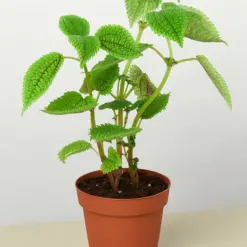
Other Pilea species worth growing include P. cadierei (Aluminum Plant, with silver-painted leaves), P. involucrata (Friendship Plant, with quilted bronze foliage), P. depressa (Baby Tears, with tiny round leaves on a creeping mat), and P. mollis ‘Moon Valley’ (deeply textured chartreuse leaves). All share the same easy care.
Care Guide
Light
Bright indirect light. Pilea is a windowsill plant, not a corner plant.
- Best: bright indirect light within 2–3 feet of a north or east window, or 4–6 feet from a sunny south/west window with a sheer curtain.
- Direct afternoon sun bleaches and crisps the leaves within days. Morning sun (gentle east light) is fine for an hour or two.
- Low light slows growth, makes stems long and leggy, and shrinks the leaf size. Plant survives but looks sad.
- Rotate the pot a quarter-turn weekly, since Pilea bends hard toward the light. Without rotation it will lean dramatically.
- If your Pilea is reaching, leaves are spaced far apart, or stems are bare at the base, it needs more light.
Water
Pilea likes consistently moist (not soggy) soil and tells you immediately when it’s thirsty.
- Water when the top inch of soil feels dry. Stick your finger in, and if it’s dry to the first knuckle, water.
- Water thoroughly until it runs from the drainage holes; empty the saucer after 10 minutes.
- Most plants need water every 7–10 days in summer, every 10–14 days in winter.
- The classic Pilea signal: leaves droop dramatically when thirsty and perk back up within 1–4 hours of watering. Don’t panic, because this is the plant talking to you.
- Yellow lower leaves = overwatering or compacted roots. Curling/cupping leaves with crispy edges = underwatered or low humidity.
- Use room-temperature water. Tap water is generally fine; if you have very hard water, switch to filtered.
Humidity
Average household humidity (40–60%) is plenty.
- Pilea tolerates dry air better than most tropicals. Most homes need no adjustment.
- Below 30% (winter heating) you may see crispy leaf edges. A small humidifier or pebble tray helps.
- Avoid placing near heating vents or drafty doors, because sudden humidity swings cause leaf curl.
- Skip the misting. Water on the round leaves causes spotting and isn’t useful for humidity anyway.
Temperature
Standard household temperatures. Pilea hates cold drafts.
- Ideal: 65–75°F (18–24°C). Tolerates 55–80°F without complaint.
- Below 50°F damages leaves and slows growth dramatically.
- Avoid placing near AC vents in summer or cold windows in winter, since temperature swings cause leaf drop.
- If the plant suddenly drops several leaves, suspect a cold draft before suspecting watering issues.
Soil
Light, well-draining mix. Pilea hates wet feet.
- Easy mix: 70% standard houseplant potting soil + 30% perlite.
- Better: equal parts potting soil, perlite, and coarse orchid bark for extra drainage.
- Avoid: dense peat-heavy mixes that stay soggy, and 100% potting soil straight from the bag.
- Use a pot with drainage holes, since Pilea rots fast in saucer-bottom or cachepot setups without internal drainage.
- Repot every 1–2 years in spring, because Pilea grows fast and quickly outgrows its pot. Go up only 1–2 inches in diameter.
Pro tip: pups are free plants
A healthy Pilea will produce baby plants (pups) from the soil around the mother plant and from nodes along the main stem. Wait until pups are 2–3 inches tall with a few leaves of their own, then dig down with a clean knife and sever the pup’s underground stem from the mother. Pups have their own roots and can be potted directly into small pots. One mature Pilea can produce a dozen pups per year. This is why everyone you know with a pancake plant gave it to a friend at some point.
Fertilizer
Light feeders during growing season. Easy to over-fertilize.
- Balanced liquid fertilizer (10-10-10 or similar) at half strength every 3–4 weeks April–September.
- Skip fertilizing October–March, since Pilea slows down and unused fertilizer salts build up in the soil.
- Brown leaf tips that show up after fertilizing = salt buildup. Flush soil with plain water until it runs clear.
- Pilea responds visibly to fertilizer, with leaves getting larger and greener within 2–3 weeks of feeding. Skip a feeding if you want to slow growth.
Seasonal Care
🌱 Spring & Summer
- New leaves emerge from the crown every 2–4 weeks on healthy plants
- Water every 7–10 days when top inch is dry
- Pups appear from soil and stem nodes; separate when 2–3 inches tall
- Fertilize every 3–4 weeks at half strength
- Best time to repot, divide, or take cuttings
❄️ Fall & Winter
- Reduce watering to every 10–14 days
- Stop fertilizing entirely
- Move from cold windows; Pilea drops leaves below 55°F
- Don’t repot until spring
- Growth pauses (1–2 new leaves a month is normal)
Common Problems & Fixes
| Symptom | Likely Cause | Fix |
|---|---|---|
| Drooping leaves | Underwatered (most common) or root rot from overwatering | Check soil; if dry, water thoroughly and leaves perk up in hours; if soggy, let dry and cut frequency |
| Yellow lower leaves | Overwatering or natural aging of oldest leaves | Reduce watering frequency; old leaves at the base shedding is normal as the plant grows taller |
| Curling/cupping leaves | Cold draft, low humidity, or being moved recently | Stabilize location; check for AC/heat vent nearby; humidity at 40%+ |
| Leggy stem with few leaves | Insufficient light | Move to a brighter spot near an east/north window; rotate weekly |
| Leaning hard to one side | Phototropism (bending toward light without rotation) | Rotate pot a quarter-turn every week; the plant straightens out within a month |
| Brown spots on leaves | Direct sun scorch or cold water on leaves | Move from direct sun; water at the soil only, not on leaves |
| White cottony spots in leaf joints | Mealybugs | Wipe with isopropyl alcohol on a cotton swab; insecticidal soap weekly until clear |
| Tiny webs under leaves | Spider mites (low humidity environments) | Rinse leaves under shower; raise humidity; treat with insecticidal soap or neem |
| Stem rotting at base | Severe overwatering (terminal) | Cut off the healthy top, let it callus 24h, root in water; the lower stem is gone |
If your Pilea droops, water it. If it perks up in three hours, you fixed it. The plant is honestly that simple.
Propagation
Pup separation (easiest, looks the same as parent)
Wait until a pup growing from the soil is 2–3 inches tall with at least 2–3 leaves of its own.
Water the mother plant 1–2 days before to soften the soil.
Dig down with a clean, sharp knife following the pup’s stem under the soil.
Sever the pup from the mother plant’s root, since pups have their own root system already.
Pot the pup in a 3-inch pot of fresh well-draining soil. Keep soil lightly moist for the first 2 weeks.
Place in bright indirect light away from direct sun.
New growth typically appears within 2–4 weeks, which tells you the pup is rooted and going.
Stem cuttings (for leggy plants or top-heavy mothers)
- Cut a 4–5 inch piece of stem with at least 2–3 leaves and one node (where leaves meet the stem).
- Strip the bottom 1–2 leaves so the lower stem is bare.
- Place stem in a glass of water with the bare nodes submerged. Leaves stay above water.
- Change water every 3–5 days. Roots emerge from the nodes in 2–4 weeks.
- Once roots are 1–2 inches long, pot up in a small pot of well-draining soil.
- Keep moist for the first 2 weeks while roots adapt to soil; then resume normal care.
Leaf cuttings (slower, mixed success)
- Cut a healthy leaf with a small piece of stem (the "petiole" with a tiny bit of the main stem attached).
- Insert the petiole into damp perlite or sphagnum moss, leaf flat above the surface.
- Cover loosely with a clear bag for humidity. Bright indirect light.
- Tiny new leaves emerge from the base in 4–8 weeks if it works (success rate ~50%).
- Pot up once new growth has 2+ leaves of its own.
Featured Pilea Species
| Species | Common Name | Notable Trait | Difficulty |
|---|---|---|---|
| P. peperomioides | Chinese Money Plant / Pancake Plant | Round disc-shaped leaves on long stalks; the famous one | 🟢 Beginner |
| P. cadierei | Aluminum Plant | Silver-painted markings on green leaves | 🟢 Beginner |
| P. involucrata | Friendship Plant | Quilted bronze-and-pink leaves; great in terrariums | 🟢 Beginner |
| P. depressa | Baby Tears | Tiny round leaves form a creeping mat; perfect ground cover | 🟢 Beginner |
| P. mollis ‘Moon Valley’ | Moon Valley Pilea | Deeply textured chartreuse leaves with bronze midribs | 🟢 Beginner |
| P. glauca ‘Aquamarine’ | Silver Sparkle Pilea | Tiny silvery-blue leaves on red-tinted creeping stems | 🟢 Beginner |
| P. peperomioides ‘Mojito’ | Mojito Pilea | Variegated splash version with creamy speckles | 🟡 Intermediate |
| P. peperomioides ‘Sugar’ | Sugar Pilea | Sparkly silver flecks across the leaf surface | 🟢 Beginner |
Shop Our Pilea Collection
Every Pilea we ship is greenhouse-grown, climate-acclimated, and packed with care for transit. Sold-out species? Use the Notify Me button on any product page and we’ll email you the moment it’s restocked.

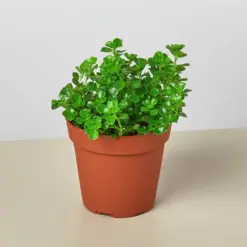
Nettle ‘Baby’s Tear’
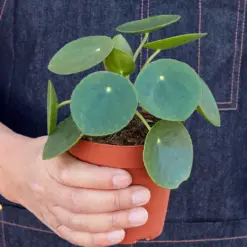
Price range: $22.99 through $39.99Chinese Money Plant (Pilea Peperomioides)
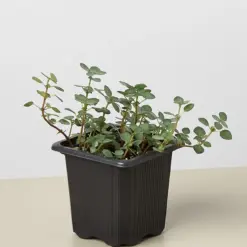
Price range: $22.99 through $56.99Nettle Plant ‘Silver Sparkle’
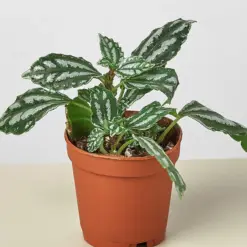
Price range: $22.99 through $39.99Pilea Plant ‘Aluminum’
Price range: $22.99 through $39.99Pilea Plant ‘Moon Valley’
$23.99
Frequently Asked Questions
Are Pilea plants safe for cats and dogs?
Yes. Pilea peperomioides and most other Pilea species are non-toxic to cats and dogs per ASPCA listings. They’re a great pick if you have pets that chew on plants. (For more confirmed pet-safe houseplants, see Calathea, Spider plant, and Peperomia.)
Why is my Pilea drooping?
Almost always one of two things: (1) thirsty, where you check the soil and if dry to your finger’s first knuckle, water thoroughly and the leaves perk up within hours; (2) overwatered, where the soil is soggy, roots are rotting, and the plant can’t absorb water. If soggy, let dry out completely before watering again. Drooping leaves are Pilea’s main communication tool.
Why does my Pilea lean to one side?
Pilea is strongly phototropic, meaning it bends hard toward the light source. Rotate the pot a quarter-turn every week to keep growth even. If you forget for a month, the plant will lean dramatically and corrective rotation takes 2–4 weeks.
How do I get my Pilea to make pups?
Bright indirect light, regular watering, and time. Healthy Pileas in good light naturally produce pups from the soil and along the stem starting around 6–12 months old. If your plant isn’t pupping, the most likely cause is insufficient light, so move it closer to a window. Light feeding during growing season also helps.
Why are the lower leaves on my Pilea yellowing and dropping?
Two normal, two not. Normal: the oldest leaves at the base of the stem yellow and drop as the plant matures and grows taller, which is fine. Not normal: if many leaves are yellowing fast, suspect (1) overwatering with soggy soil and mushy stems, or (2) cold draft, with leaves dropping after a sudden temperature change near a window or vent.
Can I propagate Pilea in water?
Yes. Stem cuttings root easily in water in 2–4 weeks. Cut a 4–5 inch piece with at least 2–3 leaves, strip the lower leaves, and submerge the bare nodes. Pups (root-attached baby plants) don’t need water rooting since they already have roots, so pot them directly. Single leaf cuttings can work but are slower (4–8 weeks) and have a lower success rate.
Why does my Pilea have curling leaves?
Three culprits: (1) cold draft, since Pilea hates sudden temperature swings (check for AC/heat vents); (2) recent move, where you give it 1–2 weeks to acclimate to a new spot; (3) low humidity in winter, which you fix with a pebble tray or small humidifier. The curl is reversible once you fix the cause; new leaves emerge flat.
Related Care Guides
- Peperomia Care Guide (the species name peperomioides means ‘looks like Peperomia’ and they share the same easygoing care)
- Calathea Care Guide
- Spider Plant Care Guide
- Propagation Guide
