
Plant Care
Ficus Care Guide: Fiddle Leaf Fig, Rubber Tree, Bonsai & Why Yours Drops Leaves
Ficus is the genus everyone loves to hate. Fiddle leaf figs (F. lyrata) became Instagram-famous and equally infamous for dropping leaves the moment you breathe wrong on them. But ficus drama is largely a myth, because they’re not fragile, they’re just opinionated. They have one consistent rule: don’t move them. Once you understand that, ficus care becomes simple. Here’s the honest guide for fiddle leafs, rubber trees, weeping figs, and the dozen other species you’ll find in cultivation.
Quick Care Card
☀️ Light
Bright indirect to direct (a few hours)
💧 Water
Top inch dry
💨 Humidity
40%+
🌡️ Temp
65–80°F
🪴 Soil
Well-draining indoor mix
🐾 Cat/Dog Safe
☠️ Toxic to cats & dogs
🎯 Difficulty
🟡 Intermediate
📏 Size
3–10 ft indoor
🌎 Zone
10–12 outdoors
🏞️ Origin
Tropical Asia / Africa / Pacific
In this guide
About Ficus
Ficus is a genus of about 850 species in the mulberry family (Moraceae), with most native to tropical Asia, Africa, and the Pacific. They range from small bonsai-friendly types (F. microcarpa) to massive banyan trees that can spread over an acre in nature. The houseplants you’ll see most often are F. lyrata (fiddle leaf fig), F. elastica (rubber tree), F. benjamina (weeping fig), F. microcarpa (ginseng bonsai), and F. audrey (Audrey ficus, the “easier fiddle leaf”).
What unifies the genus: they’re all tropical trees, not understory plants. They want substantially more light than most houseplants. They’re sensitive to environmental change (the source of their reputation). And they all produce a milky white sap when cut that is toxic to cats, dogs, and humans, and a known skin/respiratory irritant.
The famous ficus drama is actually physiological stress response: when conditions change (new home, season change, repotting), ficus species drop a percentage of their leaves to reduce metabolic load while they adapt. This is normal, recoverable, and largely preventable by minimizing changes. A ficus that hasn’t moved in 6 months almost never drops leaves.
Care Guide
Light
More light than you think. Most ficus species are sun-tolerant outdoor trees in their native range.
- Bright indirect light is the minimum. Place near a south, east, or west-facing window.
- A few hours of direct morning sun (east) or filtered afternoon sun (west) accelerates growth.
- Insufficient light shows as leggy stems, smaller new leaves, and dropped lower leaves over months. Move to brighter and the plant rebuilds.
- Variegated cultivars (rubber tree ‘Tineke’, fiddle leaf variegata) need brighter light to maintain patterns.
- If you can’t provide 6+ hours of bright indirect daily, supplement with a grow light at 12–14 hours/day.
Water
Consistent watering matters more than frequency. Pick a schedule and stick to it.
- Wait until the top 1–2 inches of soil are dry. Stick a finger in to confirm.
- Water thoroughly until water runs from the drainage holes. Empty the saucer within 15 minutes.
- Most plants need watering every 7–10 days in summer, every 14–21 days in winter.
- Use room-temperature water. Ficus aren’t fussy about water quality, so tap water is generally fine.
- Yellowing lower leaves with brown spots = overwatering or root rot. Curling, dropping leaves with dry edges = underwatering.
- Key principle: consistency beats perfection. A ficus watered slightly wrong but consistently does better than one watered correctly with random timing.
Humidity
Ficus tolerate average household humidity better than most tropical plants.
- 40% humidity is fine for all common species.
- 60%+ produces glossier, larger leaves but isn’t required for survival.
- Skip frequent misting, because it does little for ambient humidity and can encourage fungal leaf spots, especially on fiddle leaf figs.
Temperature
Stable warmth. Avoid drafts and temperature swings.
- 65–80°F (18–27°C) is ideal.
- Below 55°F slows growth and can cause leaf drop. Below 40°F kills the plant.
- Avoid AC vents in summer, exterior doors in winter, and single-pane windows where leaves touch cold glass.
- Sudden temperature swings (moving from a warm store to a cold car to a warm home in winter) trigger leaf drop within days.
Soil
Well-draining indoor potting mix. No specialty mix needed.
- Best: commercial indoor / tropical potting mix with added perlite (20–30%) for drainage.
- DIY: 70% potting mix + 25% perlite + 5% compost or worm castings.
- Avoid: dense outdoor garden soil, peat-only mixes that compact, terra cotta beds without amendments.
- Pot choice: just slightly larger than the root ball. Ficus prefer slightly snug roots, since overpotting leads to overwatering and root rot.
- Repot every 2–3 years or when roots are clearly emerging from drainage holes.
Pro tip: find the spot, then DO NOT MOVE THE PLANT
Ficus drama is almost entirely caused by environmental change. They drop leaves when moved to a new spot, when seasons change, when temperature swings, when you repot, when you decide the plant looks better on the other side of the room. Find a spot with bright indirect light + consistent temperature + no drafts, place the ficus there, and DO NOT move IT. Even a few feet matters. After 4–8 weeks of stability, the plant adapts and will tolerate more disruption. The single most effective “fix” for fiddle leaf fig drama is patience and a fixed location.
Fertilizer
Heavy feeders during growing season, since they’re trees that want to grow large.
- Balanced liquid fertilizer (e.g., 20-20-20) at half strength every 2–4 weeks April–September.
- Or use a slow-release granular fertilizer at the start of the growing season (one application lasts 3–4 months).
- Stop fertilizing October–March entirely.
- Brown leaf edges or tips after fertilizing = salt buildup. Flush soil with plain water until it runs clear.
Seasonal Care
🌱 Spring & Summer
- New leaves every 2–4 weeks on healthy plants
- Water every 7–10 days
- Fertilize bi-weekly to monthly
- Best time to repot, prune, or take stem cuttings
- Watch for spider mites, scale, and mealybugs
❄️ Fall & Winter
- Reduce watering by 30–50%
- Stop fertilizing entirely
- Some leaf drop is normal in winter, so don’t panic
- Move further from cold windows; ambient cold drops leaves overnight
- Don’t repot or move plant until spring
Common Problems & Fixes
| Symptom | Likely Cause | Fix |
|---|---|---|
| Multiple leaves dropping after a move | Stress / acclimation | Don’t move the plant again; wait 4–8 weeks for the plant to adjust; new leaves will replace dropped ones |
| Brown spots on fiddle leaf fig leaves | Bacterial leaf spot from overwatering | Reduce watering; remove affected leaves; spray remaining with diluted hydrogen peroxide |
| Yellow lower leaves dropping | Overwatering or natural shedding | Check soil moisture; reduce frequency if soggy; some lower leaf drop is normal as plant grows |
| Leaves dropping with dry brown edges | Underwatering | Water more consistently; soak entire pot if soil pulled away from the edges |
| Pale leggy growth, small new leaves | Insufficient light | Move to brighter indirect light or add a grow light |
| White cottony spots on stems / under leaves | Mealybugs | Wipe with isopropyl alcohol; insecticidal soap weekly until clear |
| Brown bumps on stems / leaf undersides | Scale insects | Scrape off with fingernail; spray with insecticidal soap weekly until clear |
| Tiny webs under leaves | Spider mites | Increase humidity; spray with neem oil; isolate from other plants |
| Sticky residue on lower leaves | Mealybugs or scale (their honeydew) | Inspect carefully for pests; treat as above |
| Leaves curling inward | Underwatering or low humidity | Water if soil is dry; increase humidity if needed |
Ficus aren’t fragile; they’re consistent. They don’t tolerate change well, but once they’re settled, they’re some of the most rewarding houseplants you can grow.
Propagation
Stem cuttings (most species)
Take cuttings in spring or early summer when the plant is actively growing.
Identify a stem with at least 2–3 leaves and a node. Sterilize a sharp blade with isopropyl alcohol.
Cut just below a node, leaving 4–6 inches of stem with leaves above.
Dip the cut end in fresh water for 30 seconds to wash away the milky sap (it can clog the cut and prevent rooting).
(Optional) Dip in rooting hormone, which significantly speeds rooting.
Place the bare nodes in a glass of water OR damp sphagnum moss OR damp perlite.
Set in bright indirect light at 70°F+. Change water weekly.
Roots emerge in 4–8 weeks (slower than philodendron). Be patient.
When roots are 2+ inches long, transplant to a small pot of well-draining mix.
Air layering (best for thick-stemmed species like rubber tree, fiddle leaf)
- Pick a healthy stem and select a node 12–18 inches below the growing tip.
- Use a sterilized knife to make a small angled cut into the stem (don’t cut through completely).
- Wedge a toothpick or matchstick into the cut to keep it open.
- Wrap the wound with damp sphagnum moss.
- Cover the moss with plastic wrap, secured top and bottom with twist ties, and leave the bottom slightly loose for airflow.
- Spritz the moss every 5–7 days to keep it damp.
- Roots fill the moss pouch in 6–10 weeks for ficus.
- Cut the stem just below the new root mass and pot up. Air layering preserves the visual appeal of large mature plants, with much higher success than stem cuttings on thick-trunked species.
Featured Ficus Species
| Species | Common Name | Notable Trait | Difficulty |
|---|---|---|---|
| F. lyrata | Fiddle Leaf Fig | Large violin-shaped leaves; Instagram-famous | 🟡 Intermediate |
| F. elastica | Rubber Tree | Glossy oval leaves in green or burgundy; very forgiving | 🟢 Beginner |
| F. elastica ‘Tineke’ | Variegated Rubber Tree | Cream-and-green leaves with pink undertones | 🟢 Beginner |
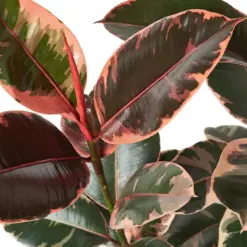
| F. elastica ‘Ruby’ | Ruby Rubber Tree | Hot pink, cream, and green variegation | 🟡 Intermediate |
| F. benjamina | Weeping Fig | Small glossy leaves on a slender trunk; the original Instagram-era ficus | 🟡 Intermediate |
| F. microcarpa | Ginseng Ficus / Indoor Bonsai | Thick swollen trunk; ideal for bonsai training | 🟡 Intermediate |
| F. benghalensis ‘Audrey’ | Audrey Ficus | Velvety olive leaves; sometimes called the ‘easier fiddle leaf’ | 🟢 Beginner |
| F. triangularis ‘Variegata’ | Variegated Triangle Ficus | Triangular leaves with cream margins; rarer find | 🟡 Intermediate |
| F. petiolaris | Rock Fig | Caudex-forming desert ficus with red veining | 🟡 Intermediate |
Shop Our Ficus Collection
Every Ficus we ship is greenhouse-grown, climate-acclimated, and packed with care for transit. Sold-out species? Use the Notify Me button on any product page and we’ll email you the moment it’s restocked.

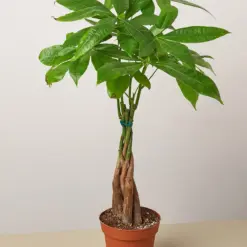
Money Tree ‘Guiana Chestnut’ Pachira Braid – Pachira Braid
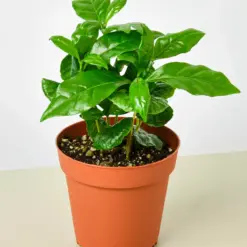
Price range: $31.99 through $158.99Arabica Coffee Plant (Coffea Arabica)
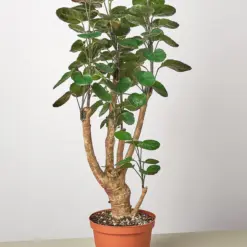
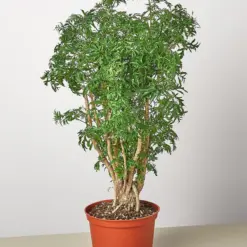
Price range: $22.99 through $39.99Aralia Fabian Stump ‘Polyscias Scutellaria’
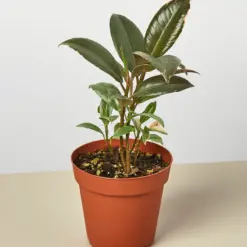
Price range: $31.99 through $56.99Ficus Elastica ‘Ruby Pink’
Price range: $29.99 through $158.99Aralia Plant ‘Ming Stump Plant’
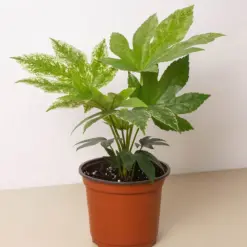
Price range: $38.99 through $68.99Fatsia ‘Spider’s Web’
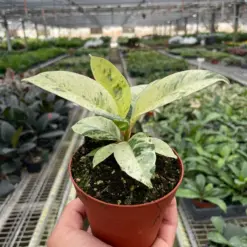
$56.99Ficus ‘Shivereana’ (Moonshine)
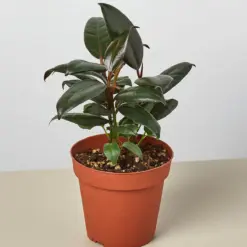
Price range: $23.99 through $70.99Ficus Elastica ‘Burgundy’
Price range: $28.99 through $164.99Ficus Elastica ‘Tineke’
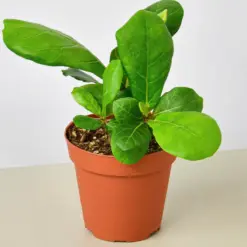
Price range: $22.99 through $164.99Ficus Lyrata ‘Fiddle Leaf Fig’
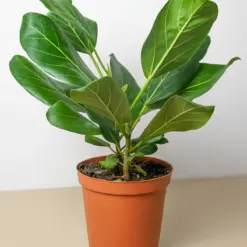
Price range: $23.99 through $121.99Ficus Plant ‘Audrey’
Price range: $26.99 through $50.99

Frequently Asked Questions
Are ficus toxic to cats and dogs?
Yes. All ficus species produce a milky white sap that contains ficin (a proteolytic enzyme) and other irritants, which are toxic to cats, dogs, and humans. Causes oral irritation, vomiting, and skin irritation if chewed or contacted. Keep all ficus species out of reach of pets and small children.
Why is my fiddle leaf fig dropping leaves?
Almost always environmental stress. The plant was recently moved (delivery, repotting, room change) or experienced a temperature/humidity swing. Find a stable spot with bright indirect light + no drafts + consistent temperature, place the plant there, and DO NOT move IT for 4–8 weeks. Leaf drop should slow within 2 weeks of stable conditions and stop within 4 weeks. New leaf growth confirms recovery.
What are the brown spots on my fiddle leaf fig leaves?
Most often bacterial leaf spot from overwatering, which causes small dark brown spots that spread over time. Reduce watering frequency, ensure good drainage, remove the worst-affected leaves, and spray remaining leaves with diluted hydrogen peroxide (1 part 3% peroxide to 4 parts water) once a week. Sun damage causes pale bleached patches (different); root damage causes browning at leaf edges (different again).
How do I make my ficus branch?
Prune the top. Ficus species rarely branch on their own, since they grow upward as a single stem. To create a bushier shape, prune the top 2–4 inches of the main stem in spring. Within a few weeks, two or more new branches emerge from below the cut. Repeat the process on each new branch for a denser canopy.
Why is my rubber tree leaning?
Insufficient light. Rubber trees grown without enough light develop weaker stems and lean toward whatever light source they have. Move to brighter indirect light. Stake the trunk if needed for support, and rotate the plant 90° every few weeks to encourage even growth.
Can I prune my ficus?
Yes, since ficus respond well to pruning. Best done in spring or early summer when the plant is actively growing. Sterilize your shears, cut just above a leaf node, and the plant will branch from below the cut within a few weeks. Save the cuttings for propagation. Wear gloves, because the milky sap is a skin irritant.
How often should I water my fiddle leaf fig?
When the top 1–2 inches of soil are dry. For most fiddle leafs that’s roughly every 7–10 days in summer and 14–21 days in winter. The exact frequency depends on pot size, light, and humidity, so always feel the soil rather than relying on a schedule. Consistency matters more than frequency: pick a routine and stick with it.
Related Care Guides
- Fiddle Leaf Fig Care Guide (the deep-dive on F. lyrata specifically)
- Bonsai Care Guide
- Dracaena Care Guide
- Light Requirements
- Plant Troubleshooting Guide
