
Plant Care
Bonsai Care Guide: Light, Water & Why Most Indoor Bonsai Are Outdoor Trees
Bonsai isn’t a species — it’s an art form: growing miniaturized trees through pruning, root reduction, and careful shaping. The houseplant trade sells "indoor bonsai" that are usually not actually indoor plants: juniper, pine, maple, and elm bonsai are temperate trees that need to live outside year-round. The only common bonsai that genuinely thrives indoors is ficus (Ficus retusa, F. microcarpa, F. ginseng). Here’s how to keep ficus bonsai alive — and what to do with the others.
Quick Care Card
☀️ Light
Bright direct or very bright indirect (6+ hours)
💧 Water
Top of soil dry; never bone-dry
💨 Humidity
40–60% (higher = better)
🌡️ Temp
65–80°F indoors (varies by species)
🪴 Soil
Specialized bonsai mix (akadama / lava / pumice)
🐾 Cat/Dog Safe
❌ Most species toxic — verify your specific tree
🎯 Difficulty
🔴 Advanced (most species need outdoor life)
📏 Size
4–24 inches tall (intentionally limited)
🌎 Zone
Varies by species
🏞️ Origin
Bonsai art originated in China & Japan
In this guide
About Bonsai
Bonsai is a Japanese term (盆栽, "tray planting") for the art of growing miniature trees in shallow containers — the practice originated in China (penjing) over 1,000 years ago and was refined in Japan. The trees are not genetically dwarf; they’re standard species kept small through pruning, root pruning, and careful shaping over years or decades.
The houseplant trade sells "bonsai" in two confusing categories: truly indoor bonsai (mostly ficus species — F. retusa, F. microcarpa, F. ginseng — which are tropical and tolerate indoor conditions) and outdoor bonsai sold as houseplants (juniper, pine, Japanese maple, Chinese elm, etc.) which are temperate trees and will die indoors within months.
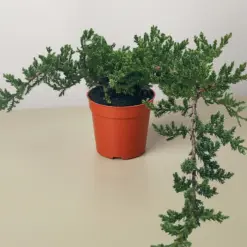
If you’ve been gifted a juniper bonsai or bought one at a mall: it needs to live outside. Junipers are temperate evergreens that require cold winter dormancy and intense direct sun — neither of which a heated indoor home provides. The plant will limp along for 6–12 months, then die. The only fix is permanent outdoor life on a porch, balcony, or in the garden, with appropriate seasonal care.
Care Guide
Light
Bonsai need more light than typical houseplants. Direct sun for indoor ficus; full outdoor sun for outdoor species.
- Indoor ficus bonsai: 6+ hours of bright direct or very bright indirect light. South or west-facing window with no obstructions.
- Outdoor bonsai (juniper, pine, maple, elm): outdoor full sun to partial shade depending on species. They will not survive indoors.
- Grow lights help indoor ficus bonsai dramatically — full-spectrum LED at 6–12 inches above the tree for 12 hours daily.
- Outdoor summer break (porch or balcony) helps indoor ficus bonsai gain strength — gradually acclimate over 1–2 weeks.
- Insufficient light is the #1 killer of indoor bonsai — ficus included. They lose leaves and weaken without enough light.
Water
Bonsai dry out fast in shallow pots. Check soil daily during growing season.
- Water when the top 1/2 inch of soil is dry. Bonsai pots are shallow with fast-draining soil — they dry out faster than typical houseplants.
- Water thoroughly until water runs from drainage holes. Soaking the entire pot in a tray of water for 5–10 minutes ensures even hydration.
- Most indoor ficus bonsai need water every 2–4 days in summer, every 5–7 days in winter.
- Outdoor bonsai may need watering daily in hot weather and less frequently in cool weather.
- Critical: never let bonsai go bone-dry — dehydrated bonsai often shed all leaves and may not recover. Equally, avoid soggy soil — bonsai soil should drain freely.
- Use room-temperature filtered or rainwater if you can; bonsai are slightly more sensitive than typical houseplants to heavily-treated tap water.
Humidity
Higher is better — especially indoors.
- Ideal: 50–60% humidity for indoor ficus bonsai.
- Tolerable: 40%. Below this, leaves crisp and the tree weakens.
- Pebble trays under bonsai pots (literally what bonsai growers call "humidity trays") are standard practice — they raise local humidity and catch water drainage.
- A small humidifier nearby is the most effective fix for very dry homes.
- Misting helps temporarily but doesn’t replace ambient humidity.
Temperature
Indoor ficus bonsai want stable warm temps. Outdoor bonsai need their natural seasonal cycle.
- Indoor ficus bonsai: 65–80°F (18–27°C). Avoid drafts and sudden changes.
- Below 55°F damages tropical ficus bonsai.
- Outdoor bonsai (juniper, pine, maple): need their natural seasonal cycle — cold winter dormancy, warm summer growing season. Will not survive indoors.
- Avoid AC vents and heating vents — sudden drops or hot air cause leaf drop on indoor ficus.
Soil
Specialized bonsai mix — never standard potting soil.
- Best: commercial bonsai soil mix — typically akadama (Japanese clay), lava rock, and pumice. Provides perfect drainage and air circulation.
- DIY: 50% akadama + 25% lava rock + 25% pumice for tropical bonsai (ficus); add some bark for organic matter.
- Avoid: standard potting soil (compacts and suffocates roots), peat-heavy mixes, anything that stays wet for more than 2–3 days.
- Bonsai pots are intentionally shallow — they restrict root growth, which keeps the tree miniaturized. Don’t replace with deeper pots.
- Repot every 2–3 years for ficus bonsai (more frequently for outdoor species during their dormant season).
Pro tip — verify your bonsai species before deciding indoor vs. outdoor
If you don’t know what species your bonsai is, look at the leaves and ask: are they small glossy oval leaves with milky sap when scratched? That’s ficus — keep indoors. Are they tiny needles or scaled foliage? That’s juniper, pine, or cypress — needs to live outdoors. Are they small toothed deciduous leaves that shed in fall? That’s elm, maple, or zelkova — also outdoors. Are they tiny oval leaves on a thick swollen trunk? That’s likely Chinese elm or jade (jade is a succulent that can go either way). Verify the species before assuming you can keep it indoors.
Fertilizer
Light feeders. Bonsai need more frequent feeding than typical houseplants because of restricted soil volume.
- Balanced liquid fertilizer at half strength every 2 weeks during growing season (spring through early fall).
- Or use slow-release bonsai fertilizer pellets per package directions.
- Skip fertilizing during dormancy (winter for outdoor bonsai; less critical for indoor ficus).
- Bonsai-specific fertilizers are formulated to promote slow controlled growth — useful for keeping the tree small.
- Brown leaf tips after fertilizing = salt buildup. Flush soil thoroughly with plain water; reduce fertilizer.
Seasonal Care
🌱 Spring & Summer
- Indoor ficus bonsai: continuous slow growth year-round in good conditions
- Outdoor bonsai: spring leaf flush, summer growth, fall leaf change (deciduous)
- Water more frequently — daily in hot weather for outdoor types
- Best time to do major pruning, wiring, and repotting (late winter/early spring for most species)
- Light pinching of growing tips throughout summer keeps tree compact
❄️ Fall & Winter
- Outdoor bonsai: leaves drop (deciduous) or grow slowly (evergreen); needs cold dormancy
- Indoor ficus bonsai: continues growing slowly; minimal seasonal change
- Reduce watering for indoor ficus to every 5–7 days
- No fertilizer during dormancy
- Don’t repot outdoor bonsai during winter
Common Problems & Fixes
| Symptom | Likely Cause | Fix |
|---|---|---|
| Massive leaf drop indoors | Wrong species — likely outdoor bonsai (juniper, pine, etc.) trying to survive indoors | Move outdoors immediately if a temperate species; indoor recovery is unlikely |
| Yellowing leaves on ficus bonsai | Overwatering, low light, or drafts | Check soil drainage; move to brighter spot; stabilize location |
| Crispy brown leaf edges | Low humidity or salt buildup | Raise humidity to 50%+ with pebble tray and humidifier; flush soil with plain water |
| Sticky white sap from cuts (ficus) | Normal — ficus produces latex sap when cut | Wipe away with damp cloth; latex can be irritating to sensitive skin |
| Tree losing its shape over time | Lack of regular pruning | Pinch new growth back to 2–3 leaves per shoot during growing season; prune main branches in late winter |
| Wire scarring the bark | Wire left on too long during shaping | Remove wire as soon as branches set in desired position (4–8 weeks for most species); never leave wire on for more than one growing season |
| Tiny webs on leaves | Spider mites (low humidity) | Rinse under shower; raise humidity; insecticidal soap or neem oil weekly until clear |
| Ants and sticky leaves | Aphids or scale insects | Spray with insecticidal soap; treat ant trail to disrupt their farming the pests |
| Roots emerging from drainage holes | Time to repot — root mass has filled the pot | Root-prune and repot in late winter/early spring with fresh bonsai mix |
If your bonsai is a juniper, pine, or maple: it doesn’t belong indoors. Move it outside permanently. Indoor heating and dim windows kill those species within a year — there’s no exception.
Propagation
Cuttings (most species — fastest method)
In late spring or early summer, take 4–6 inch semi-hardwood cuttings from healthy tips.
Cuttings should have 4–6 leaves; remove the lowest pair.
Dip cut end in rooting hormone.
Insert into damp bonsai soil mix or 50/50 perlite-peat. Keep evenly moist.
Cover loosely with a clear bag for humidity. Place in bright indirect light.
Roots form in 4–8 weeks for ficus; 6–12 weeks for outdoor species.
Once well-rooted, transition to a small bonsai training pot.
Bonsai shape and styling typically takes 5+ years from cutting to mature appearance.
Air layering (excellent for thicker bonsai material)
- On a thick stem of an established tree, ring-bark a 1/2 inch section (cut through the bark down to the cambium, all the way around).
- Apply rooting hormone to the upper edge of the cut.
- Wrap the cut area with damp sphagnum moss; cover tightly with plastic and secure top and bottom.
- Roots form into the moss in 8–16 weeks.
- Once visible roots fill the moss, cut below the rooted section and pot up as a new bonsai.
- This method produces an instant trunk thickness that would take years from a cutting.
Seeds (slowest — multi-year project for true bonsai)
- Many bonsai species can be grown from seed — collected from outdoor trees or purchased.
- Most temperate species need cold stratification (4–8 weeks in the refrigerator) before sowing.
- Sow in seedling mix; keep evenly moist; bright indirect light.
- Tiny seedlings emerge in weeks to months depending on species.
- Bonsai shape and styling takes 5–15+ years from seed to mature appearance.
- Most bonsai growers buy young trees rather than seed-starting.
Featured Bonsai Species
| Species | Common Name | Notable Trait | Difficulty |
|---|---|---|---|
| Ficus retusa / F. microcarpa | Ginseng Ficus / Banyan Bonsai | Tropical fig with thick swollen trunk; the most common true indoor bonsai | 🟢 Beginner (for bonsai) |
| Juniperus procumbens | Juniper Bonsai | Sold as "indoor bonsai" — but actually outdoor only; needs cold winter and full sun | 🔴 Outdoor only |
| Ulmus parvifolia | Chinese Elm Bonsai | Semi-deciduous; can survive indoors briefly but prefers outdoor life | 🟡 Intermediate |
| Pinus thunbergii | Japanese Black Pine Bonsai | Evergreen needles; classic outdoor bonsai; needs cold dormancy | 🔴 Outdoor only |
| Acer palmatum | Japanese Maple Bonsai | Deciduous with brilliant fall color; outdoor only | 🔴 Outdoor only |
| Crassula ovata | Jade Bonsai | Succulent with thick fleshy leaves; tolerates indoor conditions | 🟢 Beginner |
| Carmona retusa | Fukien Tea Bonsai | Small white flowers; tropical and indoor-suitable | 🟡 Intermediate |
| Sageretia theezans | Sageretia / Sweet Plum Bonsai | Tropical with peeling bark; indoor-suitable | 🟡 Intermediate |
Shop Our Bonsai Collection
Every Bonsai we ship is greenhouse-grown, climate-acclimated, and packed with care for transit. Sold-out species? Use the Notify Me button on any product page — we’ll email you the moment it’s restocked.
Frequently Asked Questions
Are bonsai trees safe for cats and dogs?
It depends on the species. Toxic to pets: juniper, ficus, jade, sago palm, azalea — most common bonsai species. Safe options: Chinese elm, fukien tea, sageretia. Always verify the botanical name of your specific tree before assuming it’s safe. Sago palm bonsai is particularly dangerous — the seeds and leaves can be fatal to pets and humans.
Why is my juniper bonsai dying inside my house?
Junipers are not indoor plants. They’re temperate evergreen trees that require cold winter dormancy (4 months below 50°F) and intense direct sun (6+ hours daily) to survive. Indoor heating and dim windows kill them within 6–12 months — no amount of careful watering or grow lights can compensate. The fix: move it outside permanently, even in winter. Junipers are cold-hardy and survive freezing temperatures fine; they don’t survive heated indoor air.
What’s the best bonsai for beginners indoors?
Ficus retusa (Ginseng Ficus) — the only widely-sold bonsai that genuinely thrives indoors. Tropical fig with a thick swollen trunk and small glossy leaves. Tolerates moderate light, handles occasional missed waterings, and recovers from beginner mistakes. Avoid juniper, pine, maple, or elm bonsai if you intend to keep it indoors — those need outdoor life. Jade bonsai is a second decent indoor option for sunny windows.
How often should I water my bonsai?
Bonsai dry out faster than typical houseplants because of shallow pots and fast-draining soil. Indoor ficus bonsai usually need watering every 2–4 days in summer and every 5–7 days in winter. Check the soil daily — water when the top half-inch is dry. Outdoor bonsai may need water daily in hot weather. Best technique: soak the entire pot in a tray of water for 5–10 minutes for thorough hydration.
How do I prune my bonsai?
Two types: (1) maintenance pinching — through the growing season, pinch back new growth to 2–3 leaves per shoot; this keeps the tree compact and encourages branching. (2) structural pruning — in late winter or early spring before growth resumes, cut larger branches to refine the tree’s shape. Use sharp bonsai-specific pruners; cut at branch junctions, not mid-branch. Major pruning should be no more than 25% of the tree per year.
Why are my bonsai’s leaves turning yellow?
Three usual causes for indoor ficus bonsai: (1) overwatering — bonsai soil should drain freely; check that water runs through within seconds, not minutes; (2) insufficient light — bonsai need bright direct or very bright indirect light, more than typical houseplants; (3) cold draft — ficus drops leaves at temperatures below 55°F or near AC vents. Stabilize watering, move to brighter light, eliminate drafts.
Can bonsai trees live forever?
Some can — there are documented bonsai over 800 years old, passed down through generations of caretakers. The art form genuinely produces multi-century plants when properly maintained. Indoor ficus bonsai can live 50+ years; outdoor pine and juniper bonsai can live for centuries. The constraints are care continuity (one missed week of watering can kill a tree) and seasonal needs (outdoor species cannot survive long indoors).
Related Care Guides
