
Plant Care
Peace Lily Care Guide: Light, Water & The Plant That Tells You When It’s Thirsty
Peace Lily (Spathiphyllum) is the houseplant that puts on the most reliable drama show: when thirsty, the entire plant droops dramatically; water it, and within 2–4 hours it perks back up to perfect health. Beyond the watering signal, it’s one of the most low-maintenance flowering houseplants you can grow, since it tolerates medium-to-low light, recovers from missed waterings, and produces elegant white "flowers" (technically spathes, which are a modified leaf) on tall stems multiple times per year.
Quick Care Card
☀️ Light
Medium to bright indirect (low tolerated)
💧 Water
Keep evenly moist; wait for the droop
💨 Humidity
40–60% (higher = better)
🌡️ Temp
65–80°F
🪴 Soil
Rich, well-draining mix
🐾 Cat/Dog Safe
❌ Toxic to cats & dogs
🎯 Difficulty
🟢 Beginner
📏 Size
12–36 inches tall
🌎 Zone
11–12 outdoors
🏞️ Origin
Tropical Americas & Southeast Asia
In this guide
About Peace Lily
Spathiphyllum is a genus of about 40 species native to tropical rainforests of Central and South America, with a few species in Southeast Asia. The name combines Greek words for "spathe" (the white flower bract) and "leaf" (phyllon). The common name "peace lily" comes from the white spathe resembling a white flag of peace.
What looks like the flower is actually a spathe, a modified leaf that surrounds the true flower, which is the small spike (spadix) in the center. The same flower structure appears in aroid relatives like anthurium, philodendron, monstera, and pothos, all of which are members of the same plant family (Araceae). Peace lily is the most reliably-flowering aroid for indoor growing.
Peace Lily entered the houseplant trade in the 1820s and gained popularity in the 1980s after NASA’s 1989 Clean Air Study listed it as one of the better houseplants for filtering household air pollutants (formaldehyde, benzene, trichloroethylene). The practical air-quality impact at indoor scales is debated, but peace lily’s reputation as a forgiving, dramatic, flowering indoor plant is well-earned.
Care Guide
Light
Medium to bright indirect light. Direct sun bleaches the leaves; very low light prevents flowering.
- Best: medium to bright indirect light within 4–8 feet of an east or north window, or behind sheer curtains on a south/west window.
- Direct afternoon sun bleaches and crisps the leaves within days.
- Low light is tolerated, since peace lily survives in dim corners and offices. But it won’t bloom in low light.
- To trigger flowering: medium to bright indirect light is the minimum. Most non-blooming peace lilies just need more light.
- Rotate the pot a quarter-turn weekly so the plant grows evenly.
Water
Keep evenly moist. The classic peace lily droop tells you exactly when to water.
- Water when the top inch of soil is dry, OR when the plant droops dramatically (whichever comes first).
- Water thoroughly until water runs from the drainage holes; empty the saucer after 10 minutes.
- Most plants need water every 5–7 days in summer, every 7–10 days in winter.
- The classic droop: peace lily collapses dramatically when thirsty. Water immediately and it perks up within 2–4 hours. The drop isn’t damage; it’s stress signaling. Try not to let it droop more than occasionally, because repeated severe wilting weakens the plant.
- Yellow leaves with mushy stems = overwatering. Brown crispy edges = tap water sensitivity, low humidity, or salt buildup.
- Use room-temperature water. Switch to filtered if you see leaf-tip browning, since peace lilies are mildly sensitive to fluoride and chlorine.
Humidity
Higher is better. Peace lily tolerates average humidity but loves more.
- Ideal: 50–60% humidity. Encourages flowering and lusher foliage.
- Tolerable: 40–50% (typical home humidity). Plant survives but flowers less.
- Below 30% (winter heating) leaves may go crispy at the edges.
- Pebble trays or a small humidifier help in dry winter rooms.
- Bathrooms with a window are great peace lily spots, since they’re bright and humid.
- Skip aggressive misting, because water sitting on leaves can encourage fungal issues.
Temperature
Standard household temperatures.
- Ideal: 65–80°F (18–27°C). Tolerates 60–85°F.
- Below 55°F damages leaves and stops flowering.
- Below 50°F is potentially fatal.
- Avoid AC vents in summer and cold windows in winter, because sudden drops cause leaf damage.
Soil
Rich, well-draining mix.
- Easy mix: 60% standard houseplant potting soil + 30% perlite + 10% orchid bark.
- Better: 50% potting soil + 30% perlite + 10% peat moss + 10% orchid bark, which adds slight acidity and texture.
- Avoid: dense potting soil that compacts, anything cactus-mix-based (too dry), pots without drainage.
- Use a deeper pot for larger specimens.
- Repot every 1–2 years in spring when roots fill the pot. Peace lily blooms more often when slightly pot-bound, so don’t repot too aggressively.
Pro tip: your peace lily wants you to wait for the droop
The single best way to water a peace lily is to wait until it droops, then water immediately. The plant tells you exactly when it’s thirsty, with no calendar required. Within 2–4 hours of watering, it perks back up to perfect health. This "reactive watering" is more reliable than checking soil moisture because the plant integrates light, humidity, and temperature into one clear signal. Don’t let it droop severely or frequently (that weakens it over time), but a slight droop is the most accurate watering cue you’ll ever get from a houseplant.
Fertilizer
Light feeders.
- Balanced liquid fertilizer at half strength every 4–6 weeks April–September.
- Skip fertilizing October–March entirely.
- Brown leaf tips after fertilizing = salt buildup. Flush soil with plain water; reduce fertilizer.
- Bloom boosters (high phosphorus) can be used briefly to encourage flowering on mature plants in adequate light.
Seasonal Care
🌱 Spring & Summer
- New leaves emerge from the crown every 2–4 weeks on healthy plants
- Mature plants produce white spathes (flowers) multiple times per year, usually spring and fall
- Spathes last 4–6 weeks, then brown and can be cut at the base
- Water every 5–7 days (or when droopy)
- Best time to repot, divide, or take cuttings
❄️ Fall & Winter
- Reduce watering to every 7–10 days
- Stop fertilizing entirely
- Move from cold drafts; below 55°F damages leaves
- Don’t repot until spring
- Flower production pauses but resumes in spring
Common Problems & Fixes
| Symptom | Likely Cause | Fix |
|---|---|---|
| Plant completely drooping | Thirsty (the famous peace lily droop is the most common cause) | Water thoroughly; plant perks up within 2–4 hours |
| Brown crispy leaf tips | Tap water fluoride/chlorine sensitivity, low humidity, or salt buildup | Switch to filtered water; raise humidity; flush soil if recently fertilized |
| Yellow leaves | Overwatering or natural shedding of oldest leaves | Reduce watering frequency; check for root rot if multiple leaves yellow rapidly |
| No flowering despite mature plant | Insufficient light or too much fertilizer (especially high-nitrogen) | Move to brighter indirect light; switch to bloom-boost fertilizer briefly |
| Green spathes (instead of white) | Too much fertilizer or normal aging of older spathes | Reduce fertilizer; spathes naturally turn green and then brown as they age, which is normal |
| Bleached patches on leaves | Direct sun scorch | Move from direct sun; affected leaves don’t recover |
| Black spots on leaves | Bacterial leaf spot (rare) or fertilizer burn | Improve air circulation; reduce fertilizer; remove affected leaves |
| Stems rotting at base | Severe overwatering, usually salvageable through division | Unpot, separate healthy crowns from rotted ones, repot in fresh soil |
| Black spots on leaf tips | Cold damage (water just above 50°F or near cold window) | Move plant; affected tips can be trimmed |
Peace lily is the only houseplant that hires itself out as a moisture meter. When it droops, water it. When it perks up, you’re done.
Propagation
Division (the only practical method)
In spring, when the plant has multiple crowns (clusters of leaves emerging from the same root system), unpot the entire plant.
Gently brush soil from the roots to see the structure, since peace lily grows from a central rhizome that produces multiple crowns.
Identify natural divisions where individual crowns can be separated with their own roots.
Use a sterilized sharp knife to cut between crowns, ensuring each division has at least 2–3 leaves and a healthy section of root.
Pot each division in fresh well-draining mix. Water lightly.
Place in bright indirect light for 2–4 weeks while establishing. Resume normal care.
Divisions usually flower within a year if conditions are good.
Featured Peace Lily Species
| Species | Common Name | Notable Trait | Difficulty |
|---|---|---|---|
| S. wallisii | Peace Lily (standard) | Most common houseplant peace lily; medium-sized plant | 🟢 Beginner |
| S. ‘Mauna Loa’ | Mauna Loa Peace Lily | Large form with broad leaves and big spathes | 🟢 Beginner |
| S. ‘Sensation’ | Sensation Peace Lily | Giant form that grows to 4 ft tall with massive leaves | 🟢 Beginner |
| S. ‘Domino’ | Domino Peace Lily | Variegated white-and-green splashed leaves; rare cultivar | 🟡 Intermediate |
| S. ‘Picasso’ | Picasso Peace Lily | Variegated with dramatic white blotches on green | 🟡 Intermediate |
| S. ‘Patricia’ | Patricia Peace Lily | Compact form with abundant blooms | 🟢 Beginner |
| S. floribundum | Snowflower Peace Lily | Small form with frequent profuse blooming | 🟢 Beginner |
Shop Our Peace Lily Collection
Every Peace Lily we ship is greenhouse-grown, climate-acclimated, and packed with care for transit. Sold-out species? Use the Notify Me button on any product page and we’ll email you the moment it’s restocked.

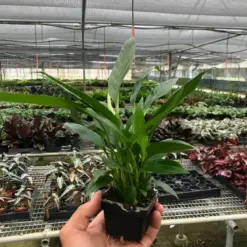
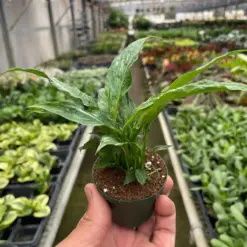
Peace Lily (Spathiphyllum)
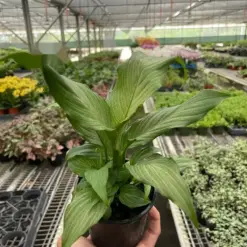
Price range: $22.99 through $54.99Variegated Spathiphyllum ‘Domino’ (Peace Lily)
Price range: $8.99 through $44.99
Frequently Asked Questions
Are peace lilies safe for cats and dogs?
No. Peace lilies are toxic to cats, dogs, and humans per ASPCA listings. Contains insoluble calcium oxalate crystals that cause intense oral pain, swelling, drooling, vomiting, and difficulty swallowing when ingested. Symptoms are immediate and severe but rarely fatal. Importantly, peace lilies are NOT in the lily family (they’re aroids) and don’t cause the kidney failure that true lilies (Lilium, Hemerocallis) cause in cats, but they’re still highly unpleasant. Keep out of reach. (For pet-safe flowering alternatives, anthurium is also toxic, so African violet or Phalaenopsis orchid are safer choices.)
Why isn’t my peace lily blooming?
Almost always insufficient light. Peace lily tolerates low light for foliage but needs medium to bright indirect light to bloom. Move to a brighter spot within 4–6 feet of an east window, or behind sheer curtains on a south/west window. Other factors: (1) plant too young (immature plants under 6 months don’t bloom); (2) too much nitrogen fertilizer (encourages leaves over flowers, so switch to balanced or bloom-boost); (3) not pot-bound enough (peace lilies bloom more when slightly cramped, so don’t over-repot).
Why does my peace lily droop so dramatically?
It’s thirsty, and the dramatic flop is the plant’s signature communication style. The entire plant collapses when soil dries out, signaling for water. Water thoroughly and within 2–4 hours the plant perks back up to normal. This is actually one of the most useful houseplant features: peace lily integrates all environmental factors (light, humidity, temperature) into a single clear watering signal. Just don’t let it droop severely or repeatedly, because that weakens the plant over time.
Why are the tips of my peace lily’s leaves brown?
Three usual culprits: (1) tap water sensitivity, since peace lilies are mildly sensitive to fluoride and chlorine, so switch to filtered or distilled water; (2) low humidity, which you fix by raising to 50%+ with a humidifier or pebble tray; (3) fertilizer salt buildup, which you fix by flushing soil with plain water periodically and reducing fertilizer. Existing brown tips don’t recover; trim with scissors at an angle to mimic the natural taper.
What should I do with brown / spent peace lily flowers?
Cut them at the base of the spathe stem (not the leaf petioles) with sterilized sharp scissors. This redirects the plant’s energy from supporting dying flowers to producing new ones. Spent spathes naturally fade from white to green to brown over 4–6 weeks; cutting them slightly earlier (once they start greening) is fine. The plant will produce new flowers 1–2 times per year if conditions are good.
Can peace lilies really clean the air?
The 1989 NASA Clean Air Study showed that peace lilies (and many other houseplants) can absorb certain volatile organic compounds (VOCs) from indoor air in a controlled chamber. However, follow-up research has shown the practical effect in a typical home is minimal, because you’d need 10+ plants per 100 sq ft to make a measurable difference compared to opening a window for 15 minutes. They’re not magical air purifiers, but they’re not zero either. Buy peace lily for the aesthetic and ease, not as a substitute for ventilation.
How do I propagate a peace lily?
Division is the only practical method, since peace lilies don’t propagate from cuttings. In spring, when the plant has multiple crowns (clusters of leaves emerging from the soil), unpot the entire plant and gently separate the crowns with a sterilized knife. Each division should have its own roots. Pot each in fresh soil and resume normal care. Divisions usually settle in within 2–4 weeks and bloom within a year if conditions are good.
Related Care Guides
- Anthurium Care Guide (another easy flowering aroid)
- Chinese Evergreen Care Guide
- Calathea Care Guide
- Orchid Care Guide
