
Plant Care
Chinese Evergreen Care Guide: Light, Water & The Toughest Patterned Foliage Plant
Chinese Evergreen — Aglaonema — is the houseplant that combines beautiful patterned foliage with near-indestructibility. It tolerates low light, dry air, missed waterings, and benign neglect. Modern hybrids come in striking colors: ‘Red Siam’ (pink-and-red), ‘Pictum Tricolor’ (camo green-cream-silver), ‘Silver Bay’ (silvery green), ‘Maria’ (deep green with silver streaks). It’s the rare combination of actually hard to kill and actually pretty — most easy plants are plain green.
Quick Care Card
☀️ Light
Medium to bright indirect (low light tolerated)
💧 Water
Top inch dry; never soggy
💨 Humidity
40–60% (average home)
🌡️ Temp
65–80°F
🪴 Soil
Standard well-draining mix
🐾 Cat/Dog Safe
❌ Toxic to cats & dogs
🎯 Difficulty
🟢 Beginner
📏 Size
12–24 inches tall
🌎 Zone
10–12 outdoors
🏞️ Origin
Tropical & subtropical Asia
In this guide
About Chinese Evergreen
Aglaonema is a genus of about 25 species native to tropical and subtropical Asia — from India through Southeast Asia and into the Philippines. They grow in the shaded understory of tropical forests, which is why they tolerate low indoor light better than most patterned-leaf plants.
Modern Chinese Evergreens are mostly hybrids — Thai breeders developed dozens of cultivars with bright pink, red, and cream variegation that didn’t exist in the wild species. Notable cultivars: ‘Red Siam’ and ‘Siam Aurora’ (pink-and-red leaves), ‘Pictum Tricolor’ (camo green-cream-silver, looks painted), ‘Silver Bay’ (silvery green with darker edges), ‘Maria’ (deep green with silver streaks — most low-light tolerant), ‘Cutlass’ (long narrow blade-like leaves).
What makes Chinese Evergreen exceptional: it’s one of the few low-light-tolerant plants that’s also pet-toxicity-aware (yes, toxic — but obviously so), keeps its color in dim conditions (especially the silver and green types), and rarely has pest issues compared to ferns or calathea. The pink/red modern hybrids need slightly brighter light to maintain their colors but otherwise match the easy care of the green types.
Care Guide
Light
Medium to bright indirect light. Pink/red types need more light than green types.
- Best: medium to bright indirect light — within 4–8 feet of an east, north, or filtered south/west window.
- Green and silver types (‘Maria’, ‘Silver Bay’): tolerate low light well — survive in dim corners and offices.
- Pink/red types (‘Red Siam’, ‘Siam Aurora’, ‘Pictum Tricolor’): need brighter indirect light to maintain their colors. In low light they fade toward green.
- Direct sun bleaches the patterns and crisps the leaves — avoid afternoon sun on any cultivar.
- Rotate the pot a quarter-turn weekly so the plant grows evenly.
Water
Top inch dry between waterings. Chinese Evergreen is forgiving with watering.
- Water when the top inch of soil is dry. Stick your finger in — if dry to the first knuckle, water thoroughly.
- Water until water runs from the drainage holes; empty the saucer after 10 minutes.
- Most plants need water every 7–14 days in summer, every 14–21 days in winter.
- Yellow lower leaves = overwatering or natural shedding. Crispy brown leaf edges = underwatered or low humidity (rare on this plant).
- Use room-temperature water. Tap water is generally fine; switch to filtered if you see leaf-edge browning.
- When in doubt, wait — Chinese Evergreen tolerates dry roots much better than wet roots.
Humidity
Average household humidity is fine.
- 40–60% humidity (typical home year-round) is plenty.
- Below 30% (winter heating) you may see slight leaf-edge browning.
- Pebble trays or a small humidifier help in dry winter rooms but aren’t strictly necessary.
- Skip aggressive misting — water on leaves can encourage fungal spotting.
Temperature
Standard household temperatures. Chinese Evergreen hates cold.
- Ideal: 65–80°F (18–27°C). Tolerates 60–85°F.
- Below 55°F damages leaves and slows growth dramatically.
- Below 50°F is potentially fatal.
- Avoid AC vents in summer and cold windows in winter — sudden drops cause leaf damage.
Soil
Standard well-draining mix. Chinese Evergreen isn’t picky.
- Easy mix: 70% standard houseplant potting soil + 30% perlite.
- Better: 60% potting soil + 30% perlite + 10% orchid bark for extra drainage.
- Avoid: dense potting soil that compacts, anything that stays wet for more than 7 days, pots without drainage.
- Use a slightly deeper pot for larger specimens; standard pots are fine for younger plants.
- Repot every 2–3 years in spring when roots fill the pot — Chinese Evergreen prefers being slightly pot-bound. Go up only 1–2 inches in diameter.
Pro tip — pink and red types want more light than the catalog says
Chinese Evergreen is famously low-light tolerant — but that applies mainly to the green and silver cultivars (Maria, Silver Bay, Cutlass). The colorful pink/red hybrids (Red Siam, Siam Aurora, Pictum Tricolor) need significantly more light to maintain their colors. In medium-low light they fade to plain green over months. If you bought one for the pink color, place it in bright indirect light — within 3–5 feet of an east window or behind sheer curtains on a south/west window. Otherwise, accept that pink will fade and choose a green/silver type instead.
Fertilizer
Light feeders.
- Balanced liquid fertilizer at half strength every 4–6 weeks April–September.
- Skip fertilizing October–March entirely.
- Brown leaf tips after fertilizing = salt buildup. Flush soil with plain water; reduce fertilizer.
- Chinese Evergreen doesn’t need much fertilizer to thrive — slow growth is normal.
Seasonal Care
🌱 Spring & Summer
- New leaves emerge from the crown every 2–4 weeks on healthy plants
- Mature plants may produce small spadix-and-spathe flowers (like a peace lily, but smaller and less showy)
- Water every 7–14 days when top inch is dry
- Fertilize every 4–6 weeks at half strength
- Best time to repot, divide, or take cuttings
❄️ Fall & Winter
- Reduce watering to every 14–21 days
- Stop fertilizing entirely
- Move from cold drafts; below 55°F damages leaves
- Don’t repot until spring
- Slower growth — 1 leaf every 4–6 weeks is normal
Common Problems & Fixes
| Symptom | Likely Cause | Fix |
|---|---|---|
| Yellow lower leaves | Overwatering or natural shedding of oldest leaves | Reduce watering frequency; old leaves shedding occasionally is normal as new growth comes in |
| Loss of pink/red color in colorful cultivars | Insufficient light | Move to brighter indirect light; new growth recolors over weeks |
| Crispy brown leaf edges | Tap water sensitivity, low humidity, or salt buildup | Switch to filtered water; raise humidity slightly; flush soil if recently fertilized |
| Drooping leaves | Underwatered or root rot from overwatering | Check soil — water if dry; if soggy, let dry and reduce frequency |
| Bleached patches on leaves | Direct sun scorch | Move from direct afternoon sun; affected leaves don’t recover |
| Stems rotting at base | Severe overwatering — usually terminal | Cut healthy top stems for cuttings; rotted base unrecoverable |
| White cottony spots in leaf joints | Mealybugs | Wipe with isopropyl alcohol; insecticidal soap weekly until clear |
| Plant flopping outward | Top-heavy from overgrown crown or weak stems | Repot in slightly larger pot; can also cut top sections to propagate and start fresh |
| Tiny webs on leaves | Spider mites (rare on Chinese Evergreen) | Rinse under shower; insecticidal soap weekly until clear |
Chinese Evergreen is what happens when easy meets pretty. Most low-light plants are plain green; this one gives you pink, red, silver, and patterned camo while tolerating a dim corner.
Propagation
Stem cuttings (easiest)
In spring or early summer, take stem cuttings 4–6 inches long with at least 2–3 leaves and 1 visible node.
Strip the bottom leaf so the lowest node is bare.
Place stem in a glass of water with the bare node submerged. Leaves stay above water.
Change water every 5 days. Place in bright indirect light.
Roots emerge from the node in 3–6 weeks.
Once roots are 1–2 inches long, pot up in a small pot of well-draining soil. Keep moist for the first 2 weeks.
Resume normal care after 2–3 weeks.
Division (mature crowded plants)
- In spring, when the plant has multiple stems crowding the pot, unpot and brush soil from the roots.
- Identify natural clumps where stems and roots can be separated.
- Use a sterilized knife to cut between sections — each division should have at least 2–3 stems and a healthy section of root.
- Pot each division in fresh well-draining mix. Water lightly.
- Resume normal care — established within 2–4 weeks.
Featured Chinese Evergreen Species
| Species | Common Name | Notable Trait | Difficulty |
|---|---|---|---|
| A. ‘Maria’ | Maria Aglaonema | Deep green leaves with silver streaks; the most low-light tolerant | 🟢 Beginner |
| A. ‘Silver Bay’ | Silver Bay Aglaonema | Silvery green with darker edges; classic patterned form | 🟢 Beginner |
| A. ‘Red Siam’ | Red Siam Aglaonema | Bright pink and red leaves; needs brighter light | 🟢 Beginner |
| A. ‘Siam Aurora’ | Siam Aurora Aglaonema | Green leaves with pink veining and edges | 🟢 Beginner |
| A. ‘Pictum Tricolor’ | Pictum Tricolor | Camo-pattern green-cream-silver leaves; striking and unique | 🟢 Beginner |
| A. ‘Cutlass’ | Cutlass Aglaonema | Long narrow blade-shaped silver-green leaves | 🟢 Beginner |
| A. ‘White Rajah’ | White Rajah | White-and-green variegated; striking contrast | 🟢 Beginner |
| A. ‘Modestum’ | Chinese Evergreen (classic) | The original solid green species; toughest of all | 🟢 Beginner |
Shop Our Chinese Evergreen Collection
Every Chinese Evergreen we ship is greenhouse-grown, climate-acclimated, and packed with care for transit. Sold-out species? Use the Notify Me button on any product page — we’ll email you the moment it’s restocked.

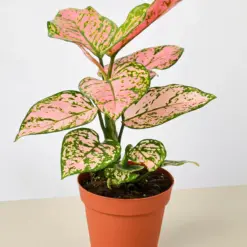
Chinese Evergreen ‘Lady Valentine’
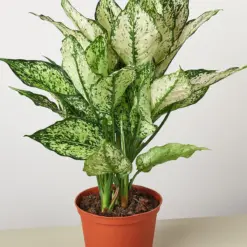
Price range: $28.99 through $41.99Chinese Evergreen ‘First Diamond’
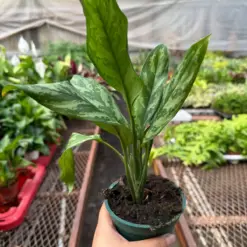
Price range: $42.99 through $70.99Chinese Evergreen ‘Maria’
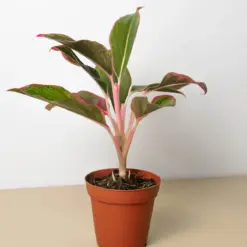
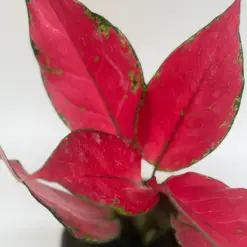
Price range: $36.99 through $53.99Chinese Evergreen ‘Red Siam’
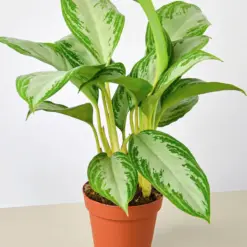
Price range: $42.99 through $50.99Chinese Evergreen ‘Silver Bay’
Price range: $34.99 through $129.99
Frequently Asked Questions
Are Chinese Evergreens safe for cats and dogs?
No — Aglaonema is toxic to cats and dogs per ASPCA listings. Contains insoluble calcium oxalates that cause oral irritation, drooling, vomiting, and difficulty swallowing in pets that chew on leaves. Skin contact with the sap can cause irritation in sensitive individuals. Keep out of reach of pets and kids. (For pet-safe patterned-foliage alternatives, see Calathea, Maranta, and Peperomia.)
Why is my Red Siam Aglaonema turning green?
Insufficient light. The pink/red colors in colorful Aglaonema cultivars come from pigments produced in response to bright light. In low light, the plant produces solid-green leaves to maximize photosynthesis. Move to a brighter spot — within 3–5 feet of an east window or behind sheer curtains on a south/west window. New leaves should come in colored once light is sufficient. Existing faded leaves don’t recolor.
Can Chinese Evergreens really live in low light?
The green and silver types yes — Maria, Silver Bay, Cutlass, and Modestum tolerate genuinely low light better than almost any other patterned-leaf plant. They survive in offices, hallways, and dim corners where most plants fail. However, the colorful pink/red hybrids (Red Siam, Siam Aurora, Pictum Tricolor) need medium to bright indirect light to maintain their colors. Match the cultivar to your light conditions.
Why are my Aglaonema’s lower leaves yellowing?
Two normal, two not. Normal: the oldest lower leaves yellow and shed naturally as new growth emerges from the top — slow gradual yellowing of 1–2 leaves at a time is part of the plant’s life. Not normal: if many leaves yellow rapidly, suspect (1) overwatering — soggy soil rotting roots; (2) cold draft — leaves yellow after sudden temperature drops near AC/heating vents.
How do I propagate Chinese Evergreen?
Stem cuttings root easily in water. Cut a 4–6 inch piece of stem with at least 2–3 leaves and one node, strip the lower leaf, and place in a glass of water with the bare node submerged. Roots emerge in 3–6 weeks. Pot up once roots are 1–2 inches long. You can also divide mature plants in spring — separate clumps of stems with their own roots and pot each division separately.
How fast does Chinese Evergreen grow?
Slowly. Healthy Aglaonemas produce 6–10 new leaves per year — roughly one leaf every 4–6 weeks during growing season. Mature plants slow further. If yours hasn’t grown in over a year, the most likely cause is insufficient light. Aglaonema isn’t a fast plant; it trades growth speed for reliability and tolerance.
Why are my Aglaonema’s leaves curling?
Three usual causes: (1) cold draft — Aglaonema curls leaves below 55°F or near AC/heating vents; (2) severely underwatered — check soil moisture; water thoroughly if dry; (3) recent move — give it 1–2 weeks to acclimate. Stable warm temps, consistent watering, and patience usually fix the curl.
Related Care Guides
- Calathea Care Guide — another patterned-leaf plant — fussier than Aglaonema
- Dieffenbachia Care Guide
- Snake Plant Care Guide
- Peace Lily Care Guide
