
Plant Care
Anthurium Care Guide: Light, Water, Velvet Leaves & Endless Blooms
Anthuriums are the largest aroid genus on earth, with over 1,000 species ranging from the supermarket flamingo flower (A. andraeanum) to rare velvet-leaved collectors (A. clarinervium, A. magnificum) commanding hundreds per plant. The flowering species bloom almost continuously when happy. The foliage species produce some of the most striking leaves in the houseplant world. Both share the same care fundamentals, so once you learn them, anthurium care becomes effortless.
Quick Care Card
☀️ Light
Bright indirect (no direct sun)
💧 Water
Top inch dry, never wet
💨 Humidity
60%+
🌡️ Temp
65–80°F
🪴 Soil
Very chunky aroid mix
🐾 Cat/Dog Safe
☠️ Toxic to cats & dogs
🎯 Difficulty
🟡 Intermediate
📏 Size
1–4 ft
🌎 Zone
10–12 outdoors
🏞️ Origin
Tropical Americas
In this guide
About Anthurium
Anthurium is a genus of more than 1,000 species in the arum family (Araceae), which is bigger than philodendron, monstera, and alocasia combined. They’re native to the rainforests of Mexico, Central America, the Caribbean, and tropical South America, where they grow as epiphytes (on tree branches) or terrestrials (in leaf litter). The two growing styles drive the two main groups in cultivation: flowering anthuriums (mostly epiphytic, the supermarket favorites) and foliage anthuriums (terrestrial, the collector favorites).
Flowering anthuriums (A. andraeanum, A. scherzerianum) are bred for their bright “flamingo flowers,” which are actually a colored leaf-like spathe surrounding a small spike (spadix) of true tiny flowers. Healthy plants bloom almost continuously, with each bloom lasting 6–8 weeks before fading. They’re extremely commercial, and you’ve seen them in hospital lobbies, hotel atriums, and grocery stores everywhere.
Foliage anthuriums are a different beast. A. clarinervium, A. magnificum, A. crystallinum, and A. warocqueanum are the velvet-leaved obsessions of plant collectors. They rarely flower indoors and the spathe is small and unremarkable; the show is in the leaf veining. Care is similar to flowering species but humidity needs to be even higher (70%+) for healthy foliage.
Care Guide
Light
Bright indirect light. No direct sun.
- Place 3–6 ft from a south or east-facing window with sheer curtains, or directly in front of a north-facing window.
- Direct sun for more than 1 hour scorches both flowering and foliage species, since leaves develop pale bleached patches.
- In low light, flowering species stop blooming and foliage species produce smaller, less-veined leaves.
- Foliage species (A. clarinervium, A. crystallinum) prefer slightly lower light than flowering types, so bright shade is ideal.
Water
Anthuriums are epiphytes. They want soil to dry slightly between waterings, and they should never sit in water.
- Wait until the top 1–2 inches of soil are dry. Stick a finger in to confirm.
- Water thoroughly until water runs from the drainage holes. Empty the saucer within 15 minutes.
- Most plants need watering every 7–10 days in summer, every 14–21 days in winter.
- Use room-temperature filtered water, because tap water with high fluoride causes brown leaf tips on velvet species over time.
- Yellowing leaves with multiple at once = overwatering or root rot. Drooping that perks up after watering = waited too long.
- Foliage species are more drought-tolerant than flowering species, so when in doubt, water less.
Humidity
60% is the floor for flowering species. 70%+ for velvet foliage species.
- Run a small humidifier within 6 ft of the plant, since it’s the most reliable method.
- Foliage species (A. magnificum, A. warocqueanum) often need a humidity tent, ikea cabinet, or grow tent to stay healthy.
- Flowering species (A. andraeanum) tolerate 50% humidity but bloom less reliably.
- Group plants together to create a humidity microclimate.
- Skip frequent misting, because droplets sitting on velvet leaves spot fungal issues.
Temperature
Stable warmth. Anthuriums are temperature-sensitive.
- 65–80°F (18–27°C) is ideal.
- Below 60°F slows growth and causes leaf damage. Below 50°F kills the plant.
- Avoid AC vents, exterior doors in winter, and single-pane windows where leaves touch cold glass.
Soil
Extremely chunky and well-draining. Anthuriums hate dense wet soil.
- DIY recipe: 30% coco chips OR potting mix, 30% perlite, 30% orchid bark, 10% horticultural charcoal.
- Alternative for foliage species: 40% sphagnum moss, 40% orchid bark, 20% perlite. Or pure sphagnum for long-leaf A. warocqueanum.
- Or buy: any chunky aroid mix.
- Avoid: dense potting soil, peat-only mixes, or any mix that stays wet for more than 5–7 days.
- Repot every 1–2 years or when roots fill the pot. Anthuriums prefer slightly snug pots.
Pro tip: semi-hydro / LECA shines for anthuriums
Velvet-leaved anthuriums (A. clarinervium, A. magnificum, A. crystallinum) thrive in semi-hydro setups with LECA (lightweight expanded clay aggregate). The constant slight moisture without soil compaction matches their epiphytic origins perfectly, eliminates fungus gnats, and makes overwatering nearly impossible. Transition: rinse soil from roots, sit in plain water 1–2 weeks to grow water roots, move to LECA + dilute hydroponic nutrient solution. Many collectors run their entire anthurium collection on LECA.
Fertilizer
Heavy bloomers need consistent feeding. Light-feeding foliage species do fine with less.
- Flowering species: balanced liquid fertilizer with extra phosphorus (e.g., 10-30-20) at half strength every 2–4 weeks during the growing season.
- Foliage species: balanced fertilizer (e.g., 20-20-20) at quarter strength every 4–6 weeks.
- Stop feeding October–March for both types.
- Brown leaf tips after fertilizing = salt buildup. Flush soil with plain water until it runs clear.
Seasonal Care
🌱 Spring & Summer
- Flowering species bloom continuously when light + humidity + fertilizer are dialed in
- New leaves every 4–8 weeks on healthy plants
- Water every 7–10 days
- Fertilize bi-weekly for flowering, monthly for foliage species
- Best time to repot or divide
❄️ Fall & Winter
- Reduce watering to every 14–21 days
- Stop fertilizing entirely
- Run humidifier, since winter heating drops indoor humidity below 30%
- Some species pause blooming briefly in winter (normal)
- Don’t repot until spring
Common Problems & Fixes
| Symptom | Likely Cause | Fix |
|---|---|---|
| Yellow leaves (multiple) | Overwatering or root rot | Cut watering frequency in half; check roots; repot in fresh dry chunky mix |
| No blooms (flowering species) | Insufficient light or fertilizer | Move to brighter indirect light; fertilize with high-phosphorus bloom formula |
| Brown crispy leaf edges | Low humidity or fluoride/salt buildup | Add humidifier; flush soil; switch to filtered water |
| Faded velvet leaves (foliage species) | Too much direct sun | Move to bright shade; damaged leaves don’t recover but new ones will |
| Black soft spot at stem base | Stem rot from overwatering | Cut above the rot; root the healthy portion as a cutting |
| Flowers turn green over time | Normal aging (anthurium spathes fade after 6–8 weeks) | Cut spent blooms at the base; new ones emerge from healthy plants |
| White cottony spots on stems / leaf joints | Mealybugs | Wipe with alcohol; insecticidal soap weekly until clear |
| Tiny webs under leaves | Spider mites | Increase humidity; spray with neem oil; isolate from other plants |
| Drooping leaves | Underwatered or root-bound | Check soil moisture and root mass; water or repot as needed |
| Stunted, pale new leaves | Low light or nutrient deficiency | Brighter indirect light; resume fertilizing in growing season |
Anthuriums look fussy. They’re actually one of the easiest aroid groups, once you stop overwatering them and accept they want chunky soil and humidity. Get those right, and the rest is automatic.
Propagation
Division (most reliable for both types)
Wait until spring repot or when the plant has multiple stems with their own root systems.
Water 1–2 days before division to ease the plant out of the pot.
Unpot and gently brush soil from the root mass.
Identify natural divisions, which are clumps of stems with their own roots emerging from the main rhizome.
Use clean hands or a sterilized blade to gently separate divisions, keeping as many roots intact as possible.
Pot each division in fresh chunky aroid mix in a small pot. Don’t over-pot.
Water in lightly with filtered water. Keep humidity high for 2–3 weeks while roots establish.
Resume normal care once new growth appears.
Stem cuttings (for stemmed climbing species)
- Some anthuriums (A. veitchii, A. coriaceum) develop visible climbing stems with nodes.
- Cut a stem section with at least one node and 1–2 leaves above.
- Place cut end in damp sphagnum moss or perlite, since anthuriums root slower in plain water than philodendrons.
- Keep humidity 70%+ in a covered container or grow tent.
- Roots emerge in 4–8 weeks. Pot up in chunky aroid mix when roots are 2+ inches long.
Featured Anthurium Species
| Species | Common Name | Notable Trait | Difficulty |
|---|---|---|---|
| A. andraeanum | Flamingo Flower | The classic supermarket bloomer; red, pink, white, or coral spathes | 🟢 Beginner |
| A. scherzerianum | Pigtail Anthurium | Curly orange spadix; smaller and more compact than andraeanum | 🟢 Beginner |
| A. clarinervium | Velvet Cardboard / Heart Anthurium | Heart-shaped velvet leaves with bold white veining | 🟡 Intermediate |
| A. magnificum | Magnificum | Large velvet leaves with silver veining; prized collector species | 🟡 Intermediate |
| A. crystallinum | Crystal Anthurium | Velvet leaves with bright silver veining; thinner than clarinervium | 🟡 Intermediate |
| A. warocqueanum | Queen Anthurium | Long pendulous velvet leaves up to 4+ ft; needs high humidity | 🔴 Expert |
| A. veitchii | King Anthurium | Massive accordion-pleated leaves up to 6+ ft | 🔴 Expert |
| A. forgetii | Forgetii | Round velvet leaves with metallic veining | 🟡 Intermediate |
| A. regale | Regale | Massive velvet leaves with white veining; rare collector species | 🔴 Expert |
Shop Our Anthurium Collection
Every Anthurium we ship is greenhouse-grown, climate-acclimated, and packed with care for transit. Sold-out species? Use the Notify Me button on any product page and we’ll email you the moment it’s restocked.

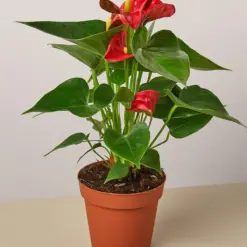
Anthurium Plant ‘Red’
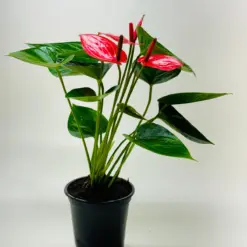
Price range: $42.99 through $65.99Anthurium Plant ‘Livium’
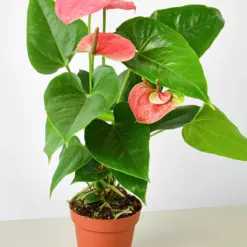
$41.99Anthurium Plant ‘Pink’
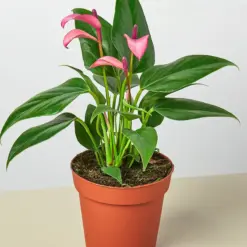
Price range: $44.99 through $53.99Anthurium Plant ‘Purple’
Price range: $44.99 through $68.99Anthurium Plant ‘White’
Price range: $44.99 through $62.99
Frequently Asked Questions
Are anthuriums toxic to cats and dogs?
Yes. All anthuriums contain calcium oxalate crystals that are toxic to cats, dogs, and humans. Causes oral irritation, drooling, and vomiting if chewed. Keep all anthuriums out of reach of pets and children.
Why isn’t my anthurium blooming?
Three usual culprits. The first is not enough light, since flowering anthuriums need bright indirect light to bloom. The second is not enough phosphorus, so switch to a bloom-boosting fertilizer (high P, e.g., 10-30-20) at half strength every 2 weeks. The third is recent stress like repotting, moving, or temperature swings, which pauses blooming for 2–3 months. Get the basics right and most anthuriums bloom continuously.
Why are my anthurium flowers green?
Anthurium spathes fade as they age, going from bright red/pink/coral when fresh, gradually shifting to green over 6–8 weeks before drying. This is normal aging. Cut spent blooms at the base of the stem to redirect the plant’s energy into new buds.
How is the velvet leaf surface created?
The velvet appearance on A. clarinervium, A. magnificum, and similar species comes from microscopic light-scattering hairs on the leaf surface. They reflect light at unusual angles, creating the velvety sheen and silver veining. Direct sun damages these hairs (causing pale patches), and frequent misting can mat them down, so handle gently.
Can I grow anthurium in pure sphagnum or LECA?
Yes. Anthuriums are epiphytes and many growers run them in pure sphagnum (especially long-leaf species like A. warocqueanum) or in LECA semi-hydro. Both methods provide constant slight moisture without soil compaction, matching their natural epiphytic conditions. Transition gradually: rinse roots, sit in water for 1–2 weeks to grow water roots, then move to your chosen medium.
How fast do anthuriums grow?
Healthy plants produce a new leaf every 4–8 weeks during the growing season. Foliage species (A. clarinervium) are slower than flowering species. Each new leaf is typically larger and more well-defined than the previous, especially in mature plants.
When should I repot my anthurium?
Every 1–2 years or when roots are visibly emerging from drainage holes. Anthuriums prefer slightly snug pots, so repot only 1–2 inches up in diameter. Use fresh chunky aroid mix. Don’t over-pot, because excess soil holds water and rots roots.
Related Care Guides
- Philodendron Care Guide (the closest aroid cousin)
- Monstera Care Guide
- Alocasia Care Guide
- Humidity & Misting
- Watering Guide
