
Plant Care
Croton Care Guide: Light, Water & The Plant That Drops Leaves Over Everything
Croton (Codiaeum variegatum) has some of the most spectacular foliage of any houseplant: leaves in fire-engine red, brilliant yellow, deep purple, hot pink, and electric green, often all on the same plant. The price for that beauty is a notorious diva attitude: croton drops every leaf if you look at it wrong. Move it, repot it, change the watering schedule, or expose it to a draft, and you get instant leaf drop. The good news is that with stable conditions, croton recovers and the new growth comes in just as colorful.
Quick Care Card
☀️ Light
Bright direct or very bright indirect (4–6+ hours)
💧 Water
Top inch dry; never bone-dry
💨 Humidity
50%+ (higher = better)
🌡️ Temp
65–80°F (avoid drafts)
🪴 Soil
Rich, well-draining mix
🐾 Cat/Dog Safe
❌ Toxic to cats & dogs
🎯 Difficulty
🟡 Intermediate
📏 Size
2–6 ft indoors
🌎 Zone
10–12 outdoors
🏞️ Origin
Southeast Asia & Pacific Islands
In this guide
About Croton
Codiaeum variegatum is native to the Indo-Pacific region, including Malaysia, Indonesia, the Philippines, and parts of Oceania. The genus has only one species but dozens of named cultivars in cultivation, each with different leaf shapes, sizes, and color patterns. Notable cultivars: ‘Petra’ (the classic large red-yellow-green broad leaves), ‘Mammy’ (curled and twisted multi-color leaves), ‘Mrs. Iceton’ (pink, peach, and gold gradients), ‘Gold Star’ (narrow yellow-spotted leaves), ‘Eleanor Roosevelt’ (narrow strap leaves), ‘Magnificent’ (huge oak-shaped leaves).
Croton is often confused with another genus called Croton (in family Euphorbiaceae, the true crotons), but houseplant croton is actually Codiaeum. The common name "croton" comes from the family naming confusion that’s centuries old at this point.
What makes croton tricky indoors: it’s a tropical sun-lover that wants 50%+ humidity, stable temps, and absolutely no environmental change. Move from greenhouse to home? Dramatic leaf drop. Move from one room to another? More leaf drop. Repot? Even more. The plant recovers, but you’ll spend the first 2–4 weeks after any change watching it look terrible. Once settled, croton is a stunning long-term resident.
Care Guide
Light
Croton needs more light than most houseplants. Direct or very bright indirect.
- Best: 4–6 hours of direct or very bright indirect light daily. South or west-facing window with no obstructions, or behind sheer curtains on a south window.
- Insufficient: low or medium light. The plant loses its colors and reverts toward green, with the brilliant reds, yellows, and oranges fading dramatically.
- Some direct afternoon sun is fine and actually intensifies colors.
- Grow lights work well, with full-spectrum LED at 12 inches above the plant for 12 hours daily.
- Color test: a healthy croton in good light has vibrant reds, yellows, and oranges. A washed-out, mostly-green croton needs more light.
Water
Keep evenly moist but not soggy. Croton is dramatic about both directions.
- Water when the top inch of soil is dry. Stick your finger in, and if dry to the first knuckle, water thoroughly.
- Water until water runs from the drainage holes; empty the saucer after 10 minutes.
- Most plants need water every 5–7 days in summer, every 7–10 days in winter.
- Critical: croton drops leaves dramatically from both overwatering and underwatering. Establish a consistent routine.
- Yellow lower leaves = overwatering. Crispy leaves with curled edges = severely underwatered or low humidity.
- Use room-temperature water. Tap water is generally fine; switch to filtered if you see leaf spotting.
Humidity
Higher is better. Croton hates dry air.
- Ideal: 50–70% humidity. Most homes need a humidifier or pebble tray to reach this.
- Tolerable: 40–50%. Plant survives but is more prone to spider mites.
- Below 30% (winter heating) leaves go crispy and drop.
- A small humidifier nearby is the most effective fix. Pebble trays help slightly.
- Group with other tropicals to create a humid microclimate.
- Bathrooms with a window are excellent croton spots if light is sufficient.
Temperature
Stable warm temperatures. Croton hates drafts and sudden changes.
- Ideal: 65–80°F (18–27°C).
- Below 55°F damages leaves and causes leaf drop.
- Below 50°F is potentially fatal.
- Avoid AC vents in summer and cold windows/heating vents in winter, since sudden temperature drops cause dramatic leaf shedding.
- Keep croton in one stable spot, because moves between rooms shock the plant.
Soil
Rich, well-draining mix.
- Easy mix: 60% standard houseplant potting soil + 30% perlite + 10% orchid bark.
- Better: 50% potting soil + 30% perlite + 10% peat moss + 10% orchid bark.
- Avoid: dense potting soil that compacts, anything cactus-mix-based (too dry), pots without drainage.
- Use a deeper pot for tree-form crotons; standard pots are fine for shrubby types.
- Repot every 2–3 years in spring, because croton hates root disturbance, so don’t repot more often than necessary. Plan for massive leaf drop after repotting.
Pro tip: leaf drop after a move is normal, and the new growth is just as colorful
When you bring a new croton home from a nursery or greenhouse, expect 30–50% of its leaves to drop within 2–3 weeks as it adjusts to your home environment. This isn’t a sign of a sick plant; it’s how croton acclimates. Don’t panic, don’t repot, don’t change anything. Maintain stable conditions: bright light, consistent watering, 50%+ humidity. New leaves emerge within 4–8 weeks and they’ll be just as colorful as the originals. The plant looks rough for a month, then bounces back. Most croton failures happen when owners panic-treat (overwater, repot, move) and trigger more drop.
Fertilizer
Light to moderate feeders during growing season.
- Balanced liquid fertilizer at half strength every 3–4 weeks April–September.
- Skip fertilizing October–March entirely.
- Croton uses nutrients to support vibrant colors, so slightly more feeding than other tropicals is fine.
- Brown leaf tips after fertilizing = salt buildup. Flush soil with plain water; reduce fertilizer.
Seasonal Care
🌱 Spring & Summer
- New leaves emerge from the growing tips every 2–4 weeks on healthy plants
- New leaves often emerge mostly green and develop color over weeks
- Water every 5–7 days when top inch is dry
- Fertilize every 3–4 weeks at half strength
- Best time to repot (only if necessary), take cuttings, or do light pruning
❄️ Fall & Winter
- Reduce watering to every 7–10 days
- Stop fertilizing entirely
- Move from cold drafts; below 55°F damages leaves
- Don’t repot until spring
- Slower growth, with minimal new leaves being normal
Common Problems & Fixes
| Symptom | Likely Cause | Fix |
|---|---|---|
| Massive leaf drop after move/repot | Stress response (croton hates change) | Resume consistent care; leave plant alone; new leaves emerge over 4–8 weeks |
| Loss of color, leaves turning mostly green | Insufficient light | Move to bright direct or very bright indirect light; new growth recolors |
| Yellow lower leaves | Overwatering, cold draft, or natural shedding | Reduce watering frequency; check for drafts; some lower leaf shedding is normal |
| Crispy curling leaves | Low humidity, dry soil, or both | Raise humidity to 50%+; check soil moisture; consistent watering routine |
| Tiny webs and stippled / yellowing leaves | Spider mites (the #1 croton pest, especially in dry indoor air) | Rinse under shower; raise humidity above 50%; insecticidal soap or neem oil weekly until clear |
| White cottony spots in leaf joints | Mealybugs | Wipe with isopropyl alcohol; insecticidal soap weekly until clear |
| Sticky residue on leaves and surrounding floor | Scale insects | Scrape off with fingernail; insecticidal soap or systemic neem; persistent treatment |
| Stems with milky-white sap when broken | Normal (croton produces latex when damaged) | Wipe away with damp cloth; the sap is irritating to sensitive skin |
| Stems rotting at base | Severe overwatering | Cut healthy stems for cuttings; rotted base usually unrecoverable |
Croton has the most beautiful foliage of any houseplant and the worst attitude. The trade is real: live with leaf drop, or settle for plainer plants.
Propagation
Stem cuttings (most common)
In spring or early summer, take 4–6 inch stem cuttings from healthy growth.
Cuttings should have 3–4 leaves; remove the lowest leaves.
Croton produces milky latex sap when cut, so wash hands after handling and avoid getting it in eyes (irritating).
Dip cut end in rooting hormone (significantly improves success rate).
Insert into damp seedling mix or 50/50 perlite-peat. Keep evenly moist.
Cover loosely with a clear bag or dome for humidity. Place in bright indirect light.
Roots form in 6–10 weeks.
Remove cover gradually once new growth is visible. Resume normal care after 2–3 months once established.
Air layering (for thicker mature stems)
- On a thick stem of an established croton, ring-bark a 1/2 inch section (cut through the bark down to the cambium, all the way around).
- Apply rooting hormone to the upper edge of the cut.
- Wrap the cut area with damp sphagnum moss; cover tightly with plastic and secure top and bottom.
- Keep moss damp by injecting water with a syringe every 2–3 weeks.
- Roots form into the moss in 8–16 weeks.
- Once visible roots fill the moss, cut below the rooted section and pot up.
- This method produces an instant mature plant rather than waiting for a cutting to grow.
Featured Croton Species
| Species | Common Name | Notable Trait | Difficulty |
|---|---|---|---|
| Codiaeum variegatum ‘Petra’ | Petra Croton | The classic large red-yellow-green broad leaves; the most common cultivar | 🟡 Intermediate |
| C. variegatum ‘Mammy’ | Mammy Croton | Curled and twisted leaves in pink, red, orange, and green | 🟡 Intermediate |
| C. variegatum ‘Mrs. Iceton’ | Mrs. Iceton | Pink, peach, and gold gradients on broad leaves | 🟡 Intermediate |
| C. variegatum ‘Gold Star’ | Gold Star Croton | Narrow leaves with golden-yellow spots on green | 🟡 Intermediate |
| C. variegatum ‘Eleanor Roosevelt’ | Eleanor Roosevelt | Long narrow strap-like leaves with yellow speckles on green | 🟡 Intermediate |
| C. variegatum ‘Magnificent’ | Magnificent Croton | Huge oak-shaped leaves with dramatic color gradients | 🟡 Intermediate |
| C. variegatum ‘Banana’ | Banana Croton | Bright yellow narrow leaves; high-light needs | 🟡 Intermediate |
| C. variegatum ‘Sunny Star’ | Sunny Star Croton | Bright yellow oval leaves with green margins | 🟡 Intermediate |
Shop Our Croton Collection
Every Croton we ship is greenhouse-grown, climate-acclimated, and packed with care for transit. Sold-out species? Use the Notify Me button on any product page and we’ll email you the moment it’s restocked.

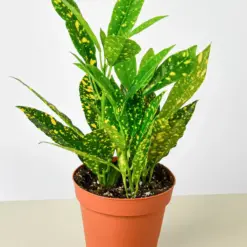
Croton Plant ‘Gold Dust’
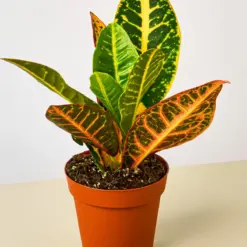
Price range: $22.99 through $39.99Croton Petra ‘Joseph’s Coat’
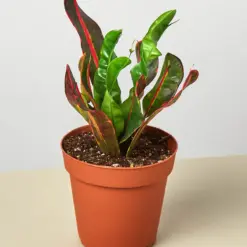
Price range: $22.99 through $39.99Croton Plant ‘Mammy’
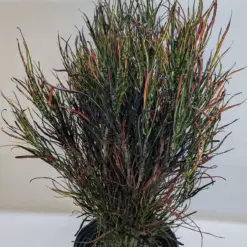
Price range: $22.99 through $91.99Croton Plant ‘Picasso’
Price range: $26.99 through $83.99Croton Plant ‘Sunny Star’
$22.99
Frequently Asked Questions
Are crotons safe for cats and dogs?
No. Codiaeum variegatum (Croton) is toxic to cats, dogs, and humans. The milky latex sap contains compounds that cause oral irritation, vomiting, diarrhea, and skin irritation. Pets that chew on leaves can experience significant GI distress. Keep out of reach of pets and kids. Wear gloves when pruning to avoid skin contact with the sap. (For non-toxic colorful alternatives, see Calathea and Maranta.)
Why is my croton dropping all its leaves?
Croton drops leaves in response to almost any environmental change: a recent move (from nursery to home, or room to room), repotting, low humidity, cold drafts, dramatic temperature swings, or inconsistent watering. Leaf drop is dramatic but usually not fatal, and the plant recovers over 4–8 weeks if you stabilize conditions. Don’t panic-treat: resist the urge to repot, fertilize, or move the plant. Just provide stable bright light, consistent watering, and humidity above 50%.
Why is my croton turning all green?
Insufficient light. The brilliant reds, yellows, oranges, and pinks in croton leaves are pigments produced in response to bright light. In low light, the plant produces solid-green leaves to maximize photosynthesis. Move to your brightest spot, such as direct sun or very bright indirect light, 4–6+ hours daily. New leaves come in colored once light is sufficient; existing green leaves don’t recolor.
Why does my croton keep getting spider mites?
Dry indoor air. Spider mites thrive in low humidity (below 40%) and croton is one of their favored targets. The single best fix is raising humidity above 50% with a small humidifier or pebble tray near the plant. Monthly showers (rinsing the plant in your bathroom shower) wash off mites and raise immediate humidity. If mites are already present, treat with insecticidal soap or neem oil weekly for 3–4 weeks while addressing humidity.
How do I propagate croton?
Stem cuttings root reasonably well but slower than most houseplants. Cut a 4–6 inch piece of stem with at least 3–4 leaves, dip the cut end in rooting hormone (croton has lower success rate without it), and insert in damp seedling mix. Cover with a clear bag for humidity. Place in bright indirect light. Roots form in 6–10 weeks. Wear gloves when cutting because croton sap is irritating.
How much light does my croton need?
More than most houseplants. Croton wants 4–6+ hours of direct or very bright indirect light daily to maintain its colors. A south or west-facing window with no obstructions is ideal. Behind sheer curtains on a south window also works. In medium light, croton survives but the colors fade dramatically. If your home only gets dim indirect light, croton is the wrong plant, so consider Aglaonema ‘Red Siam’ for similar coloring with lower light requirements.
Can I revive a croton that’s lost most of its leaves?
Yes. As long as the stems are firm and green when scratched, the plant is alive. Cut back any dead or weak branches to healthy tissue. Move to stable bright light. Water consistently when the top inch is dry. Don’t fertilize until you see new growth. Don’t repot. Patience: croton can take 4–8 weeks to start visible recovery. The new leaves emerge with full color once the plant has stabilized.
Related Care Guides
- Calathea Care Guide (patterned-leaf alternative that’s pet-safe and lower light)
- Dieffenbachia Care Guide
- Dracaena Care Guide
- Ficus Care Guide
