
Plant Care
Dieffenbachia (Dumb Cane) Care Guide: Light, Water & The Toxic Statement Plant
Dieffenbachia (also known as "dumb cane") is the houseplant equivalent of a confident statement: bold cream-and-green patterned leaves on tall cane-like stems, fast growth, low maintenance, and dramatic presence. The nickname comes from the plant’s calcium-oxalate-rich sap, which causes intense oral numbing if chewed, so definitely keep it away from pets and kids. Beyond the toxicity, it’s one of the easier large-leaf tropicals for beginners.
Quick Care Card
☀️ Light
Bright indirect (no direct sun)
💧 Water
Top inch dry; never soggy
💨 Humidity
50%+ (60% ideal)
🌡️ Temp
65–80°F
🪴 Soil
Rich, well-draining mix
🐾 Cat/Dog Safe
☠️ Highly toxic to cats & dogs
🎯 Difficulty
🟢 Beginner
📏 Size
3–6 ft indoors
🌎 Zone
10–12 outdoors
🏞️ Origin
Tropical Americas
In this guide
About Dieffenbachia (Dumb Cane)
Dieffenbachia is named after Joseph Dieffenbach, a 19th-century Austrian botanist. The genus has about 30 species native to the tropical Americas, primarily Central and South American rainforests. The houseplant trade focuses on a few large showy species and their hybrids.
Common cultivars: D. seguine ‘Tropic Snow’ (the classic large white-and-green patterned variety), D. compacta ‘Camille’ (compact form with creamy yellow leaves edged in green), D. maculata (smaller form with white speckles), ‘Reflector’ (silver-marbled with dark green veins), ‘Star Bright’ (compact white-and-green), ‘Tropic Marianne’ (creamy yellow with thin green edges).
The "dumb cane" nickname comes from the plant’s sap, which contains insoluble calcium oxalate crystals (raphides). When ingested, these microscopic needle-like crystals cause intense oral pain, swelling of the tongue and throat, drooling, and sometimes temporary inability to speak (hence "dumb cane"). Effects pass within hours but are severely unpleasant. Keep out of reach of pets that chew on plants and small children.
Care Guide
Light
Bright indirect light. Direct sun bleaches the patterns.
- Best: bright indirect light within 3–6 feet of an east or north window, or behind sheer curtains on a south/west window.
- Direct afternoon sun bleaches the variegation and crisps the leaves.
- Medium light is tolerated, since Dieffenbachia is one of the more flexible patterned-leaf plants for indoor light conditions.
- Low light slows growth dramatically and may cause loss of variegation.
- Rotate the pot a quarter-turn weekly so the plant grows evenly.
Water
Top inch dry between waterings. Dieffenbachia is forgiving with watering.
- Water when the top inch of soil is dry. Stick your finger in, and if dry to the first knuckle, water thoroughly.
- Water until water runs from the drainage holes; empty the saucer after 10 minutes.
- Most plants need water every 5–7 days in summer, every 7–14 days in winter.
- Yellow lower leaves = overwatering or natural shedding. Brown crispy edges = low humidity or salt buildup.
- Use room-temperature water. Tap water is generally fine; switch to filtered if you see leaf-edge browning.
- Wear gloves when handling plant or repotting, because the sap is irritating to skin.
Humidity
Higher is better. Dieffenbachia really likes 50%+ humidity.
- Ideal: 50–70% humidity. A small humidifier nearby is the easiest fix.
- Tolerable: 40–50% (typical home humidity). Plant survives but expect occasional crispy edges.
- Below 30% (winter heating) leaves go crispy at the edges and the plant looks stressed.
- Pebble trays help slightly. A humidifier is the most effective solution.
- Skip aggressive misting because water on leaves can encourage bacterial leaf spot.
Temperature
Standard household temperatures. Dieffenbachia hates cold.
- Ideal: 65–80°F (18–27°C).
- Below 55°F damages leaves and slows growth dramatically.
- Below 50°F is potentially fatal.
- Avoid AC vents in summer and cold windows in winter because sudden drops cause leaf damage.
Soil
Rich, well-draining mix.
- Easy mix: 60% standard houseplant potting soil + 30% perlite + 10% orchid bark.
- Better: 50% potting soil + 30% perlite + 10% peat moss + 10% orchid bark.
- Avoid: dense potting soil that compacts, anything cactus-mix-based (too dry), pots without drainage.
- Use a slightly deeper pot for tall cane-form plants.
- Repot every 1–2 years in spring because Dieffenbachia grows fast and roots fill pots quickly. Wear gloves; the sap is irritating.
Pro tip: top-cut to make a leggy plant bushy again
Mature Dieffenbachia tends to grow tall and bare-stemmed, with leaves only at the top, giving it a classic leggy "palm tree" look. The fix: cut the top off the cane (leaving about 8–10 inches of bare stem in the pot) and use the cut top as a fresh propagation cutting in water. The remaining bare stem in the pot will produce 2–3 new shoots from buds along the stem within 4–8 weeks. One leggy plant becomes a full bushy plant plus a new propagated plant. Wear gloves when cutting because the sap is irritating.
Fertilizer
Moderate feeders during growing season.
- Balanced liquid fertilizer at half strength every 4 weeks April–September.
- Skip fertilizing October–March entirely.
- Brown leaf edges after fertilizing = salt buildup. Flush soil with plain water; reduce fertilizer.
- Dieffenbachia responds visibly to feeding, so leaves grow larger and patterns intensify.
Seasonal Care
🌱 Spring & Summer
- New leaves emerge from the growing crown every 2–3 weeks on healthy plants
- Mature plants occasionally produce spadix-and-spathe flowers (like a peace lily), though this is uncommon indoors
- Water every 5–7 days when top inch is dry
- Fertilize every 4 weeks at half strength
- Best time to repot, take cuttings, or air-layer
❄️ Fall & Winter
- Reduce watering to every 7–14 days
- Stop fertilizing entirely
- Move from cold drafts; below 55°F damages leaves
- Don’t repot until spring
- Slower growth, with 1 leaf every 4–6 weeks being normal
Common Problems & Fixes
| Symptom | Likely Cause | Fix |
|---|---|---|
| Yellow lower leaves | Overwatering or natural shedding of oldest leaves | Reduce watering frequency; old leaves shedding occasionally is normal as new growth emerges |
| Loss of variegation | Insufficient light | Move to brighter indirect light; new growth comes in variegated once light is sufficient |
| Brown crispy leaf edges | Low humidity, dry soil, or salt buildup | Raise humidity to 50%+; check soil moisture; flush soil if recently fertilized |
| Drooping leaves | Underwatered, root rot, or cold draft | Check soil and water if dry; if soggy, let dry and reduce frequency; eliminate drafts |
| Leggy stem with leaves only at top | Mature growth habit; light limitations | Cut top for propagation; the bare stem produces 2–3 new shoots within weeks |
| Brown spots on leaves | Bacterial leaf spot from water on leaves or overhead watering | Water at the soil only; improve air circulation; remove affected leaves |
| Stems rotting at base | Severe overwatering | Cut healthy stems for cuttings; rotted base usually unrecoverable |
| Tiny webs on leaves | Spider mites (low humidity) | Rinse under shower; raise humidity; insecticidal soap weekly until clear |
| White cottony spots in leaf joints | Mealybugs | Wipe with isopropyl alcohol; insecticidal soap weekly until clear |
Dieffenbachia is beautiful and dangerous. Treat the sap with respect by wearing gloves and keeping it away from pets, and you’ll have a stunning bold plant for years.
Propagation
Stem cuttings (top cut is easiest)
Wear gloves throughout because Dieffenbachia sap is irritating to skin.
Cut the top 6–8 inches off the cane, just below a leaf node, with sterilized sharp scissors.
Strip the lowest 1–2 leaves so the bottom of the cutting is bare.
Place in a glass of water with the bare nodes submerged. Leaves stay above water.
Change water every 5 days. Place in bright indirect light.
Roots emerge from the nodes in 3–6 weeks.
Once roots are 1–2 inches long, pot up in well-draining soil. Keep moist for the first 2 weeks.
Bonus: the original bare stem in the pot produces 2–3 new shoots within 4–8 weeks. One plant becomes two.
Stem cuttings from cane segments (multiple plants from one stem)
- From a long cane, cut 3–4 inch segments. Each segment must contain at least one node (where leaves attached, even if scarred).
- Lay segments horizontally on top of damp seedling mix, half-buried in the soil.
- Cover with clear plastic for humidity. Keep moist and warm (70–80°F).
- New shoots emerge from the buried node within 6–10 weeks.
- Once shoots have 3–4 leaves, pot up individually.
Air layering (mature thick canes)
- On a thick stem, make an angled cut 1/3 through the stem.
- Insert a small toothpick to keep the cut open.
- Wrap the cut area with damp sphagnum moss; cover tightly with plastic.
- Keep moss damp; inject water with a syringe every 2–3 weeks.
- Roots form into the moss in 8–12 weeks.
- Cut below the rooted section and pot up as a new plant.
Featured Dieffenbachia (Dumb Cane) Species
| Species | Common Name | Notable Trait | Difficulty |
|---|---|---|---|
| Dieffenbachia seguine ‘Tropic Snow’ | Tropic Snow | The classic large white-and-green pattern; most common variety | 🟢 Beginner |
| D. compacta ‘Camille’ | Camille | Compact form with creamy yellow centers and green edges | 🟢 Beginner |
| D. maculata | Spotted Dumb Cane | Smaller form with white speckles on green leaves | 🟢 Beginner |
| D. ‘Reflector’ | Reflector | Silver-marbled with dark green veins; striking pattern | 🟢 Beginner |
| D. ‘Star Bright’ | Star Bright | Compact form with bright white-and-green patterns | 🟢 Beginner |
| D. ‘Tropic Marianne’ | Tropic Marianne | Creamy yellow leaves with thin green edges | 🟢 Beginner |
| D. ‘Sparkles’ | Sparkles | Yellow-cream variegation with green speckles | 🟢 Beginner |
| D. ‘Snow Flake’ | Snow Flake | White-mottled compact form | 🟢 Beginner |
Shop Our Dieffenbachia (Dumb Cane) Collection
Every Dieffenbachia (Dumb Cane) we ship is greenhouse-grown, climate-acclimated, and packed with care for transit. Sold-out species? Use the Notify Me button on any product page and we’ll email you the moment it’s restocked.

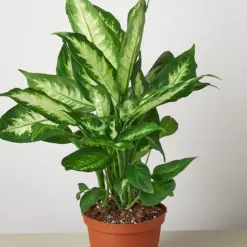
Dieffenbachia Plant ‘Camille’
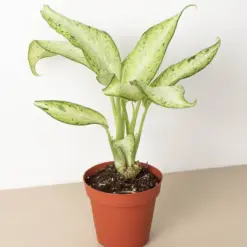
Price range: $22.99 through $39.99Dieffenbachia Plant ‘Camouflage’
Price range: $30.99 through $56.99
Frequently Asked Questions
Are Dieffenbachia plants safe for cats and dogs?
No. Dieffenbachia is severely toxic to cats, dogs, and humans. Contains insoluble calcium oxalates (raphides) that cause intense oral pain, swelling, drooling, vomiting, and temporary inability to swallow when ingested. In rare severe cases, swelling can compromise the airway. The nickname "dumb cane" refers to the temporary loss of speech from mouth swelling. Keep firmly out of reach of pets and kids. Wear gloves when handling. (For pet-safe alternatives, see Calathea, Spider plant, and Peperomia.)
Why are my Dieffenbachia’s leaves yellowing?
Two normal, two not. Normal: the oldest lower leaves yellow and shed naturally as new growth emerges from the top, with 1–2 leaves at a time being fine. Not normal: if many leaves yellow rapidly, suspect (1) overwatering with soggy soil rotting roots; (2) cold draft or sudden temperature change near AC/heating vents. Check soil moisture and location.
Why is my Dieffenbachia tall and bare on the bottom?
Mature growth habit. Dieffenbachia naturally grows tall on cane-like stems, with leaves concentrated at the top and bare stems below as lower leaves shed. To fix: cut the top off the cane (leaving 8–10 inches of bare stem) and propagate the cut top in water. The remaining bare stem in the pot will produce 2–3 new shoots within 4–8 weeks, creating a fuller plant. You get a new propagation cutting plus a bushier mother plant from one cut.
Why are my Dieffenbachia’s leaves curling and crispy?
Low humidity is the most common cause. Dieffenbachia wants 50%+ humidity and crisps below 40%. Add a humidifier or pebble tray. Dry soil is the second cause, so water more consistently. Existing crispy leaves don’t recover; trim with scissors and focus on new growth conditions.
How do I propagate Dieffenbachia?
Easiest method: top cuttings in water. Cut the top 6–8 inches off the cane with sterilized scissors (wear gloves because the sap is irritating). Strip lower leaves, place in water with bare nodes submerged, and roots emerge in 3–6 weeks. Pot up once roots are 1–2 inches long. You can also propagate from stem segments (4-inch pieces of cane laid horizontally on damp soil), which is slower but produces multiple plants from one stem.
My pet or child chewed Dieffenbachia leaves: what should I do?
Rinse the mouth thoroughly with water; do not induce vomiting. Symptoms (drooling, mouth pain, swelling) typically appear immediately and pass within hours. For pets: contact your veterinarian or the ASPCA Animal Poison Control Center (888-426-4435) for guidance. For children: contact Poison Control (1-800-222-1222) or seek medical attention if swelling affects breathing. Calcium oxalate poisoning is severely painful but rarely fatal, and most cases resolve with symptom management.
Why does my Dieffenbachia have brown spots on the leaves?
Usually bacterial leaf spot from water on the leaves. Dieffenbachia is prone to bacterial issues when water sits on the leaves during cool conditions. Water at the soil only, never on the leaves. Improve air circulation around the plant. Remove badly affected leaves to prevent spread. Avoid misting; if you raise humidity, use a humidifier instead.
Related Care Guides
- Chinese Evergreen Care Guide (similar patterned foliage; also toxic but easier)
- Philodendron Care Guide
- Anthurium Care Guide
- Peace Lily Care Guide
