
Plant Care
Fittonia (Nerve Plant) Care Guide: Light, Water & The Dramatic Fainter
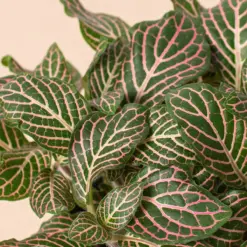
Fittonia (also called the Nerve Plant or Mosaic Plant) is famous for one trick: when the soil dries out, the entire plant flops over dramatically, leaves collapsed, looking like it died. Water it, and within 1–2 hours it perks back up to perfect health. The drama is so consistent that some growers use Fittonia as a moisture monitor for the surrounding plants. Beyond the flop, it’s a small, gorgeous, humidity-loving foliage plant with intricate pink, white, or red veining on dark green leaves, making it the perfect terrarium plant.
Quick Care Card
☀️ Light
Bright indirect (medium tolerated)
💧 Water
Keep evenly moist; never dry out
💨 Humidity
60%+ (terrarium-level humidity)
🌡️ Temp
65–80°F
🪴 Soil
Rich, well-draining, peat-based mix
🐾 Cat/Dog Safe
✅ Safe for cats & dogs
🎯 Difficulty
🟡 Intermediate (humidity-needy)
📏 Size
3–6 inches tall, spreading
🌎 Zone
11–12 outdoors
🏞️ Origin
South American rainforest understory
In this guide
About Fittonia (Nerve Plant)
Fittonia is a small genus of about 2 species native to the rainforests of South America (mostly Peru, Bolivia, Ecuador, Colombia). The plant grows on the forest floor in deeply shaded conditions with consistent high humidity. The name "nerve plant" comes from the intricate vein pattern that resembles a nervous system map across the leaves.
Houseplant cultivars all derive from Fittonia albivenis (also called F. verschaffeltii). Popular varieties: the Argyroneura Group (silver-white veined, the classic), the Verschaffeltii Group (pink and red veined), and many named cultivars including ‘Pink Star’, ‘White Anne’, ‘Red Anne’, ‘Mini Superba’ (compact), and ‘Bianco Verde’ (white-green).
Fittonia is the unofficial mascot of terrariums and closed glass containers, since its humidity needs make it a poor freestanding houseplant in dry homes but an ideal terrarium plant. In a closed glass terrarium, the humidity stays naturally above 70% and Fittonia thrives without much intervention. Outside of terrariums, it requires committed humidification or it’ll be in a constant cycle of flopping and recovering.
Care Guide
Light
Bright indirect light. Direct sun crisps it within hours.
- Best: bright indirect light within 3–5 feet of an east or north window, or behind sheer curtains on a south/west window.
- Direct sun bleaches and crisps the leaves within days, since Fittonia is a rainforest understory plant.
- Medium light is tolerated. Variegation may fade slightly.
- Low light slows growth dramatically. Plant survives but won’t be vibrant.
- Under grow lights works great, with full-spectrum LED at 8–12 inches above for 12 hours daily.
Water
Keep evenly moist. Fittonia dramatically flops if it dries out, and it recovers within hours of watering.
- Water when the top 1/2 inch of soil starts to dry. Don’t let the soil dry completely or you’ll get the famous flop.
- Water thoroughly until water runs from drainage holes; empty saucer after 10 minutes.
- Most plants need water every 3–5 days in average homes; daily in dry winter conditions.
- The famous flop: when the soil dries out, the entire plant collapses dramatically. Water immediately and within 1–4 hours it perks back up. The flop isn’t damage; it’s stress communication. Try not to let it flop more than occasionally, since repeated flops weaken the plant over time.
- Use room-temperature filtered or distilled water if possible; tap water with chlorine can cause leaf spotting over time.
Humidity
Humidity is everything. 60%+ ideal; terrariums are perfect.
- Ideal: 60–80% humidity. Terrariums (closed glass containers) provide this naturally.
- Tolerable: 50%. Plant survives but more prone to crispy edges.
- Below 40%: rapid leaf-edge crisping and frequent flopping. Most homes need a humidifier for free-standing Fittonia.
- Bathrooms with windows are good Fittonia spots because they’re bright and humid.
- Group with other humidity-loving plants under a glass dome or terrarium for a humid microclimate.
- Misting helps temporarily but doesn’t replace ambient humidity.
Temperature
Stable warm temperatures.
- Ideal: 65–80°F (18–27°C).
- Below 55°F damages leaves and causes wilting.
- Below 50°F is potentially fatal.
- Avoid AC vents in summer and cold windows in winter because sudden drops cause leaf damage on a plant that already wants stability.
Soil
Rich, well-draining, peat-based mix.
- Easy mix: 60% standard houseplant potting soil + 20% perlite + 20% peat moss or coco coir for moisture retention.
- Better: African violet mix, which is pre-formulated for shallow-rooted, humidity-loving plants like Fittonia.
- Avoid: dense potting soil that compacts, cactus-mix-based (too dry), pots without drainage.
- Use a shallow wide pot because Fittonia has shallow roots and a spreading habit.
- Repot every 1–2 years in spring. Or simply propagate cuttings and start fresh.
Pro tip: put it in a terrarium and forget about it
The fastest path to Fittonia success is a closed glass terrarium. A 1-gallon jar with a few inches of soil and some sphagnum moss creates a sealed humid environment that Fittonia thrives in indefinitely. You water it once when setting up, close the lid, and place it in bright indirect light. Condensation cycles inside the jar mimic a rainforest microclimate. The plant grows lushly with almost zero maintenance, with no flopping, no crispy edges, and no humidifier needed. If you’ve struggled to keep Fittonia happy in a dry home, this is the cheat code.
Fertilizer
Light feeders.
- Balanced liquid fertilizer at quarter strength every 4–6 weeks April–September.
- Skip fertilizing October–March entirely.
- Brown leaf edges after fertilizing = salt buildup. Flush soil with plain water; reduce fertilizer.
- Fittonia doesn’t need much fertilizer to thrive.
Seasonal Care
🌱 Spring & Summer
- New leaves emerge every 1–3 weeks on healthy plants
- Small white/cream/yellow flower spikes may appear; they’re purely cosmetic and can be pinched off
- Water every 3–5 days when top 1/2 inch is dry
- Pinch growing tips for bushier growth
- Best time to repot, take cuttings, or set up new terrariums
❄️ Fall & Winter
- Reduce watering slightly, but still keep soil from drying completely
- Stop fertilizing entirely
- Move from cold drafts; below 55°F damages leaves
- Slower growth, with 1 new leaf every 2–3 weeks being normal
Common Problems & Fixes
| Symptom | Likely Cause | Fix |
|---|---|---|
| Plant completely flopped over | Soil dried out (the famous Fittonia drama) | Water immediately and thoroughly; plant perks up within 1–4 hours |
| Crispy brown leaf edges | Low humidity (below 50%) | Raise humidity with humidifier or move to terrarium; pebble tray helps slightly |
| Yellowing leaves | Overwatering or natural shedding of oldest leaves | Reduce watering frequency; check soil drainage |
| Loss of variegation / fading vein color | Insufficient light | Move to brighter indirect light |
| Bleached patches on leaves | Direct sun scorch | Move from direct sun; affected areas don’t recover |
| Leggy growth with sparse leaves | Insufficient light or no pinching | Move to brighter spot; pinch growing tips for bushier growth |
| Stems rotting at base | Severe overwatering | Cut healthy stems for cuttings; rotted base unrecoverable |
| Tiny webs on leaves | Spider mites (rare in high humidity) | Rinse under shower; raise humidity; insecticidal soap if needed |
| White cottony spots in leaf joints | Mealybugs | Wipe with isopropyl alcohol; insecticidal soap weekly |
When Fittonia faints, water it. When it perks up two hours later, you fixed it. The plant is a moisture meter with eyes.
Propagation
Stem cuttings (easiest)
Cut a 3–4 inch piece of stem with at least 4–5 leaves and 1–2 visible nodes.
Strip the bottom leaves so the lower nodes are bare.
Place stem in a small glass of water with the bare nodes submerged. Leaves stay above water.
Change water every 5 days. Place in bright indirect light.
Roots emerge from the nodes in 1–3 weeks (Fittonia roots quickly).
Once roots are 1/2 inch long, pot up in well-draining soil. Keep moist for the first 2 weeks.
Plant 5–7 cuttings together for an instantly full plant.
Layering (in a terrarium or shallow pot)
- Pin a long trailing stem to damp soil at multiple points using hairpins or wire.
- The pinned nodes root into the soil within 2–3 weeks.
- After rooting, cut the stem connections to create separate plants, or leave attached for a fuller look.
- This is how Fittonia naturally spreads outward in its native habitat.
Division
- In spring, unpot a mature Fittonia.
- Gently separate the rootball into 2–4 sections by hand.
- Pot each division in a small pot of fresh well-draining mix.
- Water lightly and place in bright indirect light or a terrarium.
Featured Fittonia (Nerve Plant) Species
| Species | Common Name | Notable Trait | Difficulty |
|---|---|---|---|
| F. albivenis (Argyroneura Group) | Silver Nerve Plant | Classic silver-white veining on dark green leaves | 🟡 Intermediate |
| F. albivenis (Verschaffeltii Group) | Red/Pink Nerve Plant | Pink or red veining on dark green leaves | 🟡 Intermediate |
| F. albivenis ‘Pink Star’ | Pink Star Fittonia | Hot pink veining on green; vivid color | 🟡 Intermediate |
| F. albivenis ‘White Anne’ | White Anne | Bright white veining; classic terrarium plant | 🟡 Intermediate |
| F. albivenis ‘Red Anne’ | Red Anne | Crimson red veining; striking color | 🟡 Intermediate |
| F. albivenis ‘Mini Superba’ | Mini Superba Fittonia | Compact form with smaller leaves; perfect for small terrariums | 🟡 Intermediate |
| F. albivenis ‘Bianco Verde’ | Bianco Verde Fittonia | Bright white with green; high contrast | 🟡 Intermediate |
| F. albivenis ‘Frankie’ | Frankie Fittonia | Pink-tinted with serrated leaf edges | 🟡 Intermediate |
Shop Our Fittonia (Nerve Plant) Collection
Every Fittonia (Nerve Plant) we ship is greenhouse-grown, climate-acclimated, and packed with care for transit. Sold-out species? Use the Notify Me button on any product page and we’ll email you the moment it’s restocked.

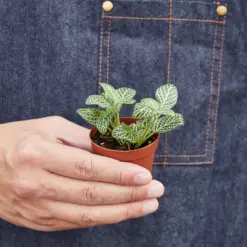
Fittonia Plant ‘White’
Price range: $22.99 through $88.99Fittonia Plant ‘Pink’
Price range: $22.99 through $50.99
Frequently Asked Questions
Are Fittonia plants safe for cats and dogs?
Yes. Fittonia albivenis (and other Fittonia species) are non-toxic to cats and dogs per ASPCA listings. They’re a great pet-safe terrarium plant. (For more confirmed pet-safe houseplants, see Calathea, Spider plant, and Peperomia.)
Why does my Fittonia faint dramatically?
It’s thirsty, and the dramatic flop is the plant’s signature stress communication. The entire plant collapses when the soil dries out completely. Water thoroughly and within 1–4 hours the plant perks back up to normal. The flop isn’t damage; it’s a warning system. To avoid repeated flopping (which weakens the plant over time): water when the top 1/2 inch of soil is dry, never let the soil dry completely, and consider raising humidity to slow evaporation.
Can I grow Fittonia in a terrarium?
Yes. Fittonia is the unofficial mascot of indoor terrariums. The high humidity inside a closed glass container is exactly what Fittonia wants, and the sealed environment requires almost no maintenance. Pot in a 1-gallon (or larger) glass jar with drainage layer (gravel + activated charcoal) and well-draining soil. Water once when setting up, close the lid, place in bright indirect light. The plant grows lushly for years with minimal intervention.
Why is my Fittonia’s leaves curling/crispy at the edges?
Low humidity. Fittonia really needs 50%+ ambient humidity and crisps below 40%. Add a humidifier or pebble tray, or move into a terrarium. Existing crispy edges don’t recover; trim with scissors and focus on new growth conditions. Tap water sensitivity is the second cause, so try filtered or distilled water if humidity alone doesn’t fix it.
How do I propagate Fittonia?
Stem cuttings root very quickly. Cut a 3–4 inch piece with at least 1–2 nodes, strip the lower leaves, and place in water with the bare nodes submerged. Roots emerge in 1–3 weeks, faster than most houseplants. Pot up once roots are 1/2 inch long. Plant 5–7 cuttings together for an instantly full plant. Fittonia also propagates well from layering (pinning stems to soil).
Why is my Fittonia losing its pink/white color?
Insufficient light. The bright veining colors in Fittonia are intensified by good light. In low light, the plant produces leaves with muted or faded veining. Move to brighter indirect light within 3–5 feet of an east window, or behind sheer curtains on a south/west window. New leaves should emerge with proper coloring within weeks.
How often should I water my Fittonia?
Every 3–5 days in average humidity, sometimes daily in dry winter conditions, or just once-when-setting-up if grown in a closed terrarium. The key is to never let the soil dry completely, so water when the top 1/2 inch is dry. Fittonia is the rare houseplant where overwatering is less common than underwatering; the constant moisture mimics its rainforest habitat. Use filtered water if your tap water is heavily treated.
Related Care Guides
- Calathea Care Guide (another humidity-loving patterned plant)
- Maranta Care Guide
- Peperomia Care Guide
- Humidity Guide for Houseplants
