
Plant Care
Coffee Plant (Arabica) Care Guide: Light, Water & Growing Indoor Coffee Trees
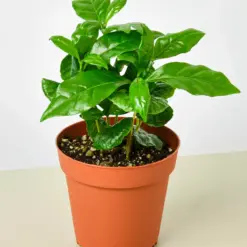
Coffee — Coffea arabica — is the houseplant that grows real coffee beans. Indoors, you can keep an Arabica coffee plant alive for decades; with patience and luck, mature 3–5+ year old plants produce small white jasmine-scented flowers, followed by red coffee cherries containing the beans. You won’t supply your morning espresso from an indoor plant, but the plant itself is beautiful — glossy dark green leaves on a slender trunk — and the novelty of harvesting your own coffee makes it a fascinating long-term project.
Quick Care Card
☀️ Light
Bright indirect (some morning direct sun)
💧 Water
Keep evenly moist; never bone-dry
💨 Humidity
50%+ (60% ideal)
🌡️ Temp
65–75°F (avoid heat extremes)
🪴 Soil
Rich, well-draining, slightly acidic
🐾 Cat/Dog Safe
❌ Toxic to cats & dogs (caffeine)
🎯 Difficulty
🟡 Intermediate
📏 Size
4–6 ft indoors
🌎 Zone
10–11 outdoors
🏞️ Origin
Highland Ethiopia
In this guide
About Coffee Plant (Arabica)
Coffea arabica is native to the highland forests of Ethiopia, where it grows as an understory shrub in the shaded canopy of taller trees. It was domesticated for the caffeine-containing seeds (called coffee "beans") over a thousand years ago, and today supplies about 60% of global coffee production (the remainder is mostly C. robusta, a hardier but harsher-tasting species).
Indoor Coffea arabica grows as a slender tree with glossy dark green leaves. The leaves themselves are attractive enough to grow as a foliage plant. After 3–5 years of growth and with proper care, mature plants produce small white star-shaped flowers (heavily fragrant — like jasmine) that develop into green-to-red coffee cherries over 6–9 months. Each cherry contains 2 coffee beans. A mature indoor plant might produce 1/4 to 1/2 lb of green beans per year — not enough for serious consumption, but enough for a novelty harvest.
Coffee plants are exceptionally light-sensitive: they evolved in shaded forest understory and direct sun scorches them within hours. They also prefer cool temperatures (65–75°F) more typical of the Ethiopian highlands than typical indoor heating. The combination of bright indirect light and cool temps is the main challenge for indoor coffee — many homes are warmer than ideal.
Care Guide
Light
Bright indirect light with some morning direct sun. Avoid afternoon direct sun.
- Best: bright indirect light with 1–2 hours of gentle morning sun — east-facing window or behind sheer curtains on a south/west window.
- Direct afternoon sun bleaches and scorches leaves within hours.
- Medium light is tolerated but blooming is unlikely.
- Low light prevents flowering and slows growth dramatically.
- Outdoor summer break (porch or balcony in dappled shade) is great — gradually acclimate to outdoor conditions over 2 weeks.
Water
Keep evenly moist. Coffee hates both bone-dry soil and soggy soil.
- Water when the top inch of soil is dry. Don’t let the rootball dry completely.
- Water thoroughly until water runs from drainage holes; empty saucer after 10 minutes.
- Most plants need water every 5–7 days in summer, every 7–10 days in winter.
- Yellow leaves with brown spots = overwatering or root rot. Crispy curling leaves = underwatered.
- Use room-temperature filtered water or rainwater if possible — coffee is slightly sensitive to fluoride.
- Consistency matters — coffee plants drop leaves dramatically from inconsistent watering.
Humidity
Higher is better. Coffee really wants 50%+ humidity.
- Ideal: 50–70% humidity. A small humidifier nearby is the easiest fix.
- Tolerable: 40–50% (typical home humidity). Plant survives but more prone to spider mites.
- Below 30% (winter heating) leaves go crispy and the plant looks stressed.
- Pebble trays help slightly. A humidifier is the most effective solution.
- Bathrooms with bright windows are great coffee plant spots.
Temperature
Cool to moderate temperatures. Coffee plants hate heat extremes.
- Ideal: 65–75°F (18–24°C). Coffee evolved in Ethiopian highlands and prefers cooler conditions than tropical lowland plants.
- Above 80°F stresses the plant and slows growth.
- Below 55°F slows growth dramatically.
- Below 40°F damages leaves and can be fatal.
- Avoid AC vents in summer and heating vents in winter — both create temperature extremes coffee dislikes.
Soil
Rich, well-draining, slightly acidic.
- Easy mix: 60% standard houseplant potting soil + 30% perlite + 10% peat moss for acidity.
- Better: 50% potting soil + 30% perlite + 10% peat moss + 10% orchid bark.
- pH: coffee prefers slightly acidic soil (pH 6.0–6.5). Most standard potting mixes are in this range.
- Avoid: alkaline soils, dense potting soil that compacts, pots without drainage.
- Use a moderately deep pot. Coffee has substantial taproot system.
- Repot every 1–2 years in spring.
Pro tip — bloom requires patience and patience
Indoor coffee plants need to be at least 3–5 years old before they bloom — and many indoor coffee plants never bloom because they don’t get enough light or cool temperatures to trigger flowering. To maximize bloom likelihood: provide bright indirect light with morning sun, keep temperatures in the 65–75°F range, fertilize regularly during growing season with a slightly acidic fertilizer, and give the plant a slight cool/dry winter rest (60°F nights, slightly reduced watering for 6–8 weeks). When flowers eventually appear in summer, they’re heavily fragrant white star-shaped clusters along the stems — and they self-pollinate, so you’ll get cherries indoors without intervention.
Fertilizer
Moderate feeders. Coffee likes regular feeding with slightly acidic fertilizer.
- Balanced acidic liquid fertilizer (or specific coffee plant food) at half strength every 4 weeks April–September.
- Or use a balanced 10-10-10 with occasional supplements of iron (chelated iron 2x per year).
- Skip fertilizing October–March entirely.
- Yellow leaves with green veins (interveinal chlorosis) = iron deficiency from alkaline soil; supplement with iron and consider soil acidity.
- Brown leaf tips after fertilizing = salt buildup. Flush soil with plain water.
Seasonal Care
🌱 Spring & Summer
- New leaves emerge from growing tips every 3–6 weeks on healthy plants
- Mature plants produce white jasmine-scented flowers in late spring/summer
- Flowers self-pollinate and develop into green coffee cherries over 6–9 months
- Water every 5–7 days when top inch is dry
- Best time to repot, take cuttings, or harvest mature cherries
❄️ Fall & Winter
- Reduce watering slightly — every 7–10 days
- Stop fertilizing entirely
- Coffee cherries ripen from green to red during late fall/winter on bloomed plants
- Don’t repot until spring
- Slower growth — minimal new leaves is normal
Common Problems & Fixes
| Symptom | Likely Cause | Fix |
|---|---|---|
| Crispy brown leaf edges | Low humidity, tap water sensitivity, or dry soil | Raise humidity to 50%+; switch to filtered water; check soil moisture |
| Yellow leaves with green veins (interveinal chlorosis) | Iron deficiency (often from alkaline water/soil) | Supplement with chelated iron; switch to filtered water; check soil pH |
| Yellow leaves with brown spots | Overwatering or root rot | Reduce watering frequency; check soil drainage |
| Massive leaf drop | Sudden temperature change, draft, or watering inconsistency | Stabilize location; resume consistent care |
| No flowering despite mature plant | Insufficient light, too warm, or too young (under 3–5 years) | Move to brighter spot; ensure cooler temperatures; give time for maturity |
| Bleached leaves | Direct sun scorch | Move from direct afternoon sun |
| Tiny webs and stippled leaves | Spider mites (low humidity) | Rinse under shower; raise humidity; insecticidal soap weekly |
| Sticky residue on leaves | Scale insects or mealybugs | Inspect carefully; treat with insecticidal soap |
| Yellow leaves at the base | Natural shedding of oldest leaves OR overwatering | Some lower leaf shedding is normal; rapid yellowing suggests overwatering |
Indoor coffee plants are beautiful trees that occasionally produce coffee beans. Don’t grow one expecting your morning espresso — grow it for the novelty and the gorgeous fragrant blooms.
Propagation
Seed (fresh green beans only)
Use only fresh green (unroasted) coffee beans — roasted beans won’t germinate.
Remove parchment skin from beans (the thin papery covering).
Soak beans in warm water 24 hours.
Plant 1/2 inch deep in damp seedling mix; cover with plastic for humidity.
Place in warm spot (70–80°F); germination takes 6–12 weeks.
Seedlings grow slowly — expect 3–4 years to reach 2-foot plant; 5+ years for first bloom.
Seed-grown coffee is genetically variable; cuttings preserve specific plant characteristics.
Stem cuttings
- Take 4–6 inch stem cuttings from healthy growth in spring or early summer.
- Cuttings should have at least 3–4 leaves; remove the lowest leaves.
- Dip cut end in rooting hormone.
- Insert into damp seedling mix or 50/50 perlite-peat. Keep evenly moist.
- Cover loosely with a clear bag for humidity. Place in bright indirect light.
- Roots form in 8–12 weeks (coffee is slower than most plants).
- Remove cover gradually once new growth is visible. Resume normal care.
Featured Coffee Plant (Arabica) Species
| Species | Common Name | Notable Trait | Difficulty |
|---|---|---|---|
| Coffea arabica | Arabica Coffee | The main commercial coffee species; what you typically buy as a houseplant | 🟡 Intermediate |
| Coffea robusta (C. canephora) | Robusta Coffee | Hardier species; harsher-tasting beans; rare as a houseplant | 🟡 Intermediate |
| Coffea liberica | Liberica Coffee | Larger leaves and cherries; rarely sold as houseplant | 🟡 Intermediate |
| Coffea arabica ‘Nana’ | Dwarf Arabica Coffee | Compact form; better for indoor growing in limited space | 🟡 Intermediate |
Shop Our Coffee Plant (Arabica) Collection
Every Coffee Plant (Arabica) we ship is greenhouse-grown, climate-acclimated, and packed with care for transit. Sold-out species? Use the Notify Me button on any product page — we’ll email you the moment it’s restocked.
Frequently Asked Questions
Are coffee plants safe for cats and dogs?
No — Coffea species are toxic to cats and dogs because of caffeine content in the leaves, stems, and beans. Causes vomiting, restlessness, elevated heart rate, hyperactivity, and tremors. Cats and small dogs are most sensitive. The beans (seeds) are most concentrated; leaves contain smaller amounts. Keep firmly out of reach. (For non-toxic alternative indoor trees, see Money Tree and Spider plant.)
Can I really grow coffee beans on an indoor plant?
Yes, but with patience. Indoor coffee plants need 3–5+ years of growth before they’re mature enough to flower. Bloom requires bright indirect light, cool temperatures (65–75°F), and regular feeding. When mature plants do bloom (typically late spring/summer), the white flowers self-pollinate and develop into red coffee cherries over 6–9 months. A mature indoor plant might produce 1/4 to 1/2 lb of green beans per year — enough for a novelty harvest but not enough to supply your daily coffee.
Why are my coffee plant’s leaves yellowing?
Three usual causes: (1) iron deficiency — yellow leaves with green veins (interveinal chlorosis); supplement with chelated iron and check soil pH; (2) overwatering — yellow leaves with brown spots and soggy soil; reduce watering; (3) too much direct sun — leaves bleach and yellow from sun scorch; move to bright indirect light. Coffee plants are sensitive — diagnose carefully before treating.
How long do I have to wait for my coffee plant to bloom?
At least 3–5 years of growth from seed, and most indoor coffee plants never bloom because they don’t get sufficient light or appropriate temperatures. Bloom requires: (1) plant maturity (3–5+ years); (2) bright indirect light with some morning sun; (3) cool nighttime temperatures (60–65°F at night during winter); (4) regular feeding. Many indoor coffee plants grow beautifully as foliage trees but never flower.
Can I roast my own indoor coffee beans?
Yes — if you harvest enough cherries. Pick ripe red cherries, remove the pulp (just the outer fruit), and dry the green beans in a single layer for 2 weeks until they’re hard and tan-colored. Then roast in a pan or popcorn popper at high heat until they’re medium-dark brown (about 15 minutes, with audible "cracks"). Let cool 24 hours before grinding and brewing. Yield from an indoor plant is typically 1/4 to 1/2 lb per year — enough for a few special cups.
Why is my coffee plant drooping?
Almost always thirst — coffee plants droop dramatically when underwatered. Check the soil; if dry, water thoroughly and the plant perks up within hours. If watering doesn’t fix the droop, check for root rot from previous overwatering (soggy soil that the roots can’t drain). Coffee plants are sensitive to both extremes of watering and droop is one of the first signs.
Why are the leaf tips on my coffee plant brown?
Three usual causes: (1) low humidity — raise to 50%+ with a humidifier; (2) tap water sensitivity — switch to filtered or rainwater; (3) fertilizer salt buildup — flush soil periodically with plain water. Existing brown tips don’t recover; trim with scissors at an angle and focus on preventing recurrence.
Related Care Guides
- Ficus Care Guide
- Calathea Care Guide
- Olive Care Guide — another "real food" tree you can grow indoors
- Herb Care Guide
