
Plant Care
Spider Plant Care Guide: Light, Water & The Plant That Pups Forever
Spider plant (Chlorophytum comosum) is the houseplant your grandmother grew. There’s a reason it survived four decades of neglect in offices, dorms, and hanging baskets: it tolerates low light, missed waterings, dry air, and forgetful owners. It’s also one of the few houseplants that’s fully pet-safe and a prolific propagator. A mature spider plant pumps out baby plants on long stems ("spiderettes") you can root in water in days. Free plants forever.
Quick Care Card
☀️ Light
Bright indirect (tolerates medium)
💧 Water
Top inch dry, then water thoroughly
💨 Humidity
30–50% (not fussy)
🌡️ Temp
60–80°F
🪴 Soil
Standard well-draining mix
🐾 Cat/Dog Safe
✅ Safe for cats & dogs
🎯 Difficulty
🟢 Beginner (easiest)
📏 Size
12–24 inches tall + babies on long stems
🌎 Zone
9–11 outdoors
🏞️ Origin
Coastal South Africa
In this guide
About Spider Plant
Spider plant is native to coastal South Africa, where it grows as a hardy ground cover in the dappled shade of woodlands. It got its English name from the "spider" appearance of the babies hanging from long arching stems on the mother plant. In its native range it’s basically a weed, which is exactly why it tolerates so much abuse indoors.
There are two main forms in the houseplant trade: variegated (the famous green-and-white striped ‘Vittatum’ and ‘Variegatum’ cultivars) and solid green (less common but tougher and more vigorous). Both produce the iconic spiderettes (small plantlets on long arching stems that root readily and can be detached as new plants). A healthy spider plant in good light produces dozens of spiderettes per year.
Spider plant became famous in the 1989 NASA Clean Air Study as one of the better houseplants for filtering formaldehyde from indoor air. The practical air-quality impact at indoor scales is debated, but the plant’s reputation as a low-maintenance, pet-safe, easy-to-propagate workhorse is well-earned.
Care Guide
Light
Bright indirect is best, but spider plant tolerates a wide range.
- Best: bright indirect light within 3–6 feet of an east, north, or filtered south/west window.
- Medium light is tolerated. Variegation may fade slightly; growth slows but the plant stays healthy.
- Low light is survivable but spiderettes stop being produced. Move closer to a window for active baby production.
- Direct afternoon sun bleaches the leaves and crisps the tips. A few hours of morning sun is fine.
- Spider plant thrives in hanging baskets, so give it room to drop spiderettes 2–3 feet below the pot.
Water
Let the top inch dry between waterings. Spider plant is drought-tolerant, since it stores water in its tuberous roots.
- Water when the top inch of soil is dry. Stick your finger in, and if it’s dry to the first knuckle, water.
- Water thoroughly until it runs from the drainage holes; empty the saucer after 10 minutes.
- Most plants need water every 7–10 days in summer, every 10–14 days in winter.
- Critical: spider plant is sensitive to fluoride and chlorine in tap water, which is the most common cause of brown leaf tips. Use filtered, distilled, or rainwater. Or fill a container and leave 24h to off-gas chlorine (doesn’t help fluoride).
- Yellow leaves at the base = overwatering. Brown crispy tips = tap water sensitivity or salt buildup.
- When in doubt, wait, since spider plant survives drought far better than soggy soil.
Humidity
Spider plant doesn’t care about humidity.
- 30–50% humidity (typical home) is fine. They tolerate dry indoor air without complaint.
- Below 25% you may see crispy tips, but it’s far more likely caused by tap water than humidity.
- Skip humidifiers, since it’s wasted effort for spider plants.
- Misting accomplishes nothing, and water on leaves can encourage fungal spotting in cool conditions.
Temperature
Wide tolerance, but hates cold.
- Ideal: 60–80°F (15–27°C). Tolerates 50–90°F.
- Below 50°F slows growth and can damage leaves.
- Below 35°F is lethal.
- Avoid placing near drafty windows in winter or AC vents in summer.
Soil
Light, well-draining mix, nothing fancy.
- Easy mix: 70% standard houseplant potting soil + 30% perlite.
- Better: 60% potting soil + 30% perlite + 10% orchid bark for extra drainage.
- Avoid: dense potting soil that compacts, anything that stays wet for more than 5–7 days.
- Use a pot with drainage holes, because spider plant rots in saucer-bottom or cachepot setups without internal drainage.
- Repot every 1–2 years, since spider plant’s tuberous roots fill a pot fast and start pushing the plant up out of the soil.
Pro tip: to get spiderettes, slightly stress the plant
Spider plant produces babies in response to mild stress and being slightly pot-bound. Plants in oversized pots and overly attentive care often stay green and lush but produce no spiderettes. To trigger baby production, keep the plant slightly pot-bound (don’t repot until it’s clearly bursting), give it 12–14 hours of bright indirect light, and let the soil dry out a bit more between waterings. Within 2–3 months you’ll see the first flower stalks emerge, and these turn into spiderette-bearing stems.
Fertilizer
Light feeders. Easy to over-fertilize.
- Balanced liquid fertilizer at half strength every 4–6 weeks April–September.
- Skip fertilizing October–March entirely.
- Brown crispy tips after fertilizing = salt buildup. Flush soil with filtered water until it runs clear; skip feeding for 2–3 months.
- Fresh soil at repotting provides enough nutrients for many months.
Seasonal Care
🌱 Spring & Summer
- New leaves emerge from the crown every 1–3 weeks
- Long flower stalks appear with small white star flowers, then spiderettes form
- Water every 7–10 days when top inch is dry
- Fertilize every 4–6 weeks at half strength
- Best time to repot, divide, or root spiderettes
❄️ Fall & Winter
- Reduce watering to every 10–14 days
- Stop fertilizing entirely
- Move from cold drafts; below 50°F damages leaves
- Don’t repot until spring
- Spiderette production may pause and resumes in spring
Common Problems & Fixes
| Symptom | Likely Cause | Fix |
|---|---|---|
| Brown crispy leaf tips | Tap water fluoride/chlorine (most common) or fertilizer salt buildup | Switch to filtered/distilled water; flush soil with plain water; reduce fertilizer |
| Yellow leaves at the base | Overwatering or natural aging of oldest leaves | Reduce watering frequency; check for soggy soil; oldest leaves shedding is normal |
| Pale leaves, loss of variegation | Insufficient light | Move to brighter indirect light; new growth recolors but existing pale leaves don’t |
| No spiderettes / babies appearing | Insufficient light, oversized pot, or over-care | Move to bright indirect light; keep slightly pot-bound; let soil dry out a bit between waterings |
| Bleached patches on leaves | Direct sun scorch | Move from direct sun; affected leaves don’t recover |
| Plant pushing up out of pot | Tuberous roots have filled the pot | Repot in a slightly larger pot in spring; or divide into multiple plants |
| Mushy stem at the soil line | Severe overwatering / crown rot | Cut off healthy leaves and root them; the rotting crown can’t be saved |
| White cottony spots on leaves | Mealybugs | Wipe with isopropyl alcohol; insecticidal soap weekly until clear |
| Tiny webs and stippled leaves | Spider mites (rare on spider plants but possible in dry environments) | Rinse under shower; insecticidal soap weekly until clear |
If your spider plant has brown tips, your tap water is the problem, not your watering schedule. Switch to filtered and the next leaves come in clean.
Propagation
Spiderettes / baby plants (easiest, fastest)
Wait until a spiderette has formed visible aerial roots, which are small white nubs at the base of the baby plant.
Option A, root in water: cut the spiderette off the stem (or leave it attached), place the base in a small glass of water with the leaves above the surface, and wait 7–14 days for visible roots to form.
Option B, root in soil: place the spiderette directly on top of damp potting soil with its base touching the soil, optionally pinning down with a hairpin or wire. Roots establish within 1–2 weeks.
Option C, "air layering": leave the spiderette attached to the mother plant’s runner, set its base in a small pot of soil next to the parent, water normally until rooted (1–2 weeks), then cut it free.
Once rooted, pot up in a small pot of well-draining soil and resume normal care.
A single mother plant can produce 5–20 spiderettes per year, giving you endless free plants.
Division (for crowded mother plants)
- In spring, when the plant is bursting from its pot, unpot and brush soil from the roots.
- Identify natural clumps where the tuberous roots can be separated.
- Tease apart the clumps by hand, or cut between root sections with a sterilized knife.
- Each division should have at least 4–5 leaves and a healthy section of root.
- Pot each division in fresh well-draining mix. Water lightly.
- Resume normal care, with the division established within 2–3 weeks.
Featured Spider Plant Species
| Species | Common Name | Notable Trait | Difficulty |
|---|---|---|---|
| C. comosum ‘Vittatum’ | Variegated Spider Plant | The most common form, with green leaves, a white center stripe, and an arching habit | 🟢 Beginner |
| C. comosum ‘Variegatum’ | Reverse Variegated Spider Plant | Green leaves with white edges (reverse of Vittatum) | 🟢 Beginner |
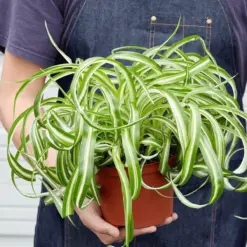
| C. comosum ‘Bonnie’ | Curly Spider Plant | Tightly curled and twisted variegated leaves; compact form | 🟢 Beginner |
| C. comosum ‘Hawaiian’ | Hawaiian Spider Plant | Bright variegation that emerges chartreuse-yellow | 🟢 Beginner |
| C. comosum (solid green) | Green Spider Plant | Solid green form, the toughest and most vigorous of all | 🟢 Beginner |
| C. laxum ‘Zebra’ | Zebra Spider Plant | Bright yellow edges with dark green center; slightly smaller form | 🟢 Beginner |
| C. comosum ‘Atlantic’ | Atlantic Spider Plant | Wider leaves with creamy variegation; compact upright form | 🟢 Beginner |
Shop Our Spider Plant Collection
Every Spider Plant we ship is greenhouse-grown, climate-acclimated, and packed with care for transit. Sold-out species? Use the Notify Me button on any product page and we’ll email you the moment it’s restocked.

Spider Plant ‘Bonnie’
Price range: $22.99 through $55.99Spider Plant ‘Reverse’
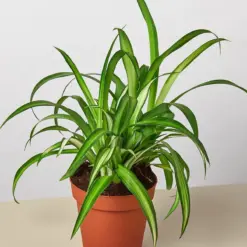
Price range: $22.99 through $66.99Spider Plant ‘Hawaiian’
Price range: $22.99 through $72.99
Frequently Asked Questions
Are spider plants safe for cats and dogs?
Yes. Spider plants are non-toxic to cats and dogs per ASPCA listings. However, cats are often particularly attracted to spider plant leaves and may chew them obsessively (some sources suggest a mild euphoric effect similar to catnip). Excessive chewing can cause mild GI upset (vomiting, diarrhea) but isn’t dangerous. Place out of cats’ reach if your cat is a determined chewer.
Why does my spider plant have brown tips?
Almost always tap water sensitivity. Spider plant is sensitive to fluoride and chlorine in municipal water, since these accumulate in the leaf tips and cause crispy brown ends. Switch to filtered, distilled, or rainwater. New leaves emerge clean within a few weeks; existing brown tips can be trimmed at an angle to mimic the natural leaf taper. Salt buildup from over-fertilizing is the second most common cause.
Why isn’t my spider plant making babies?
Spiderettes form when the plant is healthy, getting bright indirect light, and slightly pot-bound. If yours isn’t producing: (1) move it to a brighter spot near a window; (2) hold off on repotting, since slightly cramped roots trigger baby production; (3) make sure you’re letting the soil dry between waterings (over-care suppresses spiderettes). Babies typically appear after the plant is at least a year old and well-rooted.
How do I propagate the babies on my spider plant?
Three easy methods: (1) water-rooting, where you cut a baby off and place its base in a small glass of water for 1–2 weeks until roots form; (2) direct-soil, where you set the baby on damp soil and let it root in place; (3) air-layering, where you leave the baby attached to the mother and set its base in a nearby pot of soil, then cut free once rooted. All work well; method 3 has the highest success rate.
Can spider plants live in low light?
Yes, but they survive rather than thrive. In low light, growth slows, variegation fades, and spiderette production stops. The plant stays alive but won’t be the lush full plant you want. Move closer to a window or supplement with a grow light if you want active growth and babies.
How often should I water my spider plant?
Every 7–10 days in summer and every 10–14 days in winter, but always check the soil first. Water when the top inch is dry. Spider plant is drought-tolerant thanks to its tuberous roots and survives missed waterings far better than soggy soil. Always use filtered or distilled water to avoid brown tips.
Why are the leaves on my spider plant pale and limp?
Two usual causes: (1) insufficient light, since leaves go pale and limp in low light (move closer to a window); (2) overwatering, since soggy soil rots the tuberous roots, the plant can’t take up water, and leaves go pale and limp despite wet soil. Check the soil; if dry, it’s a light issue; if wet, it’s an overwatering issue.
Related Care Guides
- Pothos Care Guide (another beginner-easy trailing plant)
- Snake Plant Care Guide
- Peperomia Care Guide
- Propagation Guide
