
Plant Care
Tradescantia Care Guide: Light, Water & The Trailing Plant That Roots In Days
Tradescantia is the trailing houseplant that turned every cutting jar on Pinterest into a decoration. T. zebrina (purple stripes), T. fluminensis (white-and-green variegated), T. pallida (deep purple) — they all share the same DNA: fast-growing, easy to propagate, and slightly weedy. They root in water within days, root in soil within a week, and a 4-inch cutting can become a full hanging basket in three months. They’re also the only houseplant where the main complaint is "mine grows too fast."
Quick Care Card
☀️ Light
Bright indirect to some direct sun (variegated needs more)
💧 Water
Top inch dry, then water thoroughly
💨 Humidity
40–60% (average home)
🌡️ Temp
60–80°F
🪴 Soil
Standard well-draining mix
🐾 Cat/Dog Safe
❌ Mildly toxic — sap is irritating
🎯 Difficulty
🟢 Beginner
📏 Size
12–24+ inches trailing length
🌎 Zone
9–11 outdoors (invasive in warm climates)
🏞️ Origin
Tropical & subtropical Americas
In this guide
About Tradescantia
Tradescantia is named after John Tradescant the Elder, a 17th-century English botanist and gardener to King Charles I. The genus is native to North, Central, and South America, with around 75 species — though the houseplant trade focuses on a handful with showy variegation or trailing form.
Tradescantia got its now-controversial old name "Wandering Jew" from the spreading habit (and an antisemitic medieval folktale). Modern gardeners increasingly use "Wandering Dude," "Inch Plant," or "Spiderwort" — we use "Tradescantia" or "Inch Plant" throughout this guide.
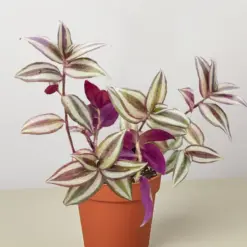
The most popular indoor species: T. zebrina (purple-and-silver striped — the most famous), T. fluminensis ‘Tricolor’ or ‘Quadricolor’ (cream/pink/green variegated), T. pallida (deep purple, often called Purple Heart), T. albiflora (silver-and-white variegated), and T. spathacea ‘Sitara’ (Moses-in-a-Cradle / Boat Lily). What unites them: they grow fast, propagate easily, root in water within a week, and need bright light to maintain their colors.
Care Guide
Light
Bright indirect light is the sweet spot. Variegated varieties need more light than solid green/purple types.
- Best: bright indirect light — within 2–4 feet of an east window, or behind sheer curtains on a south/west window. Some direct morning sun is fine and intensifies color.
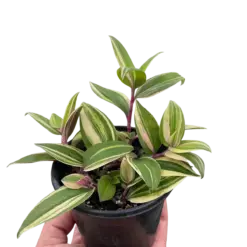
- Variegated types (‘Tricolor’, ‘Quadricolor’, ‘Nanouk’): need brighter light to maintain pink/cream stripes. Without enough light, variegation fades to plain green.
- Purple types (T. pallida, T. zebrina): tolerate slightly lower light but lose vibrancy.
- Direct afternoon sun bleaches and crisps the leaves, especially on variegated cultivars.
- Low light causes leggy stems, sparse leaves, and color fading. Move closer to a window if growth gets thin.
Water
Top inch dry, then water thoroughly. Tradescantia tells you immediately when thirsty — leaves go limp.
- Water when the top inch of soil is dry. Stick your finger in — if dry to the first knuckle, water.
- Water thoroughly until it runs from the drainage holes; empty the saucer after 10 minutes.
- Most plants need water every 5–7 days in summer, every 7–10 days in winter.
- Classic Tradescantia signal: leaves go limp and sad-looking when thirsty; perk up within a few hours of watering. Don’t panic — this is the plant talking.
- Yellow leaves at the base = overwatering or natural shedding of oldest growth. Crispy curling leaves = underwatered or low humidity.
- Use room-temperature water. Tap water is generally fine.
Humidity
Average household humidity is fine.
- 40–60% humidity (typical home year-round) is plenty.
- Below 30% (winter heating) you may see crispy leaf edges, especially on variegated varieties.
- Pebble trays or a small humidifier help in dry winter rooms.
- Skip aggressive misting — water sitting on leaves can encourage fungal spotting.
Temperature
Standard household temperatures.
- Ideal: 60–80°F (15–27°C). Tolerates 55–85°F.
- Below 50°F damages leaves and slows growth dramatically.
- Below 40°F is potentially fatal to most species.
- Avoid AC vents in summer and cold windows in winter — sudden drops cause leaf drop.
Soil
Standard well-draining mix. Tradescantia isn’t picky.
- Easy mix: 70% standard houseplant potting soil + 30% perlite.
- Better: 60% potting soil + 30% perlite + 10% orchid bark for extra drainage.
- Avoid: dense potting soil that compacts, anything that stays wet for more than 5–7 days, pots without drainage.
- Use a wider hanging basket or shallow pot — Tradescantia roots are shallow and the plant trails better with horizontal space.
- Repot every 1–2 years in spring — Tradescantia grows fast and roots fill pots quickly. Or simply propagate cuttings and start fresh.
Pro tip — pinch the tips for a full bushy plant
A wild Tradescantia trails outward in long thin strands and the original pot looks bare. To get a lush full hanging basket: pinch off the growing tip of every stem (the top 1–2 inches) every 2–3 weeks during growing season. This forces the plant to branch from the leaf nodes below — what was one stem becomes two. After 2–3 months of consistent pinching, you’ll have a dense bushy plant with full coverage. Bonus: every pinched tip is a free propagation cutting — root in water and you have unlimited new plants.
Fertilizer
Light feeders. Tradescantia grows fast and benefits from regular light feeding.
- Balanced liquid fertilizer at half strength every 4 weeks April–September.
- Skip fertilizing October–March entirely.
- Brown leaf tips after fertilizing = salt buildup. Flush soil with plain water; reduce fertilizer.
- Variegated varieties benefit slightly more from regular feeding to maintain color.
Seasonal Care
🌱 Spring & Summer
- New leaves emerge from the growing tip every 1–2 weeks on healthy plants
- Small purple/pink/white flowers may appear at stem tips in summer
- Water every 5–7 days when top inch is dry
- Pinch growing tips every 2–3 weeks to encourage bushiness
- Best time to repot, divide, or take cuttings (year-round really)
❄️ Fall & Winter
- Reduce watering to every 7–10 days
- Stop fertilizing entirely
- Move from cold drafts; below 50°F damages leaves
- Don’t repot until spring
- Slower growth — 1 leaf every 3–4 weeks is normal
Common Problems & Fixes
| Symptom | Likely Cause | Fix |
|---|---|---|
| Leggy stems with sparse leaves | Insufficient light or no pinching | Move to brighter indirect light; pinch growing tips to encourage branching |
| Loss of pink/cream variegation | Insufficient light | Move to brighter spot; cut back any solid-green reverted stems to force colored regrowth |
| Limp drooping leaves | Underwatered (most common) or root rot from overwatering | Check soil — if dry, water thoroughly and leaves perk up in hours; if soggy, let dry and reduce frequency |
| Crispy curling leaves | Low humidity, dry soil, or excessive direct sun | Raise humidity; check soil moisture; move from direct afternoon sun |
| Yellow lower leaves | Overwatering or natural shedding of oldest leaves | Reduce watering frequency; old leaves at the base shedding is normal as new growth comes in |
| Stems rotting at base | Severe overwatering | Cut healthy top stems for cuttings; the rotted base is gone |
| White cottony spots on leaves and stems | Mealybugs | Wipe with isopropyl alcohol; insecticidal soap weekly until clear |
| Tiny webs and stippled leaves | Spider mites (low humidity) | Rinse under shower; raise humidity; insecticidal soap or neem oil weekly until clear |
| Plant looks bare on top, lush only at the trailing ends | Old growth shed; no pinching to force branching | Cut back hard — to within a few inches of the soil — and pinch new growth as it emerges |
If your Tradescantia is bare on top and full only at the ends, you skipped a step: pinch the tips. Every 2 weeks. The bush you want grows out of the cuts you make.
Propagation
Stem cuttings in water (easiest)
Cut a 4–6 inch piece of stem with at least 4–5 leaves and 1–2 visible nodes (where leaves meet the stem).
Strip the bottom 1–2 leaves so the lower nodes are bare.
Place stem in a glass of water with the bare nodes submerged. Leaves stay above water.
Change water every 5 days. Place in bright indirect light.
Roots emerge from the nodes in 5–10 days — Tradescantia roots faster than almost any other houseplant.
Once roots are 1–2 inches long, pot up in a small pot of well-draining soil. Keep moist for the first 2 weeks.
Bonus: plant 5–7 cuttings together in one pot for an instantly full plant.
Stem cuttings direct in soil (also easy)
- Cut 4–6 inch stem sections with at least 1–2 nodes each.
- Strip the bottom leaves and insert directly into damp potting soil — multiple cuttings per pot for a fuller plant.
- Keep soil consistently moist for the first 2 weeks while roots establish.
- Place in bright indirect light. Roots form in 1–2 weeks; new growth visible in 3–4 weeks.
- Resume normal care after 4 weeks once cuttings are established.
Layering (for an even fuller plant)
- While the parent plant is still in its pot, take a long trailing stem and pin it down (with a hairpin or wire) onto the soil of the same pot at multiple points.
- The pinned nodes root into the soil within 2 weeks.
- After rooting, you can leave them attached for an automatically fuller plant, or cut the stem connections to create separate plants.
- This is how Tradescantia escapes pots and becomes invasive in warm climates — it roots from any node touching the ground.
Featured Tradescantia Species
| Species | Common Name | Notable Trait | Difficulty |
|---|---|---|---|
| T. zebrina | Zebrina / Wandering Dude | Purple stripes with silver shimmer on dark green; the most common | 🟢 Beginner |
| T. fluminensis ‘Tricolor’ | Tricolor Inch Plant | Cream, pink, and green variegation; fragile colors need bright light | 🟢 Beginner |
| T. fluminensis ‘Quadricolor’ | Quadricolor Inch Plant | Four-color variegation including silver — rare and showy | 🟡 Intermediate |
| T. pallida | Purple Heart | Deep solid purple foliage; vivid color in direct sun | 🟢 Beginner |
| T. spathacea | Moses-in-a-Cradle / Boat Lily | Upright clumping form with green/purple sword leaves | 🟢 Beginner |
| T. albiflora ‘Albovittata’ | Albovittata Inch Plant | Silver-and-white variegation; striking on green stems | 🟢 Beginner |
| T. cerinthoides ‘Nanouk’ | Nanouk | Pastel pink/green/lavender thick fleshy leaves; trendy compact form | 🟢 Beginner |
| T. sillamontana | Cobweb Spiderwort | Fuzzy white-haired leaves; magenta flowers in summer | 🟢 Beginner |
Shop Our Tradescantia Collection
Every Tradescantia we ship is greenhouse-grown, climate-acclimated, and packed with care for transit. Sold-out species? Use the Notify Me button on any product page — we’ll email you the moment it’s restocked.

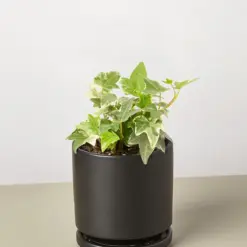
English Ivy ‘Glacier’ Plant
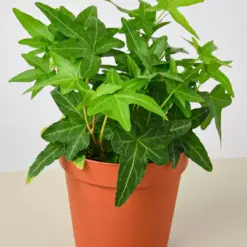
Price range: $22.99 through $47.99English Ivy ‘Green California’ Plant
Price range: $22.99 through $39.99English Ivy ‘Gold Child’ Plant
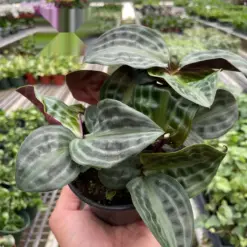
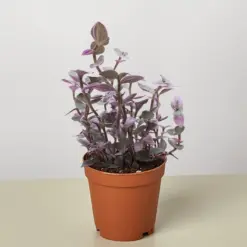
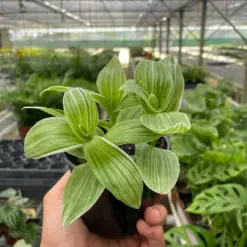
Price range: $22.99 through $39.99Tradescantia Callisia ‘Pink Panther’
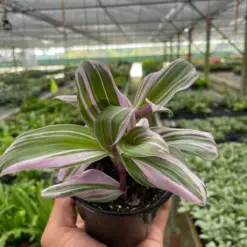
Price range: $12.99 through $40.99Tradescantia Plant ‘Nanouk’
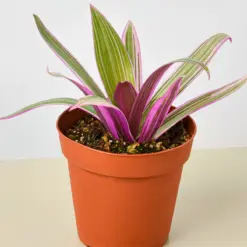
Price range: $16.99 through $50.99Tradescantia Plant ‘Sanna’
$22.99
Frequently Asked Questions
Are Tradescantia plants safe for cats and dogs?
No — Tradescantia sap is mildly irritating to cats, dogs, and humans. Causes contact dermatitis (skin redness, itching) on direct contact and oral irritation if ingested. Not life-threatening, but unpleasant. Keep out of reach of pets and kids who chew on plants. (For confirmed pet-safe trailing alternatives, see Spider plant, Hoya, and Peperomia.)
Why is my Tradescantia losing its color?
Insufficient light. The pinks, purples, and creams in Tradescantia come from pigments produced in response to bright light. In low light, the plant reverts toward plain green. Move to a sunnier spot — within 2–4 feet of an east window or behind sheer curtains on a south/west window. Variegated cultivars need the most light. Cut back any solid-green reverted stems to force colored regrowth.
How do I propagate Tradescantia?
Tradescantia is one of the easiest houseplants to propagate. Cut a 4–6 inch piece of stem with at least 1–2 nodes, strip the lower leaves, and place in a glass of water with the bare nodes submerged. Roots emerge in 5–10 days. Pot up once roots are 1–2 inches long. You can also stick cuttings directly in damp potting soil — works just as well. Plant 5–7 cuttings together in one pot for an instant full plant.
Why is my Tradescantia bare on top and only full at the trailing ends?
No pinching. Tradescantia naturally trails outward from the original growing tips, leaving the upper portion of the plant sparse over time. Pinch the growing tip off each stem every 2–3 weeks during growing season — this forces branching from lower nodes and creates a fuller plant. If yours is already bare, cut all stems back to within a few inches of the soil; new growth from the base creates a fresh full plant within 2–3 months.
Why are the leaves on my Tradescantia limp and sad-looking?
Almost always thirst. Tradescantia leaves go limp dramatically when the plant runs out of water, then perk back up within a few hours of a thorough drink. If watering doesn’t fix it, check for root rot — soggy soil rots the roots and the plant can’t take up water even when soil is wet. Limp leaves with dry soil = water immediately; limp leaves with soggy soil = stop watering and check roots.
Can I grow Tradescantia outdoors?
Yes in USDA zones 9–11 (frost-free climates), but with a warning: Tradescantia is invasive in warm climates and spreads aggressively. T. fluminensis is a banned invasive species in parts of New Zealand, Australia, California, and the Southeast US. In cold zones, grow as a houseplant or summer annual; in warm zones, keep it in pots and never let trimmings reach the ground.
Why are the lower leaves on my Tradescantia yellowing and dropping?
Two normal, two not. Normal: the oldest leaves at the base shed naturally as the plant grows new growth from the tips. Not normal: if many leaves yellow rapidly, suspect (1) overwatering — soggy soil rotting roots; (2) cold draft — leaves drop after sudden temperature changes near AC vents or cold windows.
Related Care Guides
- Pothos Care Guide — another fast-trailing easy plant
- Spider Plant Care Guide
- Hoya Care Guide
- Propagation Guide
