
Plant Care
Schefflera (Umbrella Tree) Care Guide: Light, Water & The Easy Big Indoor Tree
Schefflera is the houseplant version of an easy big tree, with distinctive umbrella-shaped leaflets radiating from a central stem, tolerant of moderate light, forgiving with watering, and capable of growing into a 6-foot indoor specimen. The houseplant trade focuses on two species: S. arboricola (Dwarf Umbrella Tree, which is smaller, bushier, and the most common) and S. actinophylla (Umbrella Tree, the larger tree-form with bigger leaflets). Both share the same easy care.
Quick Care Card
☀️ Light
Bright indirect (medium tolerated)
💧 Water
Top inch dry; consistent
💨 Humidity
40–60% (average home)
🌡️ Temp
65–80°F
🪴 Soil
Well-draining standard mix
🐾 Cat/Dog Safe
❌ Toxic to cats & dogs
🎯 Difficulty
🟢 Beginner
📏 Size
3–6 ft indoors
🌎 Zone
10–11 outdoors
🏞️ Origin
Tropical Asia & Pacific Islands
In this guide
About Schefflera (Umbrella Tree)
Schefflera is a genus of about 600 species native primarily to tropical Asia, the Pacific Islands, and northern Australia. The houseplant trade focuses on two: S. arboricola (Dwarf Umbrella Tree, Hawaiian Schefflera) and S. actinophylla (Umbrella Tree, Octopus Tree, Australian Schefflera).
S. arboricola is the most common indoor schefflera, with a compact bushy form and smaller leaflets (3–5 inches long), often sold as a 1–4 foot plant in standard houseplant pots. Cultivars include ‘Gold Capella’ (variegated yellow-and-green), ‘Trinette’ (creamy yellow variegation), and ‘Renate’ (curled leaves).
S. actinophylla is the larger relative, a tree-form with massive leaflets up to 12 inches long, capable of reaching 6+ feet indoors. The botanical genus was recently moved to Heptapleurum actinophyllum, though the houseplant trade still uses Schefflera. Both species share the same characteristic umbrella-like leaf arrangement (6–9 leaflets radiating from a central point) that gives the genus its common name.
Care Guide
Light
Bright indirect light is best. Tolerates medium light better than most large indoor trees.
- Best: bright indirect light within 3–6 feet of an east, north, or filtered south/west window.
- Some direct morning sun is fine. Direct afternoon sun bleaches the leaves, especially on variegated cultivars.
- Medium light is tolerated. Growth slows; variegated cultivars may lose pattern intensity.
- Low light is survivable but the plant gets leggy and sheds lower leaves.
- Rotate the pot a quarter-turn weekly so the plant grows evenly. Schefflera leans toward light.
Water
Top inch dry between waterings. Schefflera is forgiving with watering.
- Water when the top inch of soil is dry. Stick your finger in, and if it’s dry to the first knuckle, water thoroughly.
- Water until water runs from the drainage holes; empty the saucer after 10 minutes.
- Most plants need water every 7–10 days in summer, every 10–14 days in winter.
- Yellow lower leaves = overwatering or natural shedding. Brown crispy leaf tips = underwatered or low humidity.
- Use room-temperature water. Tap water is generally fine.
- When in doubt, wait, since Schefflera tolerates dry roots much better than wet roots.
Humidity
Average household humidity is fine.
- 40–60% humidity (typical home year-round) is plenty.
- Below 30% (winter heating) you may see slight crispy edges.
- Pebble trays or a humidifier help in dry winter rooms but aren’t critical.
- Skip aggressive misting, since water on leaves can encourage fungal issues.
Temperature
Standard household temperatures.
- Ideal: 65–80°F (18–27°C). Tolerates 60–85°F.
- Below 55°F damages leaves and slows growth.
- Below 45°F is potentially fatal.
- Avoid AC vents in summer and cold windows in winter.
Soil
Well-draining standard mix. Schefflera isn’t picky.
- Easy mix: 70% standard houseplant potting soil + 30% perlite.
- Better: 60% potting soil + 30% perlite + 10% orchid bark for drainage.
- Avoid: heavy clay soils, peat-only mixes that compact, pots without drainage.
- Use a sturdy deep pot, since mature Schefflera gets top-heavy.
- Repot every 2–3 years in spring when roots fill the pot.
Pro tip: pinch growing tips to make it bushy
Schefflera tends to grow tall and leggy if left alone, with leaves only at the top and bare stems below. To keep it bushy, pinch the growing tips with sterilized scissors every 6–8 weeks during growing season. This forces the plant to branch from lower nodes, creating a fuller multi-stemmed look. The trimmings can be used as propagation cuttings. After a year of consistent pinching, you’ll have a dense bushy plant instead of a thin leggy one. Don’t worry about "over-pruning," because Schefflera tolerates regular trimming well.
Fertilizer
Moderate feeders during growing season.
- Balanced liquid fertilizer at half strength every 4 weeks April–September.
- Skip fertilizing October–March entirely.
- Brown leaf tips after fertilizing = salt buildup. Flush soil with plain water; reduce fertilizer.
- Schefflera responds visibly to feeding with denser growth and deeper green leaves.
Seasonal Care
🌱 Spring & Summer
- New leaves emerge from the growing tips every 3–6 weeks on healthy plants
- Mature outdoor plants may produce red or pink flower spikes (rare indoors)
- Water every 7–10 days when top inch is dry
- Fertilize every 4 weeks at half strength
- Best time to repot, take cuttings, or do light pruning
❄️ Fall & Winter
- Reduce watering to every 10–14 days
- Stop fertilizing entirely
- Move from cold drafts; below 55°F damages leaves
- Don’t repot until spring
- Slower growth (1 new leaf every 4–6 weeks is normal)
Common Problems & Fixes
| Symptom | Likely Cause | Fix |
|---|---|---|
| Yellow lower leaves | Overwatering or natural shedding of oldest leaves | Reduce watering frequency; some lower leaf shedding is normal as plant matures |
| Crispy brown leaf tips | Low humidity, dry soil, or salt buildup | Raise humidity slightly; check soil moisture; flush soil if recently fertilized |
| Leggy stem with leaves only at top | Mature growth habit or insufficient light | Move to brighter spot; pinch growing tips to encourage branching |
| Loss of variegation (Gold Capella, Trinette) | Insufficient light | Move to brighter indirect light; cut back any solid-green reverted growth |
| Drooping leaves | Underwatered or root rot from overwatering | Check soil; water if dry; if soggy, let dry and reduce frequency |
| Bleached patches on leaves | Direct sun scorch | Move from direct sun; affected leaves don’t recover |
| Sudden massive leaf drop | Sudden temperature change, cold draft, or extended drought | Stabilize location; resume consistent watering; new leaves emerge over weeks |
| White cottony spots in leaf joints | Mealybugs | Wipe with isopropyl alcohol; insecticidal soap weekly until clear |
| Tiny webs on leaves | Spider mites (low humidity) | Rinse under shower; raise humidity; insecticidal soap weekly until clear |
Schefflera is the easy big indoor tree no one talks about. Easier than fiddle leaf fig, tougher than ficus, faster than monstera. Why isn’t this everyone’s first big plant?
Propagation
Stem cuttings (most common)
In spring or summer, take 4–6 inch stem cuttings from healthy growth.
Cuttings should have 3–4 leaf clusters; remove the lowest leaves.
Dip cut end in rooting hormone.
Insert into damp seedling mix or 50/50 perlite-peat. Keep evenly moist.
Cover loosely with a clear bag for humidity. Place in bright indirect light.
Roots form in 4–8 weeks.
Once well-rooted, transition to normal care. New plants are vigorous and reach mature size within 2–3 years.
Air layering (for thicker mature stems)
- On a thick stem, ring-bark a 1/2 inch section (cut through the bark to the cambium, all the way around).
- Apply rooting hormone to the upper edge of the cut.
- Wrap the cut with damp sphagnum moss; cover tightly with plastic.
- Keep moss damp; inject water every 2–3 weeks.
- Roots form into the moss in 8–12 weeks.
- Cut below the rooted section and pot up as a new plant.
Featured Schefflera (Umbrella Tree) Species
| Species | Common Name | Notable Trait | Difficulty |
|---|---|---|---|
| Schefflera arboricola | Dwarf Umbrella Tree / Hawaiian Schefflera | Compact bushy form; the most common indoor schefflera | 🟢 Beginner |
| S. arboricola ‘Gold Capella’ | Gold Capella Schefflera | Variegated yellow-and-green leaflets; needs bright light | 🟢 Beginner |
| S. arboricola ‘Trinette’ | Trinette Schefflera | Creamy yellow variegation; compact form | 🟢 Beginner |
| S. arboricola ‘Renate’ | Renate Schefflera | Curled and ruffled leaflets; novelty form | 🟢 Beginner |
| Schefflera actinophylla (Heptapleurum actinophyllum) | Umbrella Tree / Octopus Tree | Larger tree form with massive leaflets up to 12 inches | 🟡 Intermediate |
| S. taiwaniana | Taiwan Schefflera | Cold-hardy outdoor species; rarely indoor | 🟡 Intermediate |
Shop Our Schefflera (Umbrella Tree) Collection
Every Schefflera (Umbrella Tree) we ship is greenhouse-grown, climate-acclimated, and packed with care for transit. Sold-out species? Use the Notify Me button on any product page and we’ll email you the moment it’s restocked.

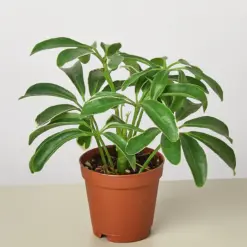
Schefflera Arboricola Plant
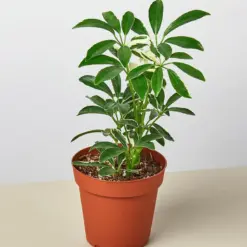
Price range: $22.99 through $164.99Schefflera Plant ‘Moonlight’
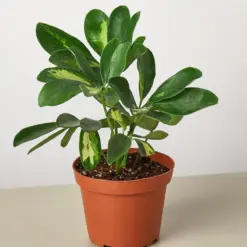
Price range: $22.99 through $43.99Schefflera Plant ‘Variegated’
Price range: $22.99 through $100.99
Frequently Asked Questions
Are schefflera plants safe for cats and dogs?
No. Schefflera species are toxic to cats and dogs per ASPCA listings. Contains insoluble calcium oxalate crystals that cause oral pain, drooling, vomiting, and difficulty swallowing in pets that chew on leaves. Skin contact with the sap can cause irritation. Symptoms are usually mild but unpleasant. Keep out of reach. (For pet-safe indoor trees, see Money Tree, Calathea, and Spider plant.)
Why are my schefflera’s lower leaves yellowing and dropping?
Two normal, two not. Normal: the oldest lower leaves yellow and shed naturally as new growth emerges from the top, and 1–2 leaves at a time is fine. Not normal: if many leaves yellow rapidly, suspect (1) overwatering with soggy soil rotting roots, or (2) cold draft near AC or heating vents. Check soil moisture and stabilize location.
How do I make my schefflera bushy instead of tall and leggy?
Pinch the growing tips with sterilized scissors every 6–8 weeks during growing season. This forces the plant to branch from lower nodes. After a year of consistent pinching, you’ll have a multi-stemmed bushy plant. The trimmings can be used as propagation cuttings. Don’t worry about over-pruning, because Schefflera tolerates regular trimming well. Insufficient light also causes legginess; move to a brighter spot.
Why is my variegated Gold Capella schefflera reverting to green?
Insufficient light. Variegated cultivars (Gold Capella, Trinette) need brighter indirect light to maintain their patterns. In low light, the plant produces solid-green leaflets to maximize photosynthesis. Move to a brighter spot within 3–5 feet of an east window or behind sheer curtains on a south/west window. Cut back any solid-green reverted growth to force variegated regrowth from healthy nodes.
Can I grow schefflera in low light?
It survives but doesn’t thrive. Schefflera tolerates medium light reasonably well but in genuinely low light it becomes leggy, sheds lower leaves, and stops growing. For a low-light indoor tree, consider Dracaena or Aglaonema (Chinese Evergreen) instead. If you’re committed to schefflera in low light, accept that it will be a thin sparse version of itself.
How fast does schefflera grow?
Moderately fast for an indoor tree. Healthy schefflera produces 6–12 new leaves per year on each growing stem, with growth concentrated in spring and summer. A 1-foot plant can reach 3–4 feet over 2–3 years in good conditions. Schefflera is faster than ficus or fiddle leaf fig and tougher than monstera, which makes it a great choice for an indoor tree if you want visible progress.
How do I propagate schefflera?
Stem cuttings root reasonably well. Cut a 4–6 inch piece with 3–4 leaf clusters, strip the lowest leaves, dip the cut end in rooting hormone, and insert into damp seedling mix. Cover with a clear bag for humidity. Roots form in 4–8 weeks. You can also air-layer thicker stems for instant rooted sections. Both methods work; air layering has slightly higher success rates.
Related Care Guides
- Money Tree Care Guide (another easy palmate-leaved indoor tree)
- Aralia Care Guide
- Dracaena Care Guide
- Ficus Care Guide
