
Plant Care
Aralia Care Guide: Light, Water & The Lacy-Leaved Ming Aralia
Aralia is a confusing common name covering several unrelated genera: Polyscias (Ming Aralia, Balfour Aralia, Fabian Aralia — the most common houseplants), Fatsia japonica (Japanese Aralia — large glossy lobed leaves), and the true Aralia genus (mostly outdoor garden plants). Indoors, when someone says "aralia," they almost always mean Polyscias — slow-growing tropical shrubs with intricate foliage that love consistency and hate sudden change.
Quick Care Card
☀️ Light
Bright indirect (no direct sun)
💧 Water
Top inch dry; never bone-dry
💨 Humidity
50%+ (higher = better)
🌡️ Temp
65–80°F (avoid drafts)
🪴 Soil
Well-draining peat-based mix
🐾 Cat/Dog Safe
❌ Toxic to cats & dogs
🎯 Difficulty
🟡 Intermediate
📏 Size
2–6 ft indoors
🌎 Zone
10–12 outdoors
🏞️ Origin
Tropical Asia & Pacific Islands
In this guide
About Aralia
Polyscias is a genus of about 150 species native to tropical Asia, Africa, and the Pacific Islands. The houseplant trade focuses on a few intricately-leafed species: P. fruticosa (Ming Aralia — fern-like compound leaves), P. balfouriana (Balfour Aralia — round scalloped leaflets), P. fabian (Fabian Aralia — large rounded leaflets in a tree form), and P. scutellaria (Shield Aralia — large round leaves).
Aralias have a reputation for being "divas" — they hate change. Move them, repot them, change their watering schedule, or introduce a draft, and they shed leaves in protest. The fix is consistency: stable temperature, consistent watering, no relocations. With routine care they’re long-lived and gorgeous; without it they look perpetually stressed.
Fatsia japonica (Japanese Aralia) is a related but different plant — large glossy hand-shaped leaves on a small tree. It’s the easier and tougher option in the "aralia" family for beginners, and tolerates lower light and cooler temperatures than Polyscias.
Care Guide
Light
Bright indirect light. Aralias hate direct sun on their delicate foliage.
- Best: bright indirect light — within 3–6 feet of an east window, or behind sheer curtains on a south/west window.
- Direct afternoon sun bleaches and crisps the small leaflets within days.
- Medium light is tolerated by Fatsia and tougher Polyscias cultivars; Ming aralia drops leaves in low light.
- Rotate the pot a quarter-turn weekly so the plant grows evenly and doesn’t lean.
- If the plant is dropping leaves heavily, check light conditions — too low or too direct are both common causes.
Water
Top inch dry between waterings. Aralias hate both soggy soil and being completely dry.
- Water when the top inch of soil is dry. Stick your finger in — if dry to the first knuckle, water thoroughly.
- Water until water runs from the drainage holes; empty the saucer after 10 minutes.
- Most plants need water every 7–10 days in summer, every 10–14 days in winter.
- Critical: aralias are notorious leaf-droppers from inconsistent watering. Establish a routine and stick to it.
- Yellow leaves with stem mush = overwatering. Brown crispy edges with soft leaves = severely underwatered.
- Use room-temperature water. Tap water is generally fine; switch to filtered if you see leaf spotting.
Humidity
Higher is better. Polyscias aralias really want 50%+ humidity.
- Polyscias (Ming, Balfour, Fabian): 50–60% humidity ideal. Below 40% they shed leaves and look stressed.
- Fatsia japonica: tolerates household humidity (40%) better — the easier choice for dry homes.
- Pebble trays help slightly. A small humidifier nearby is the most effective fix.
- Group with other tropicals to create a humid microclimate.
- Skip aggressive misting — water sitting on leaves can encourage spotting.
Temperature
Stable warm temperatures. Aralias hate drafts and sudden changes.
- Ideal: 65–80°F (18–27°C) for Polyscias.
- Fatsia japonica tolerates cooler conditions — 50–75°F is fine.
- Below 55°F damages Polyscias leaves and causes leaf drop.
- Avoid AC vents in summer and heating vents in winter — sudden drops cause dramatic leaf shedding.
- Keep aralia in one spot — frequent moves shock the plant.
Soil
Light, well-draining, peat-based mix.
- Easy mix: 60% standard houseplant potting soil + 30% perlite + 10% orchid bark.
- Better: 50% peat-based mix + 30% perlite + 10% orchid bark + 10% coco coir.
- Avoid: dense potting soil that compacts, anything cactus-mix-based (too dry), pots without drainage.
- Use a deep pot for tree-form aralias (they have substantial root systems); wider pots for shrubby types.
- Repot every 2–3 years in spring — aralias dislike root disturbance, so don’t repot more often than necessary. Go up only 1–2 inches in diameter.
Pro tip — pick a spot and don’t move it
The single biggest cause of aralia leaf-drop is relocation. Aralias acclimate slowly to a specific spot — light angle, ambient temperature, humidity, watering rhythm — and respond to changes by shedding leaves. Once your aralia looks happy, leave it there. Don’t move it to a different room, don’t rotate it more than a quarter-turn weekly, don’t repot unless absolutely necessary. The boring static life is exactly what aralias want.
Fertilizer
Light feeders during growing season.
- Balanced liquid fertilizer at half strength every 4–6 weeks April–September.
- Skip fertilizing October–March entirely.
- Brown leaf edges after fertilizing = salt buildup. Flush soil with plain water; reduce fertilizer.
- Aralias don’t need much fertilizer to thrive — slow growth is normal.
Seasonal Care
🌱 Spring & Summer
- New leaflets emerge from the growing tips every 3–6 weeks on healthy plants
- Aralias may push out small inconspicuous flower clusters (purely cosmetic)
- Water every 7–10 days when top inch is dry
- Fertilize every 4–6 weeks at half strength
- Best time to repot if necessary, take cuttings, or do light pruning
❄️ Fall & Winter
- Reduce watering to every 10–14 days
- Stop fertilizing entirely
- Move from cold drafts; below 55°F damages Polyscias
- Don’t repot until spring
- Slower growth — minimal new leaflets is normal
Common Problems & Fixes
| Symptom | Likely Cause | Fix |
|---|---|---|
| Massive leaf drop after moving / repotting | Stress response — aralias hate change | Resume consistent care; new leaves emerge over 4–8 weeks if conditions are stable |
| Yellow leaves | Overwatering, cold draft, or natural shedding | Reduce watering frequency; check for AC/heat vents; stabilize location |
| Crispy brown leaf edges | Low humidity or dry soil | Raise humidity to 50%+; check soil moisture |
| Leggy stems with sparse leaves | Insufficient light | Move to brighter indirect light; pinch growing tips to encourage bushiness |
| Leaves losing variegation (Fabian, etc.) | Insufficient light | Move to brighter spot; cut back solid-color reverted growth |
| Tiny webs on leaves | Spider mites (low humidity) | Rinse under shower; raise humidity; insecticidal soap weekly until clear |
| White cottony spots on leaves and joints | Mealybugs | Wipe with isopropyl alcohol; insecticidal soap weekly until clear |
| Sticky residue on leaves | Scale or mealybugs | Inspect carefully; treat with insecticidal soap or systemic neem |
| Stems rotting at base | Severe overwatering | Cut healthy stems for cuttings; rotted base usually unrecoverable |
Aralias don’t have problems — they have opinions. Pick a spot, water on a schedule, don’t move them, and they’ll quietly thrive for decades.
Propagation
Stem cuttings (most common method)
In spring or early summer, take 4–6 inch stem cuttings from healthy growth.
Cuttings should have 2–3 leaf clusters; remove the lowest leaves.
Dip cut end in rooting hormone (improves success rate significantly).
Insert into damp seedling mix or 50/50 perlite-peat. Keep evenly moist.
Cover loosely with a clear bag or dome for humidity. Place in bright indirect light.
Roots form in 6–10 weeks — slower than most houseplants.
Remove cover gradually once new growth is visible. Resume normal care after 2–3 months once cutting is established.
Air layering (for thick mature stems)
- On a thick stem, make an angled cut about 1/3 through the stem.
- Insert a small piece of toothpick to keep the cut open.
- Wrap the cut area with damp sphagnum moss (squeeze out excess water).
- Wrap the moss tightly in plastic; secure with tape or twist ties top and bottom.
- Keep moss damp by injecting water with a syringe occasionally — usually every 2–3 weeks.
- Roots form into the moss in 8–16 weeks.
- Once visible roots fill the moss, cut the stem below the rooted section and pot up.
Featured Aralia Species
| Species | Common Name | Notable Trait | Difficulty |
|---|---|---|---|
| Polyscias fruticosa | Ming Aralia | Fern-like compound leaves on woody stems; intricate texture | 🟡 Intermediate |
| Polyscias balfouriana | Balfour Aralia | Round scalloped leaflets; often variegated white-and-green | 🟡 Intermediate |
| Polyscias fabian | Fabian Aralia | Tree form with large round purplish leaflets; striking architectural plant | 🟡 Intermediate |
| Polyscias scutellaria | Shield Aralia | Large round shiny leaves; tropical statement plant | 🟡 Intermediate |
| Polyscias guilfoylei | Geranium Aralia | Variegated white-edged leaves with serrated margins | 🟡 Intermediate |
| Fatsia japonica | Japanese Aralia | Large glossy hand-shaped lobed leaves; tougher and easier than Polyscias | 🟢 Beginner |
| Schefflera arboricola | Dwarf Umbrella Tree (often grouped with aralias) | Compact umbrella-shaped leaflets; far easier than true aralias | 🟢 Beginner |
Shop Our Aralia Collection
Every Aralia we ship is greenhouse-grown, climate-acclimated, and packed with care for transit. Sold-out species? Use the Notify Me button on any product page — we’ll email you the moment it’s restocked.

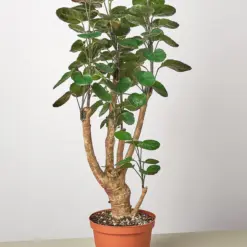
Aralia Fabian Stump ‘Polyscias Scutellaria’
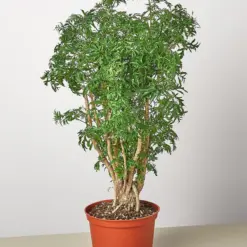
Price range: $31.99 through $56.99Aralia Plant ‘Ming Stump Plant’
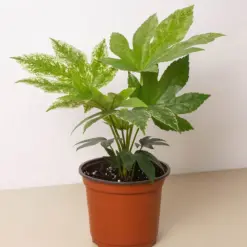
Price range: $38.99 through $68.99Fatsia ‘Spider’s Web’
$56.99
Frequently Asked Questions
Are aralia plants safe for cats and dogs?
No — Polyscias and Fatsia japonica are toxic to cats and dogs. They contain saponins and triterpenoid compounds that cause vomiting, diarrhea, lethargy, and oral irritation when ingested. Skin contact with the sap can cause contact dermatitis in sensitive individuals. Keep out of reach of pets and kids.
Why is my aralia dropping all its leaves?
Aralias drop leaves in response to stress: (1) recent move — different light angle, humidity, or temperature; (2) cold draft from AC or heating vent; (3) watering inconsistency — soaked one week, bone-dry the next; (4) recent repotting — root disturbance shocks aralias. Resume consistent care, leave the plant alone, and new leaves emerge over 4–8 weeks. Don’t move it during recovery — moves on top of moves cause cascading drop.
How fast do aralias grow?
Slowly. Polyscias aralias produce 4–8 new leaves per year on healthy plants, with growth concentrated in spring and summer. Mature aralias can live for decades indoors but will never be fast-growing. Fatsia japonica is faster — can produce 8–12 new leaves per year. If your aralia hasn’t grown in over a year, check light (too low) and consistency (too much change) before assuming it’s failing.
Why are my aralia’s leaves curling and crispy?
Two usual causes: (1) low humidity — Polyscias aralias want 50%+ humidity and curl/crisp below 40%; raise with a humidifier; (2) dry soil — aralias hate going bone-dry; water more consistently. Existing crispy leaves don’t recover; trim with scissors and focus on new growth conditions.
Can I prune my aralia?
Yes — light pruning encourages bushier growth and is well-tolerated. In spring, pinch growing tips with sterilized scissors to force branching from lower nodes. Remove any dead or damaged branches at the base. Avoid heavy pruning (cutting more than 25% of the plant) — aralias respond poorly to heavy pruning and may shed all remaining leaves in protest.
Why does my variegated Balfour aralia keep losing its variegation?
Insufficient light. Variegated cultivars (Balfour, Marginata, Fabian variegated) need brighter indirect light to maintain their patterns. In low light, the plant produces solid-color leaves to maximize photosynthesis. Move to a brighter spot — east window with sheer curtain or filtered south/west light — and cut back solid-color reverted growth. New growth in proper light should come in variegated.
What’s the difference between Aralia and Fatsia?
Common-name confusion. Aralia typically refers to Polyscias species (Ming, Balfour, Fabian) — small intricately-leafed tropical shrubs that are fussy indoors. Fatsia japonica is the "Japanese Aralia" — a different genus with much larger glossy lobed leaves that’s tougher and easier to grow. Both are sold as "aralia" in nurseries; check the botanical name to know which you have. For beginners, Fatsia is the better choice.
Related Care Guides
- Schefflera Care Guide — umbrella tree — easier alternative to aralia
- Dieffenbachia Care Guide
- Fiddle Leaf Fig Care Guide
- Dracaena Care Guide
